

Georgia and Armenia: independent travel diary (Part 2)
We continue Luis and Pilar's account of their journey through the Caucasus. If you haven't read the beginning yet, we invite you to discover the first part of the Georgia and Armenia travel diary.
Day 7: From Sighnaghi to Gori — In Stalin's footsteps
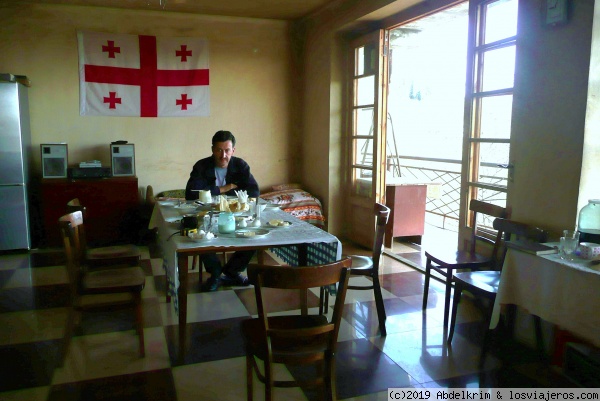
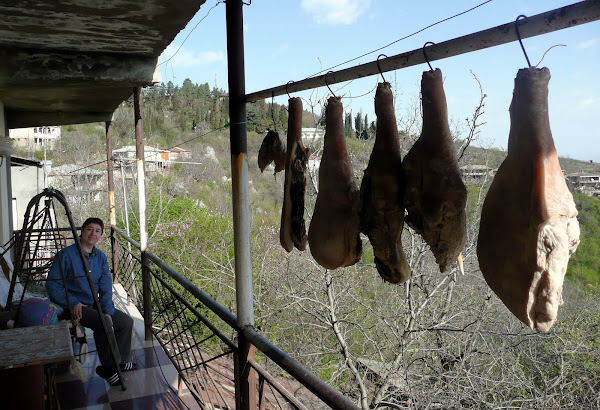
A splendid morning. We have breakfast by the balcony where several hams, shoulders, loins, and bacon cuts are hanging to dry, and then head out for a stroll. Sighnaghi has had considerable investment poured into creating the slightly artificial feel of a well-restored and well-maintained medieval town: there are cobbled pedestrian streets and the buildings in the center look immaculate, though beyond the walls there are plenty of run-down shanties. There is even an enjoyable collection of original metal sculptures scattered around the squares.
Despite the heat we decide to walk to Bodbe Convent, about 3 km away. This is where Saint Nino is buried, and the community that occupies it is of nuns. We arrive at the end of a very well-attended ceremony: the nuns are singing and many women come and go to rest outside, since the ceremony has lasted several hours.
When things quieten down a little we go in to see the very simple tomb and the 19th-century paintings that adorn the walls. In the surrounding grounds there is a spring considered miraculous, but we don't feel like climbing up to it and besides we are a little pressed for time. We make use of a taxi waiting idly at the entrance to get back to town and collect our luggage at the Zandarashvili home. The grandfather drives us to the square where the marshrutkas stop, hoping to drum up new customers. We say our farewells and buy tickets to Tbilisi (12 GEL).

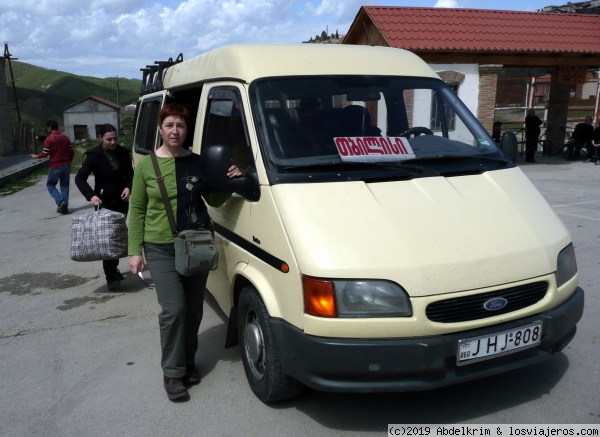
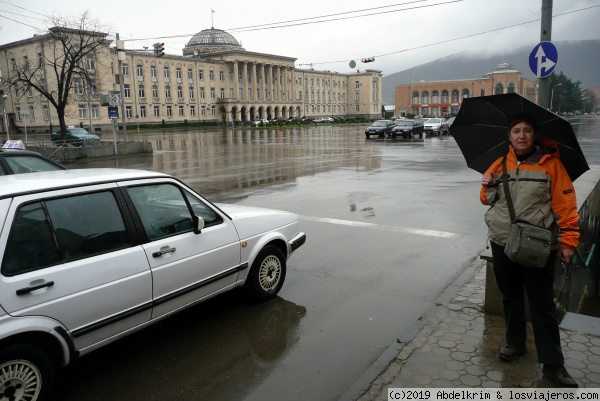
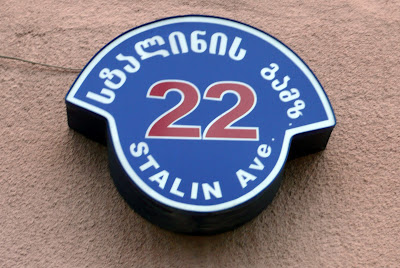
At Tbilisi's Didube station we wander a few streets until we find a bus to take us to Gori. You need to buy a ticket at the window, but within a couple of minutes the bus is completely full and we depart. In 2 hours we arrive in Stalin's hometown; we know where to get off because not every city of 50,000 inhabitants has an artery as disproportionate as Stalin's Gamziri.
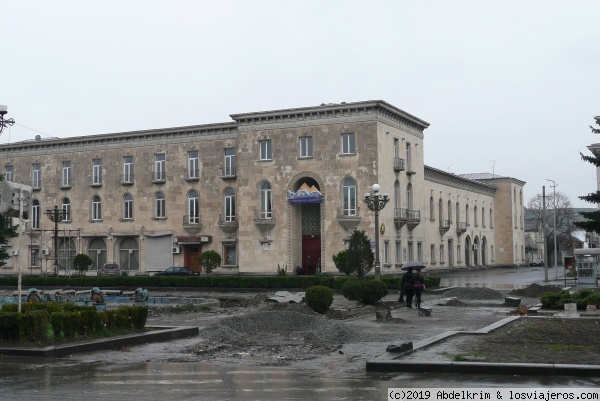
Gori is a kind of architectural fantasy shaped for the greater glory of the great Soviet dictator. All the grandeur is concentrated on a boulevard several kilometers long, lined with immense official buildings: museum, town hall, banks, and other civic facilities. The rest of the city consists of run-down neighborhoods of ramshackle little houses and a hill with an ancient fortress of little interest.
Accommodation and food in Gori
The Intourist intimidates us a little from outside, so we opt for Hotel Victoria, near the southern end of the avenue, before the bridge over the Mtkvari River. It takes us a while to find it as there are no signs off the main boulevard and the locals don't quite follow what we're asking. The hotel is empty and, like any good Soviet creation, has something faintly sinister about it, but on the whole it's not bad. It costs us 80 GEL without breakfast [VERIFY].
For dinner there are several options and we choose a restaurant decorated in rustic style with many mounted hunting trophies. On walking in we witness a scene we are getting used to: a customer tries to get up but can't because his legs won't hold him; his friend tries to help but, being equally "the worse for wear," can't manage to drag him up. Eventually the waiter steps in and barely manages to get them both out the door.
No sooner are we seated than we get a little annoyed with the waitresses because they tell us there's no house wine — the people we saw drinking it had brought it themselves. We end up choosing a bottled wine at 15 GEL and dinner is acceptable. We insist on a late-night walk, a bitter wind is blowing and the few bars still open on the deserted avenue are like inhospitable oases. We turn in early.
Day 8: From Gori to Borjomi — The Stalin Museum and thermal waters
Another rainy morning. We have Turkish coffee and khachapuri in a café on the boulevard decorated like an old railway carriage, then head to the museum, which according to the guidebook is the most interesting in all of Georgia. The Stalin Museum (15 GEL, guided tour included) was inaugurated in 1957, four years after the leader's death. While Khrushchev was working to eradicate the political legacy of Stalinism, a personality cult was simultaneously being encouraged — limited, however, to Stalin's hometown.
The museum is a vast two-story building with a tower, railings, and gardens, easily recognizable from outside by the life-size statue in front of the entrance. The exhibition covers the full history of Stalin and Soviet communism while glossing over the most uncomfortable aspects; it makes for interesting viewing for any visitor curious about history, though most of the explanatory texts are not in English. In the grounds are preserved the brick-and-wood house where Stalin was born and the armored railway carriage he used to travel across the USSR. On the way out we stop at the shop and buy several copies of his Complete Poetic Works, a notebook-sized volume with very few pages, each poem in three languages: Georgian, Russian, and English.
After the museum we go to the station and board a marshrutka for Borjomi. We have given up on visiting Uplistsikhe as the descriptions didn't appeal; we are saving ourselves for the Vardzia caves later. Past the road junction at Khashuri we enter a magnificent landscape of forested mountains, rivers, and villages.
Borjomi was one of the favorite spa resorts of the aristocracy in Tsarist times and remained very popular during the Soviet era. The natural carbonated water that rises from its famous spring was exported to every republic of the USSR and is still found throughout Georgia today — we are big fans too. We go out to see what remains of the old spa and draw water from the spring, just as good as the bottled version but at a high temperature.
The splendid park has been turned into a kind of amusement park, not very busy at this time of year. We walk to the far end and then continue along a beautiful trail that climbs gently into the forests; the temperature is pleasant and we enjoy the tall birches and firs, spot many mushrooms and flowering plants, and wade through a couple of small streams. Eventually we reach a river too wide to cross and have to turn back.
There is some kind of vigil around a church in the middle of the riverside park; a large crowd has gathered outside, many holding candlesticks with burning candles. It must be their way of marking Maundy Thursday, and we are surprised to see many young people, in a very cheerful mood despite the solemnity of the moment.
Christian devotion is a social phenomenon in Georgia that cuts across all sections of the population: very young women who don't hesitate to cover their heads with scarves to go from church to church praying and lighting candles before their favorite icons; burly men who may once have been soldiers or truck drivers displaying their tattoos as they cross themselves in front of every monastery.
Nearby, another curiosity catches my eye: at the railway station barely two trains arrive each day from the capital, yet the vestibule still displays a timetable in Russian listing more than a hundred cities from which trains once arrived, including many as distant as Riga or Almaty.

Accommodation and food in Borjomi
After consulting with the tourist office manager we settle on Hotel Borjomi (50 GEL with breakfast) [VERIFY]. It is a wooden house painted in pastel colors in 19th-century style; the rooms are small and simple and breakfast is nothing special. For lunch and dinner we start frequenting Taverna Nia: a wooden house with balconies over the river that may be very pleasant in summer but at this time of year its vast dining room feels cold and damp.
The food is not bad and that evening we run into some Spaniards we'd already met at the Tbilisi hotel, and we share a few beers. The following night we explore a bit further and discover a small family restaurant serving very simple meals and excellent wine in avant-garde crystal goblets.
Day 9: Borjomi — Vardzia — Borjomi — Caves and fortresses of the south
We take a marshrutka to Akhaltsikhe (4 GEL) [VERIFY] and there hire a taxi to take us to the Vardzia caves and other places of interest.
Today it is not raining, but it is overcast and the mountain profiles blend into the grey sky; when we arrive at the caves we can barely make them out on the hillside. Vardzia is another emblematic site for Georgian culture, perhaps more so in the current political climate, since we have noticed that many inhabitants of Javakheti, the region we are in, are Armenian and would like to be part of the neighboring country.
We pay the entrance fee (currently 15 GEL) before climbing the long slope on foot to the far end of the cave complex. Vardzia was conceived as a defensive structure by the Georgian kings of the 12th century and was later extended by Queen Tamar with a monastery comprising a multitude of caverns arranged on 13 levels, which once housed more than 2,000 monks. It subsequently suffered an earthquake that demolished the outer walls, leaving it defenseless against invasions; the last — by the Persians in the 16th century — would leave the site deserted until a small community of monks moved in relatively recently.
The site impresses by its scale (more than 500 carved caves with hundreds of different rooms) and by the magnificent views that open up when the sun finally comes out. A church occupying the center of the cliff face preserves all its original architectural elements and paintings, as well as a series of narrow passageways that delight the more adventurous visitors.
On the way back we stop to see Khertvisi Fortress, perched high on the hill that dominates the entrance to a valley. Its origin involves a legend in which Queen Tamar organized a competition among the country's architects to see who could build the finest stone tower. The most famous master was beaten by a simple apprentice and, consumed with rage, threw himself from the top of his tower. Today the castle has been virtually rebuilt and makes a very picturesque sight in the midst of the bucolic landscape.
Before returning to Akhaltsikhe we take a narrow road that climbs for about 10 km through a breathtaking landscape with the Caucasus mountains in the background, ending at Sapara Monastery. This complex has its origins in the 9th century and, in addition to its hair-raising position high above a gorge, its six churches are incredibly well preserved. In one of them, Saint Saba's, you can see what are probably the finest medieval frescoes in Georgia, dating from the 14th century.
When we get back to Borjomi it is already dark and pouring with rain again.
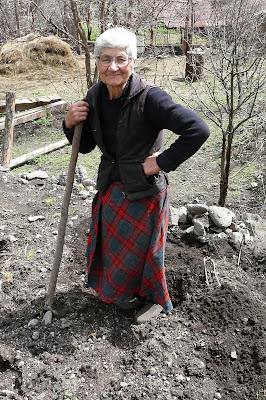
Day 10: From Borjomi to Kutaisi — Cathedrals and monasteries of the west
It is still raining, so we abandon the idea of an excursion into the neighboring Borjomi-Kharagauli National Park and set off early for Kutaisi. The first marshrutka takes us to the Khashuri junction, where a policeman points out the spot where minivans heading west stop, and we prepare to wait. But today is Easter Sunday and it turns out to be the most important day of the Orthodox Easter.
Later we see how Georgians stream out en masse toward their home regions to perform the ritual of visiting their ancestors' graves. The cemeteries are generally spacious and each tomb has its own area enclosed by a small railing; that is where each family sets up to eat and drink, always bringing the traditional dyed Easter eggs.
Every marshrutka that passes through Khashuri is full. People are piling up at the stop and continuing the journey is looking difficult. When we are already thinking of hiring a taxi something curious happens: just a few steps from where we stand, a fruit seller's van has stopped; the driver disappears somewhere and when he comes back he approaches us, inviting us to get in. The other waiting travelers protest, but for some reason the man has decided to take foreigners and can only take two people. We set off — he is heading to Batumi on the Black Sea coast — and try to communicate with gestures and a few words in Russian.
We cross a mountain pass with quite a lot of snow and on the way down stop at a permanent market selling all kinds of earthenware. The road is sometimes very busy, especially with Turkish lorries entering or leaving Georgia loaded with goods. Even so, we reach Kutaisi in under 3 hours.
We say goodbye to the friendly driver and give him 20 GEL for getting us out of our fix, but a taxi driver immediately swindles us and charges 10 GEL to take us to the hotel (5 GEL would have been plenty).
After settling in we climb up through the old neighborhood to the hill that houses Kutaisi's most famous monument: the ancient Bagrati Cathedral. Along the way we pass a flower market and other typical Easter stalls, but there are barely any customers since everyone is still at the cemeteries.
Kutaisi was the capital of a kingdom for centuries and its cathedral was magnificent, as was the palace-fortress that occupied the same hill. Both were destroyed by different disasters in the 18th century. Today the cathedral has been extensively restored (a process that generated controversy and cost it its UNESCO World Heritage status at one point), but it retains an undeniable magnetism.
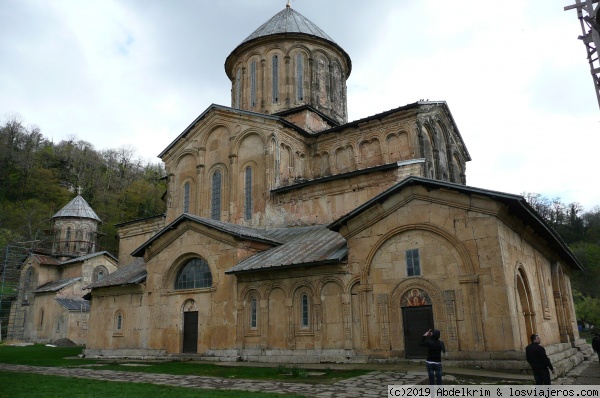
To make good use of the afternoon we hire a taxi (12 GEL) [VERIFY] and visit two nearby monasteries in much better condition: Gelati and Motsameta. Gelati was another of the medieval philosophical academies, and some of Georgia's most famous kings are buried in its churches.
Motsameta occupies a truly spectacular location high on a hill commanding a meander of the Tskhaltsitela River; the approach to the small church is very narrow and hard to photograph, but the visit is certainly worth the effort. The river's name means "red water" and its origin lies in a legend: the dukes of Argveti were two brothers who governed the region in the 8th century, during the Arab invasion. The invaders killed everyone and threw the dukes into the river, but lions gathered their bodies and carried them back up to the hill, which is why a church was built there to bury them. Their tomb was the object of special devotion for centuries, and in 1923 the Cheka tried to seize it and move it to Kutaisi, but — according to tradition — the bones of the two martyrs miraculously returned to their starting point. Even today many worshippers visit the church to perform the ritual of crawling on their knees under the narrow tomb.
Accommodation and food in Kutaisi
We had been recommended the newly opened Hotel Old Town, an elegant place with well-equipped rooms by Georgian standards, but also rather expensive. We were given the most expensive room (90 USD with breakfast) [VERIFY], which annoyed us initially.
As for restaurants, we got the impression they were scarce and in any case we couldn't find a single one open. Easter is celebrated in Kutaisi in the manner of Holy Thursday in 1950s Spain, and practically everything was shut. We made do with buying cheese, cold cuts, bread rolls, and beer at a shop and eating in the room.


Day 11: From Kutaisi to Mestia — Heading to mythical Svaneti
We leave Kutaisi as we found it: with empty streets. A marshrutka takes us in about 2 hours to Zugdidi (7 GEL) [VERIFY], from where we hope to continue toward the mythical mountain region of Svaneti. Transport to that area is scarce; there are only a couple of daily departures in minivans that the locals also use to transport goods.
We ask at the booth and are told the afternoon marshrutka will leave at 3 pm. As it is not yet noon we take the opportunity to look around, leaving our bags without a second thought; we are confident our luggage will still be there when we get back.
For a second-tier city, Zugdidi turns out to be much better equipped and livelier than Kutaisi: there is a very interesting covered market and several internet cafés open. We are also surprised to find a boulevard decorated with mosaics depicting large Georgian flags with the five crosses of Saint George. This boulevard bears the name of Zviad Gamsakhurdia, the controversial president who proclaimed the country's independence in 1989 and later became a coup leader. Zugdidi was his home territory and the city proudly preserves his memory.
Still, the most unusual thing is that according to the guidebook this city is home to one of the best restaurants in the country, the Diaroni. We are curious to see if this is true and the claim turns out to be correct: we eat very well and the service is excellent.
Back at the marshrutka station we notice a replica of the Svan-style defensive towers, which we will soon see in abundance. The van sets off shortly before 3 pm, but only to drive a few hundred meters into the courtyard of a warehouse. A tedious wait begins during which the driver, helped by a couple of passengers, struggles to fit in a cargo consisting of many boxes of tomatoes, sacks, and all manner of odds and ends.
When they seem to have managed it, we continue waiting until another traveler arrives with a large stack of egg cartons. At last we pull out onto the road and pay 20 GEL per person [VERIFY]; it is now half past four and we know the road to Mestia, the village that serves as the regional capital of Svaneti, is quite long due to its poor condition. Besides the driver and the two of us, five sturdy Svans and a young Israeli tourist are traveling with us. Soon the road leaves the fertile valley and begins to climb parallel to the river toward a large reservoir; in the distance we can see snow-covered peaks.
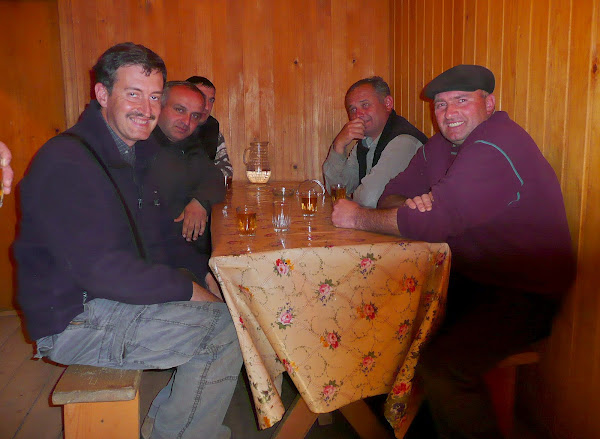
An hour and a half later we stop again at a kind of hyper-rustic roadside bar. It turns out we are not just stopping to use the toilet: the Svans intend to hold a proper session. We join them at a large table and soon several kubdari (oven-baked meat-filled breads) cut into wedges are placed in front of us, along with a couple of two-liter jugs of wine. We are handed glasses and the tamada begins his duties, ordering them to be filled and delivering long, elaborate toasts.
Like the Israeli girl, we try to skip several rounds — not only for fear of ending up in an ethylic coma, but also because the wine is rather poor. The driver announces his withdrawal after draining six glasses, but the rest keep going. By the time we get up nearly two hours have passed and five large jugs of wine have been consumed — pale in color but turbid in every other sense.
We continue toward dusk. While the light lasts we see an increasingly impressive high-mountain landscape with great ranges in every direction. At one of the villages the little bald man who acted as tamada gets off, and the others tell us with a smirk that he is a policeman. We arrive in Mestia at 10 pm, but we had the foresight to phone ahead to a guesthouse; they drop us at the door and we find dinner ready and rooms prepared.
Accommodation and food in Svaneti
At Nino's house we will pay 40 GEL per person per day on a full-board basis [VERIFY], which seems a little pricey but we are not going to stay long enough to compare. The food is good: there is not much meat but in the evenings there is soup, and a varied selection of salads and cold dishes are available all day. Wine and beer are not included but we can buy bottles of quite good wine for 8 GEL [VERIFY].
With the room we are less lucky, because Nino's house is full and we are sent to the neighbor's across the road: large bare rooms with a rather battered bed, threadbare blankets, and nothing else. We have a small electric heater that keeps us warm the first night, but in the morning the element burns out and it never works again before we leave.
Day 12: Svaneti — Trekking to Chalaadi Glacier
At breakfast we meet several Israeli tourists we already know from earlier stages, as well as an Italian living in Russia and a group made up of a Slovenian, a Portuguese, and a Russian girl from Latvia; they are traveling together because all three live in the Netherlands and work for the same company.
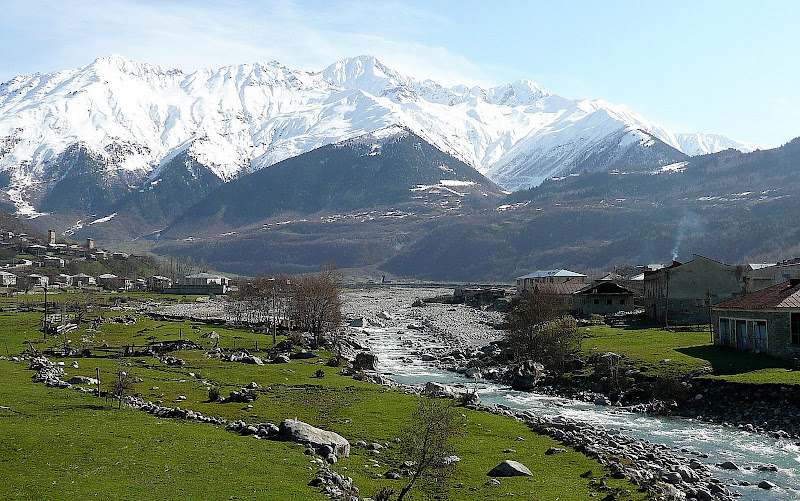
Another Israeli couple and the Italian are planning an excursion up into the mountains to the Chalaadi Glacier; I join them and we stock up with food and water for the day. Setting out from the house we realize that the capital of Svaneti is still an agricultural village where tourism investment is only just beginning to arrive: streets full of mud and potholes, and as soon as you leave the main road you have to navigate your way around farms with livestock enclosures.
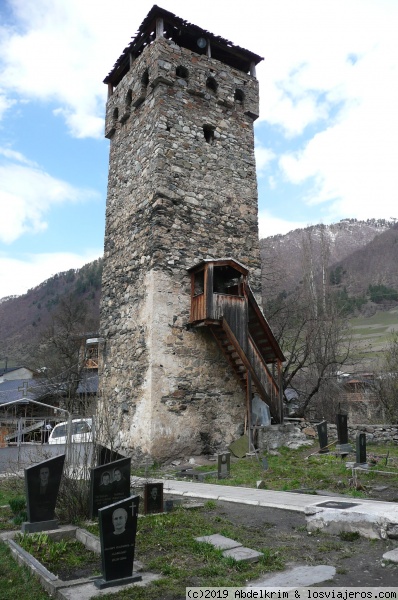
Rising up among the farmhouses are the curious defensive stone towers, of uncertain origin and up to 20 meters tall; there is no doubt that the inhabitants of this valley have been very warlike, since instead of building communal defenses each family or clan built their own. There are magnificent snowy ranges in every direction, forming a cirque around the valley. We set off walking up the river and on leaving the village pass by the airport.
As a passenger terminal there is a sort of metacrylate tube bent like a staple with the point facing upward; it may well have won an architecture prize, but it does not look like a practical or comfortable installation. We keep walking until we find a footbridge across the river, and from here the path begins to climb; half an hour later we find an iron bridge suspended over the river again. We continue climbing through conifer forests and soon catch a glimpse of the impressive mountain closing off the glacial cirque.
There is quite a lot of snow and we start sinking in. No one has gaiters, but the Israelis are resourceful and have brought a large roll of duct tape; within minutes we are all protected with plastic bags tied around our ankles. Thus equipped we continue walking and by midday we reach the glacier's tongue. You cannot go further without equipment: the ground is icy and you can hear intermittent crashes of rockfall. We spend a while contemplating the fascinating landscape and catching our breath, but as a fairly cold wind is blowing we soon head back down into the forest to find a sheltered spot to eat before starting the return.
Meanwhile Pilar spends the day wandering around the village: looking at the strange defensive towers, visiting the museum with its collection of ancient manuscripts, crosses, and medieval icons from the valley's communities, strolling through the muddy streets. We are told an airline offers flights between Mestia and Tbilisi; the fares are reasonable, but we decide not to book for several reasons: to get to Armenia it is not essential to go back through Tbilisi, we would have to stay more days in Mestia, and above all we are not entirely convinced the flights actually operate.
Dinner is very lively with such young and cosmopolitan company; we drink plenty of wine and beer and arrange with Nino for a 4×4 excursion the following day.
Day 13: Svaneti — Excursion to Ushguli, the highest village in Europe
The going rate that drivers charge for the round trip to Ushguli is 200 GEL [VERIFY], but since there are eight of us today they offer two vehicles at a small discount, coming out to 45 GEL per person. We get into a Mitsubishi Pajero and ask the girl from Riga to sit in the front because she is the only one who speaks Russian.
The road has some decent stretches and others where going faster than 10 km/h is suicidal; even so we can say we are lucky because in some years it remains closed by snow until June. We stop a couple of times in the most open spots to throw snowballs and admire the superb Mount Ushba (4,700 m), whose ascent has a reputation for being dangerous.
As we go up, the driver tells our companion in Russian all the legends relating to the villages we pass through and she translates them into English for us. Some are Romeo-and-Juliet types but most have more in common with Macbeth or King Lear: ambushes, betrayals, and slaughters of every description.
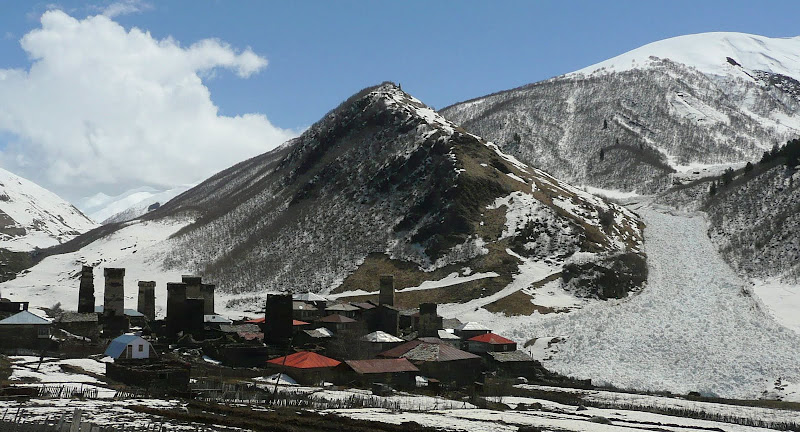
It takes us well over two hours to reach Ushguli, which at 2,100 meters above sea level claims to be one of the highest permanently inhabited villages in Europe. As we approach we can see the result of an avalanche that has fallen very close to the houses.
Ushguli preserves the structure of medieval villages with its stone houses and watchtowers, less well maintained than those of Mestia. It is a visibly very poor village but the snowy landscape gives it an imposing appearance. We climb to a hill overlooking the village and arrive just in time to glimpse the outline of Mount Shkhara before the fog erases it. This summit reaches over 5,000 meters and is the second highest in the entire Caucasus (after Elbrus in the Russian Federation).
We go to see the old St. George's Church at the top of the hill and use the precarious shelter of the cemetery wall to eat something, but it is cold and we don't manage to sit for long. We start heading back when sleet begins to fall and the streets become even muddier from the droppings of the sheep, cattle, and pigs that wander everywhere. Some young men persuade us to pay the entrance fee for an "ethnological museum"; it is nothing special but we spend a while sheltered from the cold looking at the interior of a traditional house crammed with old ingenious odds and ends.
We get into the cars in soaking wet clothes, but before long it stops raining and the sky clears again; by the time we reach Mestia there is a beautiful evening light. We shower in the rudimentary bathroom of our accommodation and before dinner accept the invitation of our driver, who is waiting for us in his tiny shop-bar. When we arrive, our Slovenian and Portuguese companions are already seated with him, drinking the apple-flavored vodka he makes at home, which we find delicious despite the fact that both of us hate vodka.

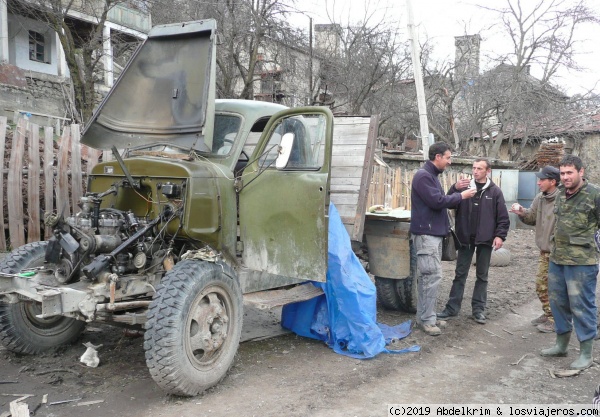
Day 14: From Mestia to Akhaltsikhe — Heading south again
The morning marshrutka to Zugdidi picks us up punctually at 6:15. The journey takes 5 hours, slightly less than on the way there because the obligatory stop at the roadside bar is shorter. Today the Georgian transport system proves impressively efficient: in Zugdidi we quickly board another minivan going to Tbilisi that drops us at the Khashuri junction (13 GEL); we walk a short distance to the other terminal and board a third vehicle that takes us to Akhaltsikhe (6 GEL) [VERIFY].
After settling in at the hotel we spend a while online and then take a stroll through Rabati, the old quarter. At that time it still had traditional houses and, a great rarity in Georgia, the remains of a mosque and a madrasa. (Today Rabati Fortress has been spectacularly restored and has become one of the main attractions of southern Georgia, complete with museum, hotel, and tourist facilities.) The castle has a museum, but it is already closed and in any case we are very tired. We turn in early and recharge for entering the Republic of Armenia tomorrow.
Accommodation and food in Akhaltsikhe
There are very few hotels, but they seem to be sufficient as not many travelers stop in Akhaltsikhe. We go for Hotel Prestige (50 GEL without breakfast) [VERIFY]. On a central street we find the city's entire gastronomic offer, which is limited to khachapuri in its various varieties (imeruli, acharuli, kubdari...) and beer.
END OF THE GEORGIA SECTION OF THE TRAVEL DIARY
You can continue reading the diary on the Losviajeros forum, where the text and photos were reproduced with the permission of Luis and Pilar.
If you have your own travel experience in Georgia and would like to share it with our readers, you can send it via this link.