

One Week in Georgia: Day-by-Day Travel Diary Through the Caucasus
In the summer of 2019, we spent two weeks driving through Georgia and Armenia. We were very curious about the destination, especially Georgia, and our reasons for choosing this corner of the Caucasus were clear:
- The chance to enjoy a relaxed, stress-free holiday
- Short driving distances (the longest barely 3 hours)
- Accommodation most nights in the respective capitals, Tbilisi and Yerevan, with day trips from there
- No early starts
- A destination still free from over-tourism (Georgia above all)
- Incredibly rich and varied cuisine
- Very affordable prices for the European traveler
Important note (2026 update): From January 1, 2026, all tourists entering Georgia must have compulsory medical and accident insurance, with a minimum coverage of 30,000 GEL. The policy must be in English or Georgian and must cover the entire stay. It can be taken out with Georgian or foreign insurance companies.
 Kazbegi mountains
 Mount Ararat
Georgia: the start of the adventure
 Almost there...
Day 1. Arrival in Tbilisi
We leave Barcelona at 10:55 on a direct Georgian Airways flight that arrives in Tbilisi at 17:30. Since 2018 the direct Barcelona–Tbilisi route operates several times a week, so we preferred it to a connecting flight, even though it is a little more expensive. We paid €799.35 for two tickets with cancellation insurance. It is a fairly new aircraft, an Embraer 190 with 98 seats, comfortable enough — two seats per side — and spacious for the four-and-a-half-hour flight. That said, it is worth making sure your tablet is fully charged as the individual screens are not always active. [VERIFY current prices and frequencies of Georgian Airways Barcelona–Tbilisi]
We arrive at the airport. Used to Barcelona, where there are always long queues, in Tbilisi there are only the passengers from our plane. We go through customs, collect our bags, withdraw our first GEL in cash (commonly called laris), and buy two data SIM cards. All of that in just 45 minutes.
We look for the train station and ask a guard where it is. He looks at us blankly. In his limited English he tells us "no train, only bus," pointing to the stop for bus 37 a few meters from the terminal, about to depart. In 2026, bus 337 connects the airport with the city center and you can pay directly by contactless bank card. The journey covers about 15 km with many stops. As it approaches the historic center, the traffic gets heavier. We decide to get off at Avlabari square and take the metro.
At the ticket office they explain how the MetroMoney card works (today a Travel Card also exists). The card costs 2 GEL and each metro or bus journey costs 1 GEL, with free transfers within 90 minutes. It is the most economical and practical public transport system in Tbilisi.
 Tbilisi and its characteristic balconies
The first impression of the metro is that it feels like the Moscow one: long escalators, a guard sitting in her booth at the bottom, a great vault with sculptures and decorations, platforms on both sides, and that overall sense of grandeur. And very noisy. Two lines, the red and the green, with high frequency. Station names are displayed in Georgian and English.
 The streets are signed in English
Our apartment is a 5-minute walk from Marjanishvili station (მარჯანიშვილი). Although the building looks like it's falling apart and the entrance from the inner courtyard is a bit confusing, inside it has been completely renovated. Very well rated online, but a little noisy since it's on Marjanishvili Avenue and the balconies are not well soundproofed. We paid 700 GEL for 5 nights.
We go out for a stroll around the neighborhood. On the first day, we don't venture into the center. The Marjanishvili neighborhood is full of shops, fruit and vegetable stalls, and restaurants. The streets are teeming with people.
 Fruit market
For dinner, we head to Samikitno tavern, recommended on travel websites. It has several restaurants in Tbilisi and one is 10 minutes from the apartment. We try Georgia's famous khachapuri — the national dish — for the first time. We pay 21 GEL (about €7 at the time) for a salad, the small khachapuri (they come in sizes up to "Titanic"), and drinks. A calorie bomb, but if you like cheese, it's absolutely delicious.
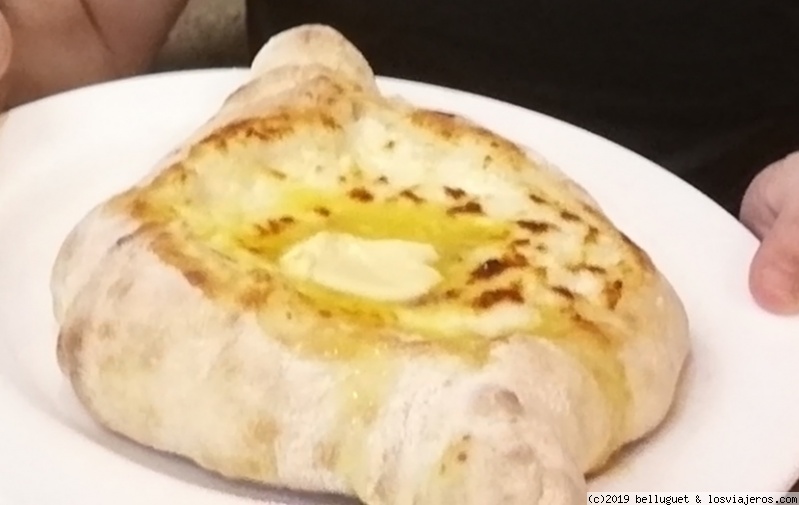 The famous Khachapuri
Day 2. Discovering Tbilisi
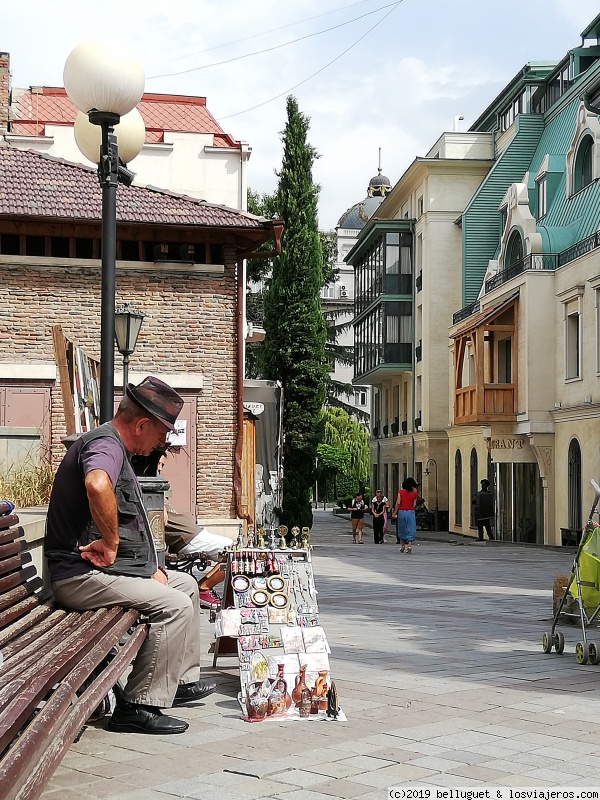 Corners of Old Tbilisi
We start the day with breakfast at a café on Rustaveli Square, buzzing with activity at 10 in the morning. Even the street market under the porticos is in full swing. We pass by the Parliament building, constructed when the country gained independence from Russia in 1991.
The whole of Rustaveli Avenue (curiously designed by Haussmann, the same man who transformed Paris) is a mix of grand classical buildings, art nouveau facades, and very Soviet structures. All the international brands are here. We reach Freedom Square (Tavisuplebis Moedani), dominated by a splendid central column topped with a huge golden Saint George slaying the dragon. Not for nothing is he the patron saint of Georgia, from which the country takes its name. This square was called "Lenin Square" during the Soviet period.
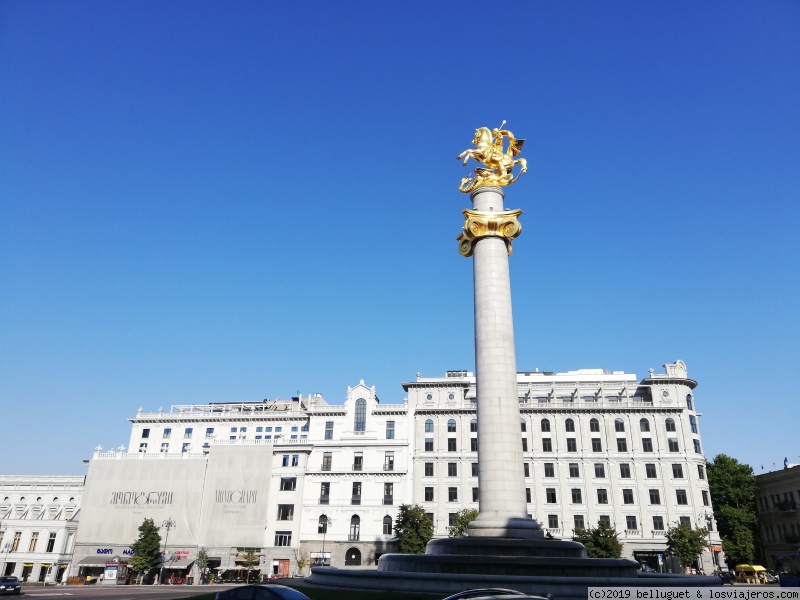 Saint George's column in Freedom Square
Fortunately, the ancient walls and historic center were not destroyed under Russian rule. Tbilisi is, without a doubt, a city of great charm and it is wonderful to stroll through the old neighborhood, known as Old Tbilisi.
 Old Ottoman houses now converted into hotels and B&Bs
Following the perimeter of the old walls, we reach the famous Gabriadze clock tower just as it is about to strike the hour. Although it is a recent construction, it is undoubtedly a delightful tourist attraction. Unlike other famous clocks such as the Prague Astronomical Clock, surrounded by hundreds of tourists, here there are barely 20 people.
 The famous clock of Old Tbilisi
We visit the Anchiskhati Basilica (6th century), the exterior of the Episcopal Palace, the Bridge of Peace (opened in 2010), Rike Park, and the ancient Sioni Orthodox Cathedral. Young people cross the modern glass bridge and many vendors offer boat trips on the Kura River.
 The Kura River
The thermometer reads 37 degrees. Hot and a little weary, we climb up to Metekhi Church (13th century) on a cliff overlooking the city. Mass is in progress and we arrive at the moment of the blessing. When the priest throws the holy water, he does so with such force that it reaches us even from our corner at the back.
Old Tbilisi has great charm: its narrow alleys, facades with wooden balconies arranged in irregular rows, forming step-like color compositions that have become the symbol of the city. And they are still inhabited.
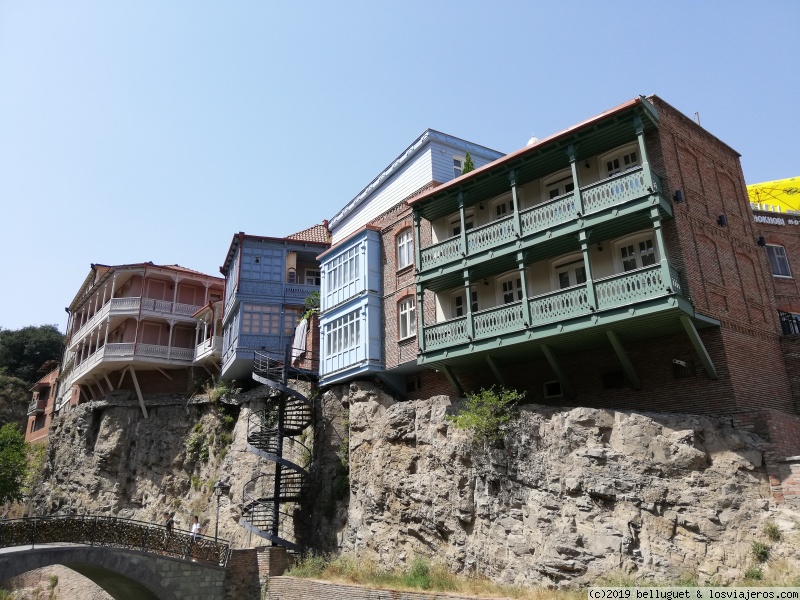 Walls of Old Tbilisi
We walk about 20 minutes to Tsminda Sameba Cathedral (Holy Trinity), which still smells new. It was completed in 2004 to mark 1,500 years of the Georgian Patriarchate, and its golden dome, 85 meters high, is visible from all over the city. They say it can hold more than 15,000 worshippers. It impresses more by its sheer scale than by its decoration. The dress code is strict: we are even told off for keeping our hands in our pockets, and photography is forbidden.
 The Cathedral with its unmistakable golden dome
On the way out, a sculptor works painstakingly on the entrance colonnade, as if he were a medieval craftsman.
 Sculptor at work on the Cathedral's reliefs
The Abanotubani neighborhood is characterized by the clay domes of the sulfurous bathhouses. We approach the Chreli Abano baths, whose facade of blue mosaics is reminiscent of the mosques of Uzbekistan. We go in hoping to find a spot, but today it is fully booked, so we reserve for the following day. A little further on, the famous waterfall, which is very busy at this hour.
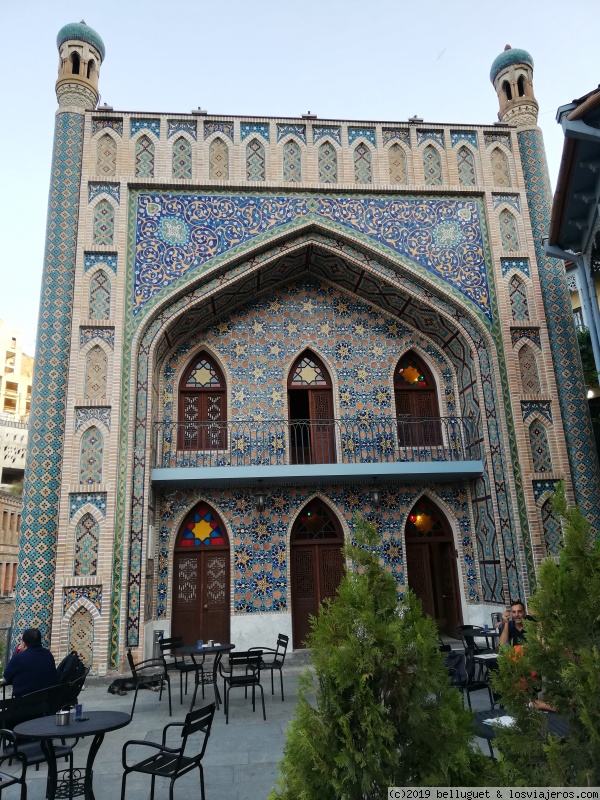 No, we're not in Uzbekistan
We continue up the steep streets to Narikala Fortress, with its magnificent walls and the sculpture of Kartlis Deda (Mother of Georgia) that dominates the entire city. The views from up here are beautiful. And if you don't want to climb on foot, the cable car from Rike Park will take you up comfortably (2.5 GEL per trip with the transport card).
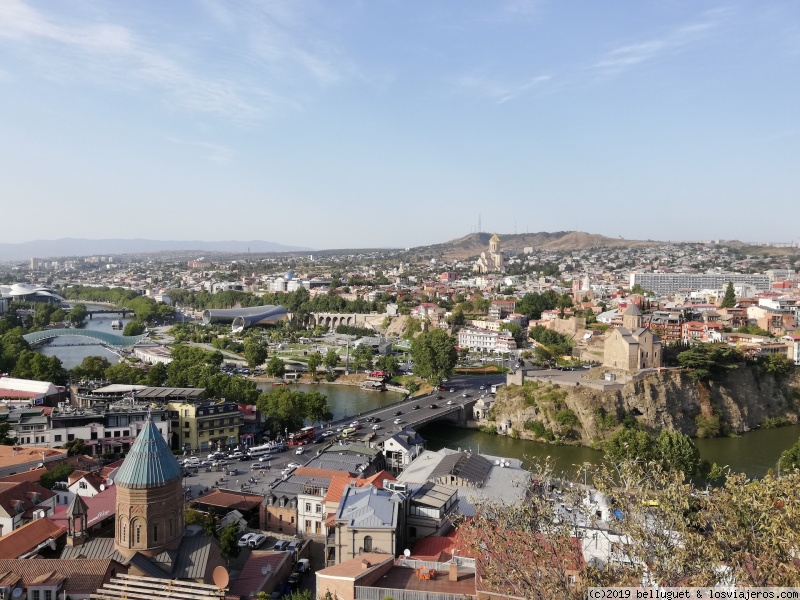 From Narikala Fortress
We have dinner in Old Tbilisi, by the river. They say Tbilisi is the most beautiful city in the Caucasus. And honestly, it has won us over completely.
Day 3. Tbilisi – Monasteries and churches of Mtskheta
The Avis office is in Freedom Square. We collect the 4×4 (almost essential for the roads ahead). It is a Suzuki Vitara for which we pay €518 fully insured for 12 days. Add €25 for permission to cross the border and €36 for GPS. The GPS turned out to be unnecessary as it is cheaper to use Google Maps on your phone. [VERIFY current car rental prices in Tbilisi]
Once we successfully navigate out of Tbilisi, we head to nearby Mtskheta, the spiritual capital of Georgia and a UNESCO World Heritage Site.
 The walls of Mtskheta
Svetitskhoveli Cathedral dates back to the 4th century, when the Georgians adopted Christianity through Saint Nino, who managed to convert King Mirian III. The current 11th-century building still has its original defensive walls and towers. Believed to house a relic of Christ's robe, this church is considered one of the holiest sites in Christendom. Until 2004, when Tbilisi's Holy Trinity Cathedral was built, it was the largest church in Georgia.
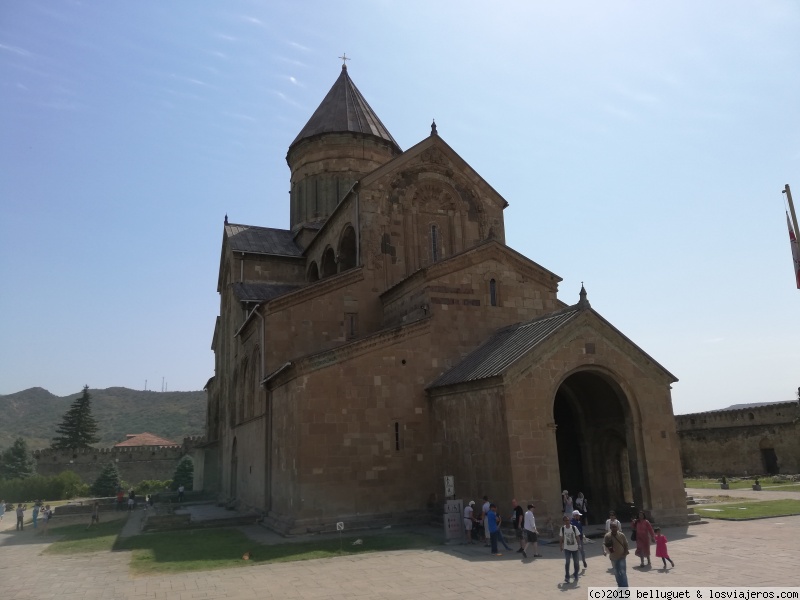 Svetitskhoveli Cathedral
Also in Mtskheta is Samtavro Church (11th century), built on the spot where Saint Nino used to preach. This women's monastery houses the tomb of Mirian III and his wife, and outside stands a small chapel dedicated to Saint Nino, with a long queue of people waiting to enter.
 Women's monastery of Samtavro
Jvari Monastery (7th century) occupies a privileged spot with views over the whole valley. They say that from here you can see the two colors of the Kura and Aragvi rivers merging in front of Jvari, but we couldn't quite make it out.
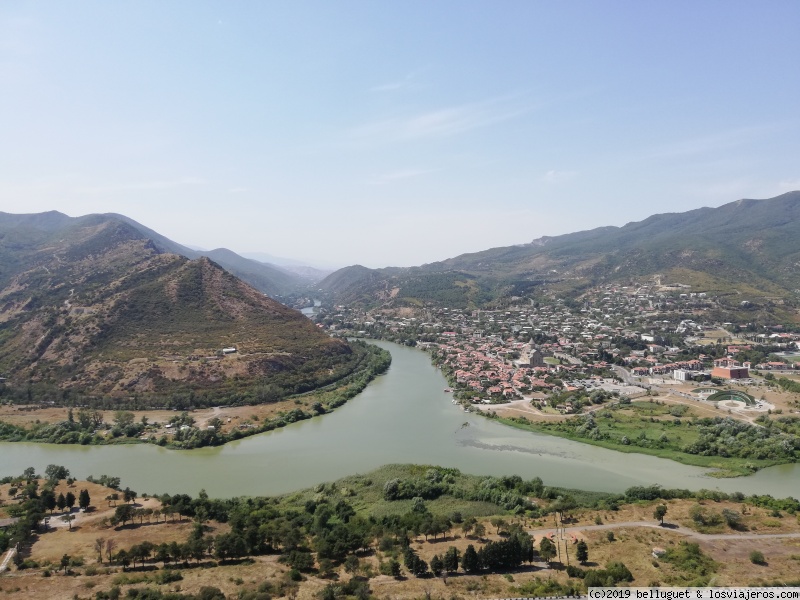 From Jvari Church
At the tourist office they recommend a visit to Shio-Mgvime Monastery, 12 km from Mtskheta. It doesn't appear in many guidebooks, but it is one of the oldest, founded in the 6th century by one of the first 13 Assyrian missionaries. It once became the largest monastic community in Georgia, with around 2,000 monks. Despite the winding road to get there, it is worth it for the solitude you find and the beautiful natural surroundings.
By around 2 pm we are back in Tbilisi. The rental car comes with a kind of exemption that allows you to park in any marked zone without paying.
In the afternoon we have a bath reservation at Chreli Abano (we chose one hour in a private bath for 50 GEL). On the way out, a nearby restaurant's chicken barbecue catches our attention — it is the Alani — and we end up staying. Taxi back: 4 GEL.
 Sunset in Old Tbilisi
Day 4. Tbilisi – Uplistsikhe – Gori – Ateni Sioni
Located 70 km from Tbilisi is the rock-hewn city of Uplistsikhe. It is one of Georgia's most important monuments, inhabited almost continuously from its founding in the 1st millennium BC until the 19th century.
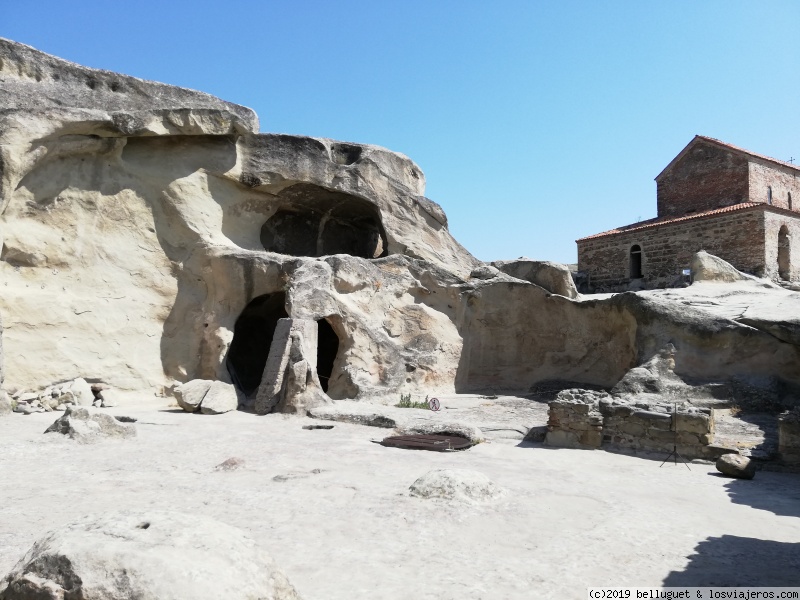 The city of Uplistsikhe
The visitable area comprises about a hundred caves from different eras that served as homes, storehouses, churches, and noble spaces. It is estimated that up to 20,000 people once lived here, taking advantage of how easy sandstone is to carve. Admission is 7 GEL and the audio guide costs 10 GEL. Taking our time at each stop, the visit takes us nearly 2 hours. [VERIFY Uplistsikhe entry prices]
 Uplistsikhe
We continue to Gori, 13 km away. We are close to the border with South Ossetia, a territory occupied by Russian troops since 2008 following the conflict with Georgia. Gori is the city where Stalin was born, and the museum and his birthplace are a big draw. We skip the museum (15 GEL) — we have no interest in celebrating a dictator's "life and works" — but in the grounds we see the birthplace house, relocated from its original site, and the railway carriage he used for travel.
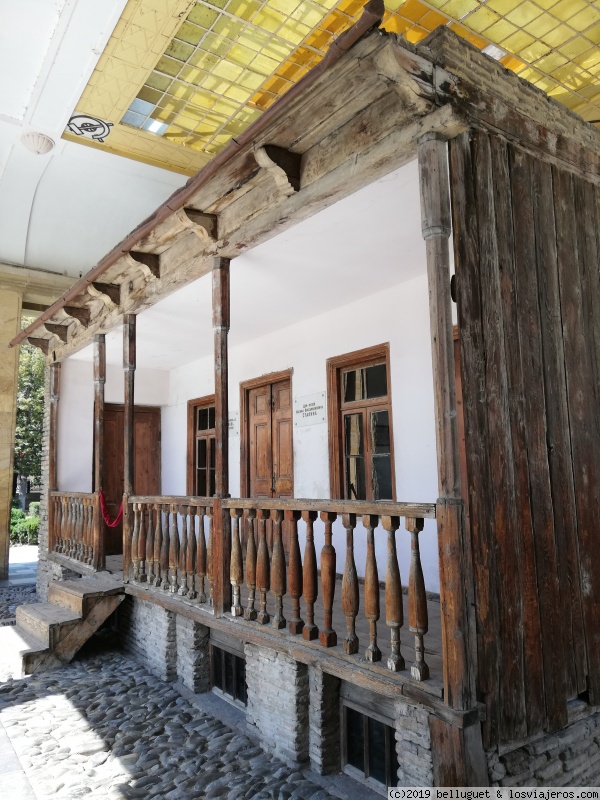 Stalin's house
Gori Fortress dates from the 13th century and is impressive from below, with its huge scale and towers. The access path and the views are more rewarding than the interior, which is still being restored.
 Gori Fortress
The Lonely Planet recommends Ateni Sioni Monastery, 12 km from Gori, considered a masterpiece. Getting there is quite an ordeal along a narrow, potholed road, but the scenery of the Tana River valley is beautiful and the church perches on the edge of a cliff. It is a beautiful cross-plan church that is opened exclusively for us, with 9th-century paintings and inscriptions in an early version of the Georgian alphabet.
In the early afternoon we are back in Tbilisi. We visit the Art Museum (museums close between 5 and 6) with a flat admission of 15 GEL. [VERIFY museum prices]
 Strolling near Rustaveli Avenue
We walk along Rustaveli Avenue again and pass by the protest camp outside Parliament over the Russian military presence in South Ossetia.
 Georgia's Parliament
We enter the National Gallery, which is part of the Georgian National Museum. It is a magnificent art collection in which the works of Niko Pirosmani (or Pirosmanashvili) stand out — famous for his paintings of rural Georgian landscapes and characters from the early 20th century — as do those of the sculptor Jacob Nikoladze, who became an assistant to Auguste Rodin. As an interesting aside, there is a good deal of work by Georgian women painters of the 20th century, though they are little known outside their country.
 One of Pirosmani's most famous works
 National Gallery
We end the afternoon at the amusement park on Mtatsminda Mountain to enjoy the views over Tbilisi and the Great Caucasus mountains in the distance. We have dinner on the terrace of the Chela restaurant and stroll through the park. The Ferris wheel and the large TV antenna visible from all over the city are up here. The funicular currently costs around 8–10 GEL per trip. [VERIFY Mtatsminda funicular price]
 From Mtatsminda Amusement Park
Day 5. Tbilisi – David Gareja – Tbilisi's Stonehenge
One of the most important monastic complexes in Georgia is David Gareja, in the Kakheti region. Entirely carved into the rock, it was founded in the 6th century by Saint David Garejeli to spread Christianity, and for centuries was an important pilgrimage center under royal protection.
 Entrance to David Gareja Monastery
The road from Rustavi is awful and the signs pointing to the monastery are barely visible. Part of the route runs close to the Azerbaijani border, with a military presence throughout the area.
 The Georgian-Azerbaijani border zone
We start at Lavra Monastery, which retains its walls, towers, and a small Church of Saint Nicholas where Saint David Garejeli and two of his disciples are buried.
 Entrance courtyard
Founded in the 6th century, the current complex is practically from the 18th century. The caves or "kenakons" used as cells, stables, or storerooms are the highlights. Higher up, a rock features a diagonal crack that forms part of a clever rainwater collection system.
 Inside the Monastery
We wanted to visit Udabno Monastery, famous for its rock-carved caves with extraordinary frescoes. However, near the border barrier we learn that passage has been forbidden since the summer of 2019, when Azerbaijan restricted access. As of today (2026), Udabno Monastery remains inaccessible to tourists due to the border dispute between Georgia and Azerbaijan. Only Lavra Monastery and the spectacular Rainbow Hills in the surrounding area can be visited. If you plan to go, check the current situation in advance.
As an amusing aside, on the way back some soldiers ask us to stop while they finish target practice. When they are done, they ask if we can give them a lift back to the barracks so they don't have to walk.
Back on the outskirts of Tbilisi, we visit the enormous black stone monument known as the Tbilisi Stonehenge (Chronicle of Georgia). Built from 1985 by Zurab Tsereteli, it consists of massive black basalt columns whose reliefs narrate the history of Georgia. It is a very popular and beloved monument.
 Tbilisi's Stonehenge
We end the afternoon at the Georgian National Museum, whose archaeology collection is spectacular. Around 600 pieces form the Treasury, the room housing the ancient goldwork. On the top floor, a permanent exhibition about Georgia's 20th-century history is very interesting, especially the section dedicated to the independence movement.
We have dinner at Pasanauri, recommended for its delicious traditional khinkali. The portions are generous: dumplings as big as your fist.
Day 6. Tbilisi – Georgian Military Highway – Kazbegi
 Aragvi Lake
We set off toward Kazbegi along the famous Georgian Military Highway, which connects Georgia with Russia. Considered a must on any trip to Georgia… though it requires plenty of patience in the face of constant reckless driving by Georgian motorists.
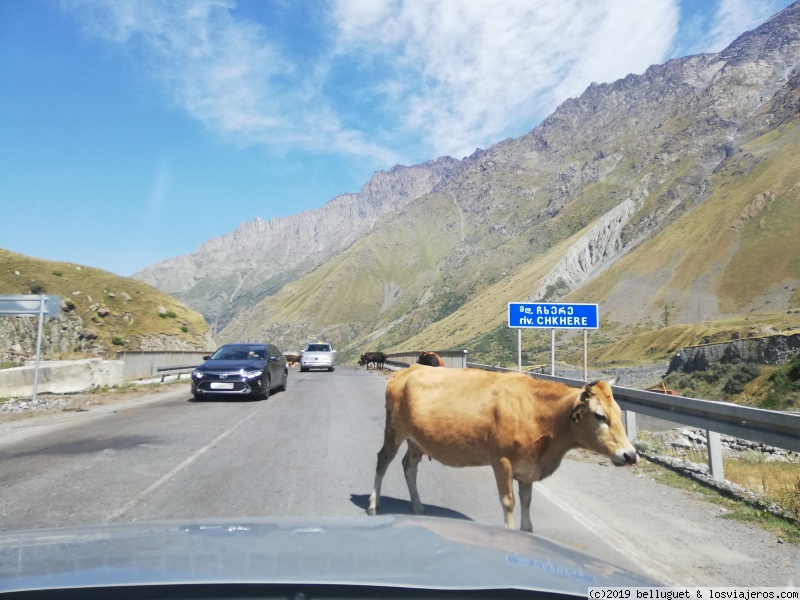 Stay calm at all times...
Opened in the 19th century, this road follows the traditional route across the Caucasus used for centuries. The first stretch is good and the landscape is beautiful. At Aragvi Lake we stop to visit Ananuri Castle, a very popular spot.
 Ananuri Fortress, 18th century
It is an 18th-century fortified complex made up of two enclosures of walls, a church, and a square tower (the oldest part, from the 14th century) that reminds us of the fortifications of San Gimignano.
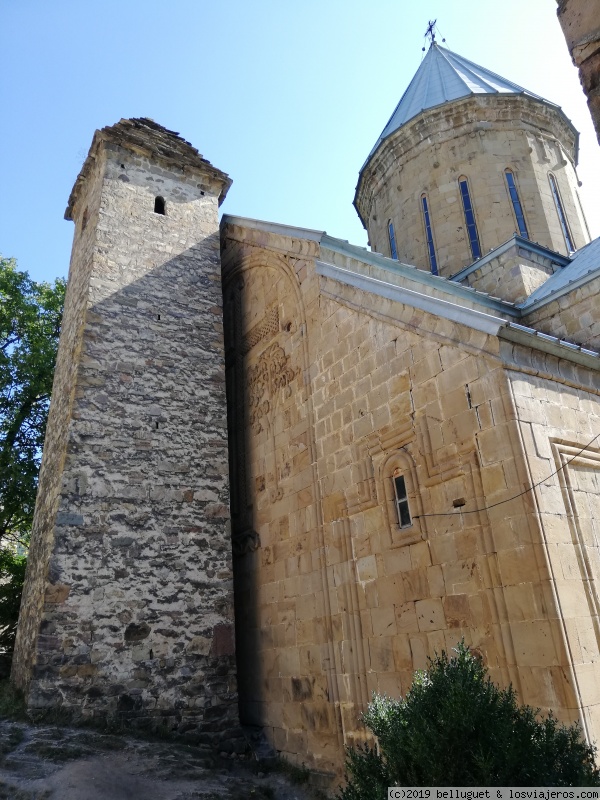 Fortress towers
As we head deeper into the Caucasus mountains, the landscape becomes ever more spectacular.
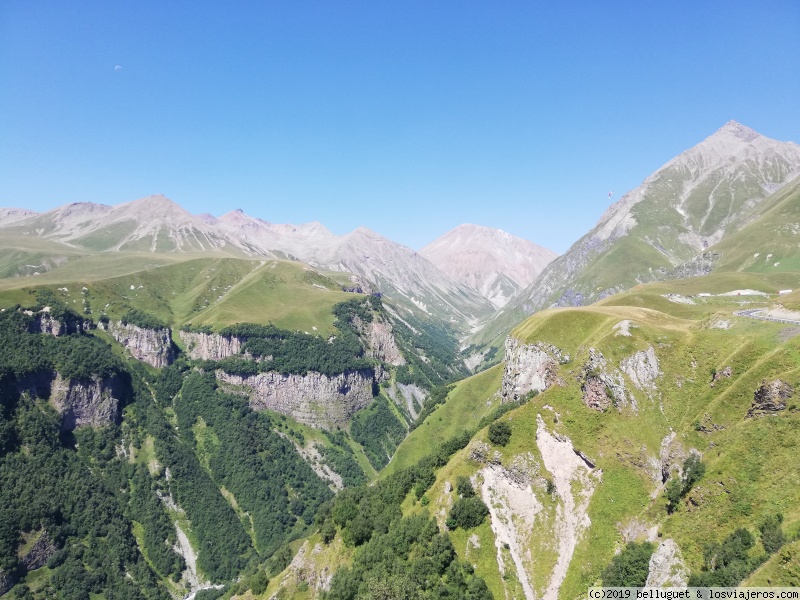 Jvari Pass on the Military Highway
One of the stops is the Monument of Georgia–Russia Friendship, built in 1983 to mark the 200th anniversary of the Treaty of Friendship against Turkey. It is a popular spot with fruit sellers, souvenir stalls, and even paragliding flights. Set at Jvari Pass at 2,379 meters, it is a wonderful stop to take in the immensity of the mountains, whose peaks reach 5,000 meters, although the monument itself is an eyesore.
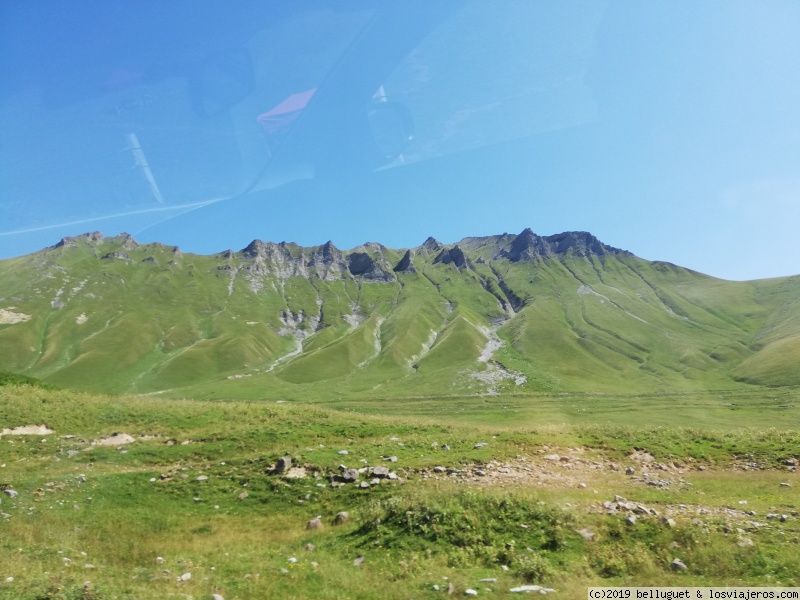 Landscapes on the Military Highway
From Jvari Pass we begin the descent. In the meadows we notice a large number of tables and colorful canopies on both sides of the road. These are picnic areas that fill with people at weekends. Judging by the number of young lambs in simple branch enclosures, you buy the main course, cook it, and eat it on the spot.
In just a few kilometers, we arrive at Stepantsminda.
Day 6 (continued). Kazbegi
We arrive at Kazbegi, also known as Stepantsminda, the last town in Georgia before the Russian border. We stay at Anano Guest House, highly rated — and we can confirm the praise is deserved. The house has spectacular views of Mount Kazbek (80 GEL for a room with private bathroom). Breakfast is not included but we add it on: 15 GEL per person. [VERIFY current accommodation prices in Kazbegi]
 A room with a view
Our first intention is to visit Dariali Monastery in the gorge of the same name, but the road is blocked by trucks and cars waiting to cross the Russian border, about 10 km further on. After two attempts, we give up entirely.
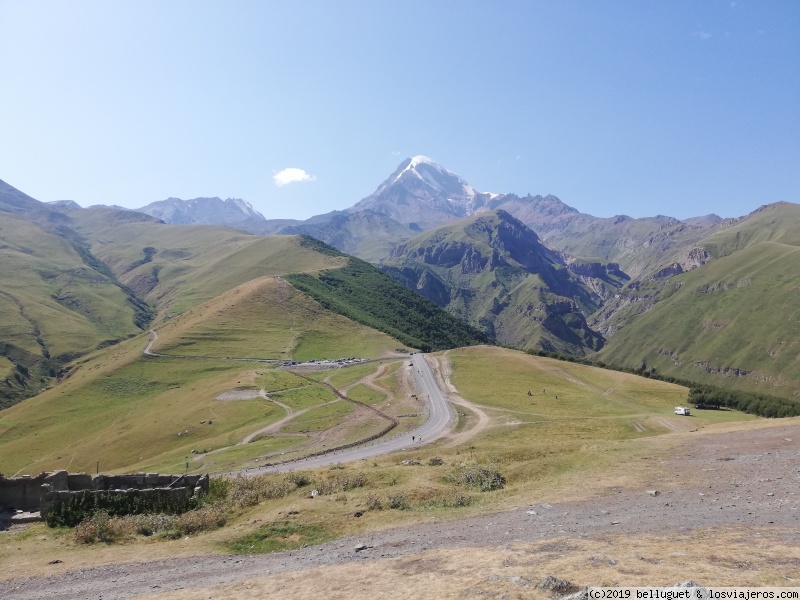 Kazbek is always there
On the way back, we do the Gveleti waterfalls hike, the Large and the Small. At a leisurely pace, both together take us just under 2 hours. The Small one is more accessible because the path to the Large one is uneven with some narrow sections requiring care, especially when passing other walkers (some of whom are wearing flip-flops quite cheerfully). Hiking poles would have been very useful.
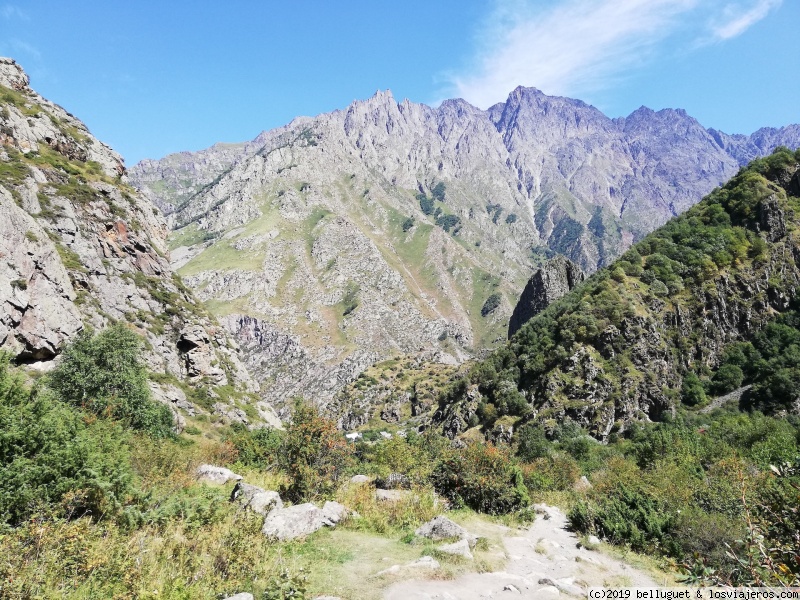 On the way to Gveleti waterfalls
And finally, the highlight: the famous Tsminda Sameba Church (Gergeti Trinity Church), perched at nearly 2,200 meters. It is the iconic image of Georgia, with Mount Kazbek in the background.
 Tsminda Sameba Church
Private cars and taxis can drive up to the church, but not tourist buses. The 5 km access road can be done on foot, though the vegetation is dense, there are no views on the way up, and you need to watch out for cars whose drivers seem to think they are on an F1 circuit. On arriving at the summit, it is easy to understand why this is a symbol of Georgia: surrounded by immense mountains and with the fantastic 5,033-meter Mount Kazbek in the background — a dormant volcano and one of the highest peaks in the Caucasus — the solitary church looks magnificent. A postcard-perfect landscape, without a doubt.
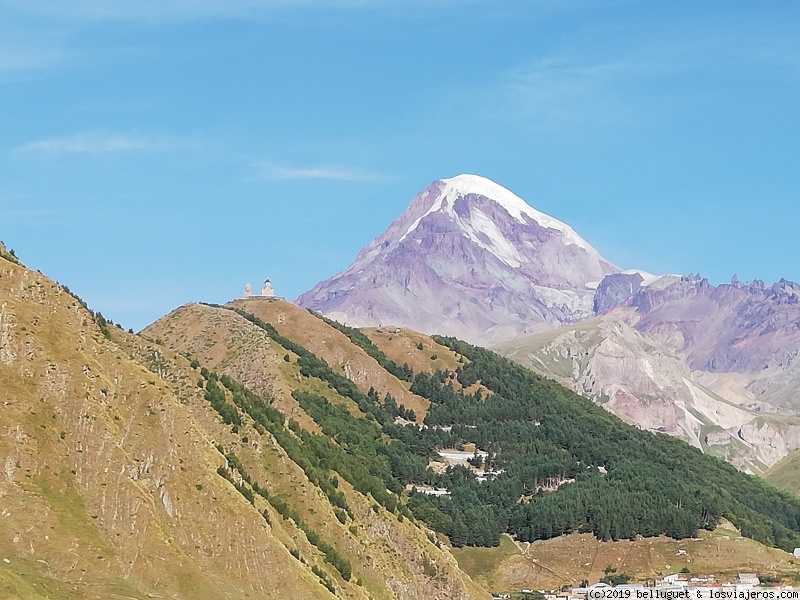 Georgia's classic postcard
In the late afternoon we walk over to Rooms Hotel, considered one of the most luxurious hotels in the Caucasus, to enjoy the sunset from the publicly accessible entrance terrace. Fortunately, bar prices are reasonable for the area. When it starts to get cold, blankets are handed out, so wrapped up warm we enjoy a magnificent sunset.
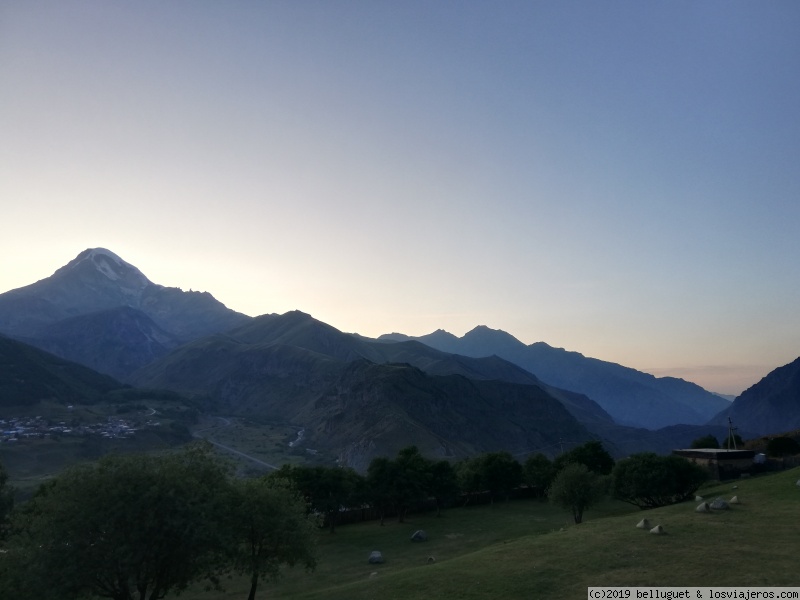 Caucasus sunset
Day 7. Stepantsminda – Truso Valley – Tbilisi
At 8 o'clock the table is already laid and breakfast is a feast. Made with love: fruit, butter and jam, eggs, sausages, pancakes, cheese rolls, cold cuts, porridge, and omelette. You start the day with an enormous amount of energy.
Of the recommended hikes, we choose the Truso Valley. Without GPS it is impossible to reach Kvemo Okrokana, and without a 4×4 it's best not to attempt it at all. The track is actually the bed of a dry river and the stones turn the 4 km stretch into a rally.
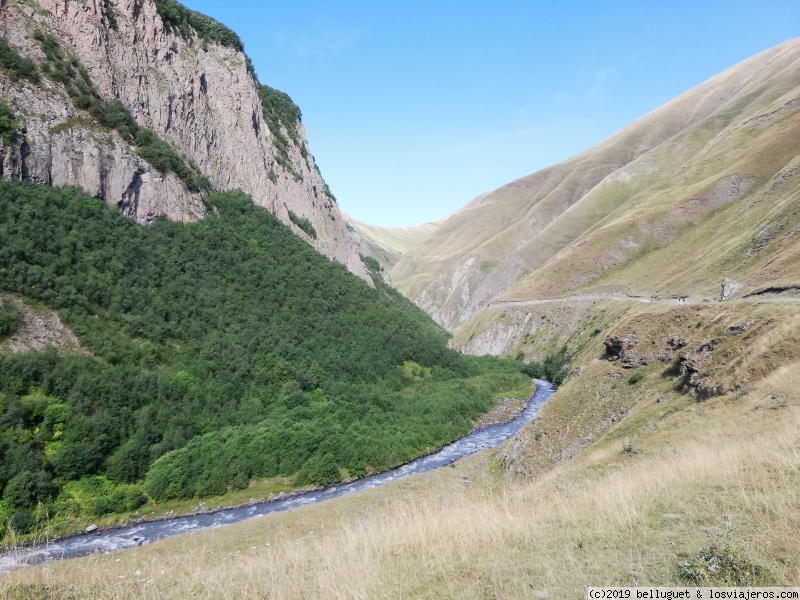 Hiking in Truso Valley
From there we continue on foot. The route has several points of interest as far as the Zakagori ruins (about 20 km in total) and for much of the way runs through the beautiful Kasari Canyon. Some of the houses were inhabited well into the 20th century, but the harsh winters led to their abandonment. Today some have been restored for tourism, and there is even a campsite. We reach the hamlet of Ketrisi and turn back. Going and coming together takes us just under 4 hours.
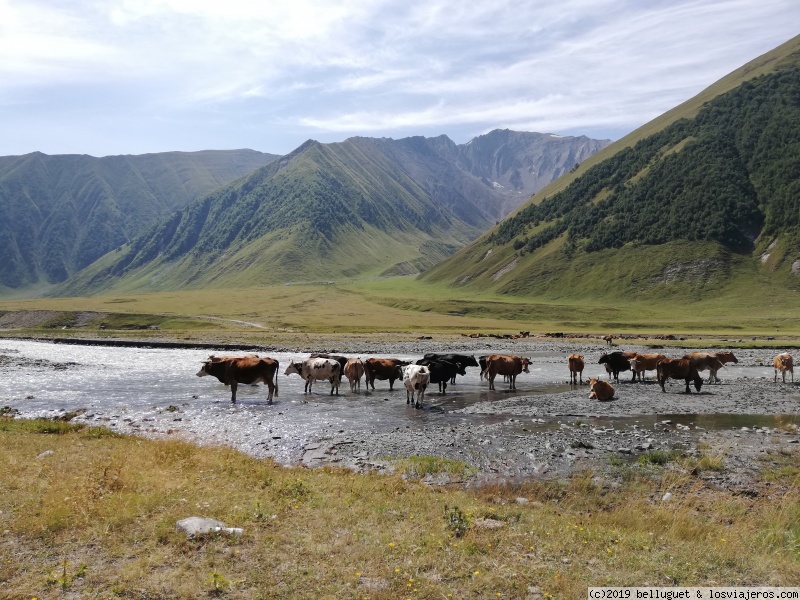 Truso Valley
Back on the Military Highway, we are curious about the Gudauri cable car, at the ski resort of the same name.
 Climbing toward 2,000 meters in Gudauri
A gondola-type cable car opened in 2019, it covers 7.5 km in 15 minutes. The views at 2,000 meters are breathtaking. Absolutely recommended. [VERIFY Gudauri cable car prices]
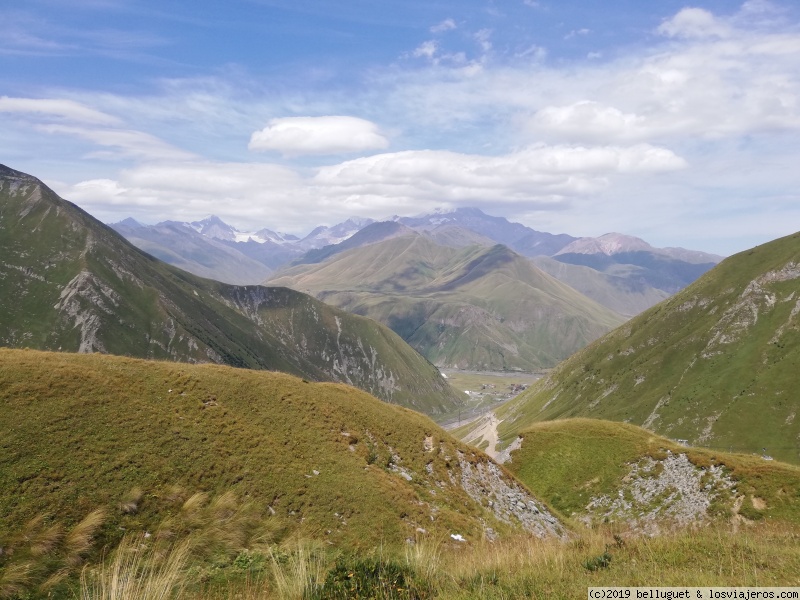 From the first station of the Gudauri cable car
Back in Tbilisi, we have an apartment on Nino Street, near Rike Park. It is a quiet apartment in an Ottoman house with a balcony and, most importantly, very peaceful for sleeping (110 GEL per night).
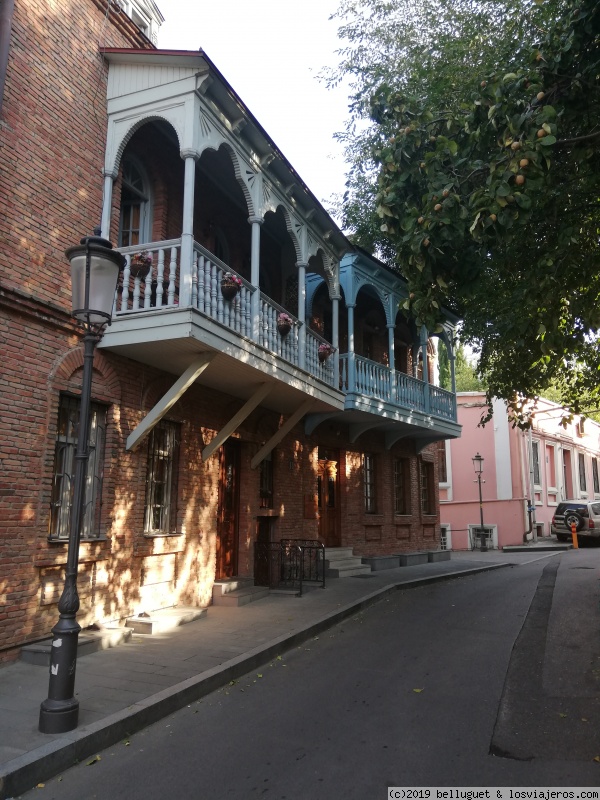 Old Tbilisi
We go out to dinner in Old Tbilisi and soak up the lively Saturday night atmosphere. On the way home, a piece of the Berlin Wall in a corner of the park.
 Even the Berlin Wall has a presence in Tbilisi
As we reach the apartment, it starts to pour. That is the city's goodbye to us. Tomorrow we set off for Armenia.
Practical information for your week in Georgia
- Travel insurance: Mandatory from January 2026, with a minimum coverage of 30,000 GEL.
- Public transport in Tbilisi: Metro and buses at 1 GEL per trip. MetroMoney or Travel Card (2 GEL). Contactless bank card payment is also accepted.
- Currency: Georgian lari (GEL). ATMs are everywhere. International cards are accepted in most establishments.
- Car rental: Highly recommended for exploring outside Tbilisi. A 4×4 is preferable for secondary roads.
- Useful apps: Bolt for taxis, Google Maps for navigation and public transport.
Reproduced from the losviajeros.com forum with the author's permission.
Diary author:
Núria Pujol
Tourism guide from Barcelona
To see more posts or get in touch with the author: Instagram @amobarcelona_guiaoficial
Email: nuria.pujol@amobarcelona.com