

A Linguistic Treasure of the Caucasus
The Georgian alphabet is far more than a writing system: it is a work of calligraphic art, a symbol of national identity, and one of the few entirely original living alphabets in the world. In this article you will discover its history, its structure, its role in Georgian culture, and practical tips for starting to learn it.
Brief History and Significance
The Georgian alphabet has been fundamental in preserving the language, literature, and memory of Georgia. From its earliest origins, it has accompanied Christian faith, great epic narratives, and the identity of a resilient people. In 2016 UNESCO inscribed it as Intangible Cultural Heritage of Humanity, in its three variants: asomtavruli, nuskhuri, and mkhedruli.
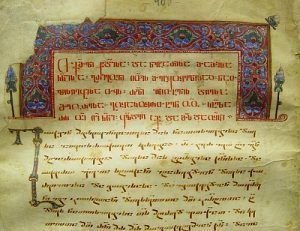 Nuskhuri, ancient Georgian script.
Origins and History of the Georgian Alphabet
Tradition attributes the creation of the first Georgian alphabet — the asomtavruli — to King Parnavaz I of Iberia in the 3rd century BC. The oldest surviving inscriptions date from the 5th century AD. Over the centuries the alphabet evolved into three successive forms:
- Asomtavruli: the oldest, uppercase and monumental, used in manuscripts and religious inscriptions.
- Nuskhuri: derived from asomtavruli, used during the Middle Ages to copy liturgical texts.
- Mkhedruli: the current form, born in the 10th century. It is the script taught in schools today and seen on streets, in books, and on screens.
Some Armenian historians argue that Mesrop Mashtots, creator of the Armenian alphabet, also created the Georgian one, but the majority of Georgian researchers defend its autochthonous and older origin.
Evolution and Changes
Originally the alphabet had 38 letters, but the current mkhedruli form retains 33: 28 consonants and 5 vowels. Its rounded shapes and fluid lines make it one of the most aesthetically beautiful alphabets in the world.
Structure and Characteristics of the Georgian Alphabet
Each letter represents a unique sound. It is written left to right and has no distinction between uppercase and lowercase in the Latin sense. Let's look at its key components.
Vowels and Consonants
Georgian has five vowels:
- /a/ — ა
- /e/ — ე
- /i/ — ი
- /o/ — ო
- /u/ — უ
And 28 consonants, with sounds that do not exist in English, such as the pharyngeal q (ყ), the guttural gh (ღ), and the aspirated and glottalized pairs (p/p-glottal, t/t-glottal, k/k-glottal).
| ა (a) | მ (m) | ღ (gh) |
| ბ (b) | ნ (n) | ყ (q') |
| გ (g) | ო (o) | შ (sh) |
| დ (d) | პ (p') | ჩ (ch) |
| ე (e) | ჟ (zh) | ც (ts) |
| ვ (v) | რ (r) | ძ (dz) |
| ზ (z) | ს (s) | წ (ts') |
| თ (t) | ტ (t') | ჭ (ch') |
| ი (i) | უ (u) | ხ (kh) |
| კ (k') | ფ (p) | ჯ (j) |
| ლ (l) | ქ (k) | ჰ (h) |
Uppercase and Lowercase
In modern mkhedruli there is no formal distinction between uppercase and lowercase: all letters have a single size. To imitate the effect of capitals, the mtavruli is used, a decorative variant of the mkhedruli itself.
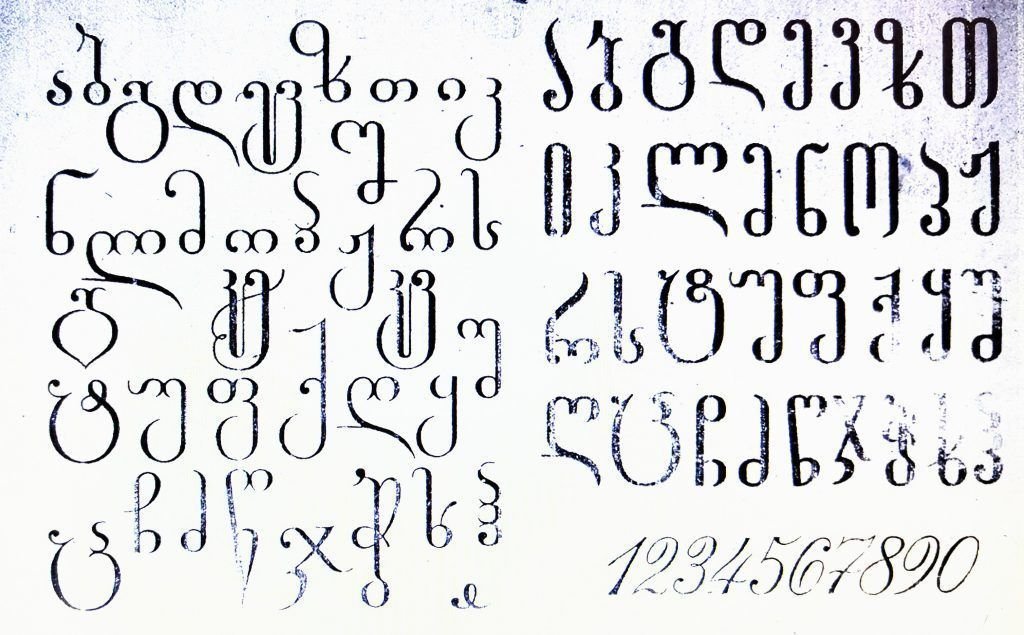 The complete Georgian alphabet.
The Georgian Alphabet in Culture and Society
The Georgian alphabet is present in every sphere of life in the country:
- Cultural identity: it is a national emblem, like the flag or the anthem.
- Literature and poetry: from the medieval epic of Shota Rustaveli to contemporary poets.
- Art and design: it inspires jewelry, logos, murals, and sculptures.
- Education: taught from primary school.
- Branding and visual identity: many Georgian brands use native typefaces as a badge of pride.
Literature and Poetry
Shota Rustaveli wrote in the 12th century The Knight in the Panther's Skin, considered the masterpiece of Georgian literature and an epic poem comparable to the great European classics.
The Deda Ena: the "Mother Tongue"
In the 19th century, writer and educator Iakob Gogebashvili created Deda Ena (Mother Tongue), the book with which many generations of Georgian children still learn to read and write today.
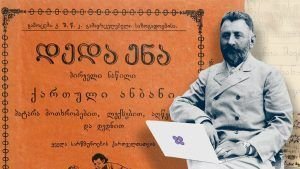 Iakob Gogebashvili and the Deda Ena.
National Identity
During the long centuries when Georgia was under foreign rule, the alphabet was a bastion of cultural resistance. Even in the Soviet era, keeping the language and its script alive became an act of national pride.
 Georgian school books.
How to Learn the Georgian Alphabet
Learning the Georgian alphabet may seem like a challenge, but with method and consistency it is perfectly achievable. Here is a practical guide.
Key Tips
- Get familiar with letters and sounds using audio and video resources on YouTube.
- Practice handwriting: copying each letter several times helps memorize its strokes.
- Learn basic words (gamarjoba, madloba, diakh) to apply what you've learned.
- Install the Georgian keyboard on your phone and computer.
- Combine resources: apps, books, online classes, and exposure to Georgian media.
Useful Resources
- Apps: Learn Georgian Alphabet, Drops, Memrise.
- Videos: YouTube channels dedicated to Georgian for beginners.
- Books: Beginner's Georgian, Georgian for Everyone.
- Private lessons with native speakers, ideal for making rapid progress.
Practical Exercises
- Repeat the letters aloud every day.
- Write your name and the names of people close to you in the Georgian alphabet.
- Read signs and menus in Georgian when you travel to the country.
- Listen to Georgian songs and try to recognize letters and sounds.
Conclusion
- The Georgian alphabet is one of the 14 original alphabets in current use worldwide.
- It consists of 33 letters (28 consonants and 5 vowels), with no uppercase/lowercase distinction in the Latin sense.
- Its current variant, the mkhedruli, has been UNESCO Intangible Cultural Heritage since 2016.
- It plays a central role in the literature, education, and national identity of Georgia.
- There are many resources for learning it, from apps to online classes.
Would you like to discover the Georgian alphabet on the ground — reading its letters on the facades of Tbilisi and hearing its sounds from native speakers? At Iberogeorgia we organize tailor-made trips so you can experience Georgia in depth, with Spanish-speaking guides who will bring you closer to its culture, history, and language.