

Have you always wanted to understand Georgia but found it a puzzle? You've come to the right place. In this guide we explain, in a clear and engaging way, everything essential about this fascinating country in the Caucasus, situated between Eastern Europe and Western Asia.
Georgia is a nation of ancient history, vibrant culture, spectacular landscapes, and legendary hospitality. From the snow-capped peaks of the Caucasus to the wineries of Kakheti, through the cobblestone alleyways of Tbilisi, there is so much to discover. Welcome to our journey through Georgia in simple terms.
Where Is Georgia? A Look at Its Geography
Georgia is located in the Caucasus, a transitional region between Europe and Asia. It borders the Black Sea to the west, Russia to the north, Turkey and Armenia to the south, and Azerbaijan to the southeast.
Although it is a small country (around 69,700 km²), its geography is incredibly varied: high mountains in the Greater Caucasus, rolling green hills inland, fertile valleys, and subtropical beaches on the Black Sea coast. That mosaic also explains its climatic diversity: subtropical on the coast, alpine on the peaks, and continental in the east.
Want to know more? Take a look at our full article on Georgia's location.
A Brief History of Georgia: From Past to Present
Georgia has a history stretching back thousands of years. It was one of the first nations in the world to adopt Christianity as its official religion, in the 4th century. During the Middle Ages it experienced its Golden Age under King David IV the Builder and Queen Tamar, reaching extraordinary cultural and political splendor.
Then came centuries of Mongol, Persian, Ottoman, and Russian invasions that tested its identity. In the 20th century it was part of the Soviet Union until independence in 1991. Since then it has embarked on an intense path of democratic reforms and, in December 2023, obtained the status of EU candidate country.
Georgia's Political System, Simply Explained
Georgia is a parliamentary republic. Executive power is headed by the Prime Minister, while the President plays a largely ceremonial role. Legislative power rests with the Parliament of Georgia, a unicameral body directly elected by the people.
 The Parliament of Georgia.
The judiciary is independent and structured across three levels: the Supreme Court, courts of appeal, and courts of first instance. Together these three pillars uphold the country's democracy.
The Georgian Economy: How Does the Country Make Its Living?
The Georgian economy is diverse and constantly evolving. Agriculture — especially wine, nuts, and fruit — remains important, but in recent years tourism, services, technology, and logistics have grown strongly.
The country has positioned itself as a regional business hub thanks to its pro-business reforms, low taxation, and strategic location between Europe and Asia. Tourism in particular is enjoying a golden moment: Georgia has become one of the most fashionable destinations in the Caucasus. [VERIFY] recent international arrival figures.
Population and Demographics: Who Are the Georgians?
Georgia has approximately 3.7 million inhabitants [VERIFY]. The majority are ethnic Georgians, although the country is also home to minorities of Azerbaijanis, Armenians, Russians, Ossetians, and other groups. This mix is part of its cultural richness.
The official language is Georgian, one of the oldest languages in the world, with its own unique alphabet (the mkhedruli). The majority of the population belongs to the Georgian Orthodox Church, although there are also Muslim, Armenian Apostolic, and Catholic communities.
The Linguistic Diversity of Georgia
Georgian belongs to the Kartvelian language family, distinct from Indo-European and Turkic. Alongside it, other languages are spoken:
- Azerbaijani and Armenian in the southern minority communities.
- Russian, widely spoken among older generations.
- Abkhaz and Ossetian, local languages with their own status in the corresponding regions.
- English, increasingly present among young people and in the tourism sector.
 Alphabet Tower in Batumi.
Religion: A Look at Local Beliefs
Faith plays a central role in Georgian life. The Georgian Orthodox Church, founded in the 4th century, is one of the pillars of national identity. Monasteries such as Gelati, Davit Gareja, and Jvari are genuine spiritual and architectural treasures.
 Svetitskhoveli Cathedral, in Mtskheta.
Despite the strong religious presence, Georgia is a secular state and is noted for its tolerance toward other faiths.
Georgian Culture: Traditions, Music, and Dance
Georgian culture is a vibrant tapestry of age-old traditions. Georgians are renowned for their hospitality, their polyphonic singing — recognized by UNESCO as Intangible Cultural Heritage — and their spectacular folk dances, full of elegance, strength, and precision.
Traditional instruments such as the panduri or the salamuri, male choirs, and ritual toasts (tamada) are experiences every traveler should have at least once.
Georgian Cuisine: A Journey for the Palate
Georgian cuisine is one of the country's greatest surprises. Its signature dishes include:
- Khachapuri: cheese-filled bread, in multiple regional varieties.
- Khinkali: large steamed dumplings filled with meat and spices.
- Mtsvadi: Georgian skewers grilled over grapevine embers.
- Pkhali: vegetable paté with walnuts and spices.
And, of course, wine. Georgia is considered the birthplace of wine, with 8,000 years of tradition. Its method of fermenting wine in clay amphorae (kvevri) is also UNESCO Intangible Cultural Heritage.
Climate: When to Travel to Georgia
Thanks to its geographical variety, Georgia has climates to suit everyone:
- Black Sea coast: humid subtropical, ideal in summer.
- Tbilisi and central Georgia: warm summers and mild winters.
- High mountain areas: long snowy winters, perfect for skiing in Gudauri or Bakuriani.
The best time to visit Georgia is usually spring (May–June) and autumn (September–October), when the weather is mild and the landscapes are at their most magnificent.
Tourism in Georgia: Must-See Places
Tbilisi, the capital, is a must, with its old town, sulfurous baths, and vibrant cultural scene. Very nearby lies Mtskheta, the ancient religious capital and a UNESCO World Heritage Site.
In the Kakheti region you can visit traditional wineries and taste unique wines fermented in kvevri. For mountain lovers, Svaneti, Kazbegi, and Tusheti offer some of the most spectacular hiking routes in the Caucasus.
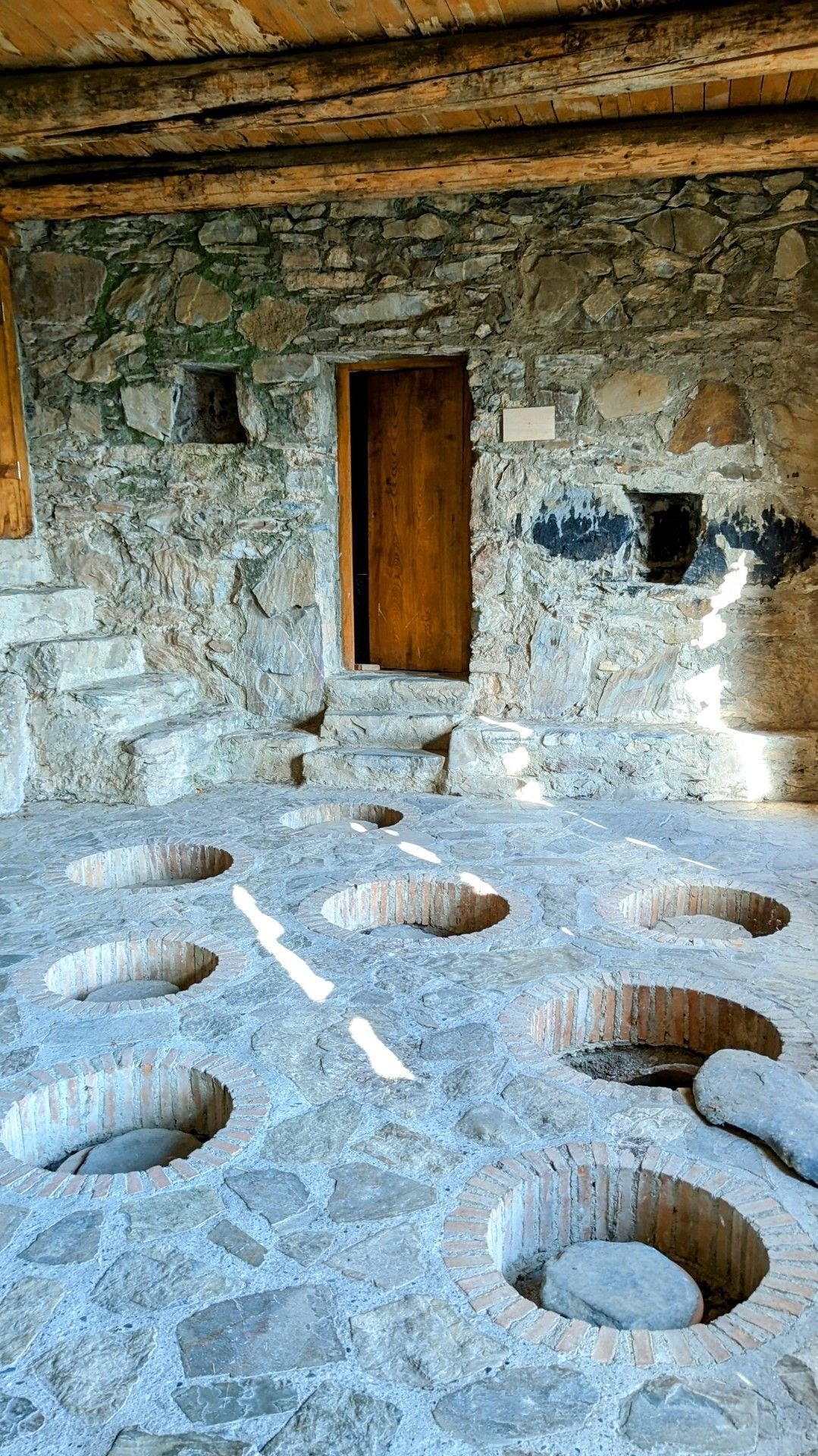 Nekresi Monastery and its kvevri.
Challenges and Opportunities in Today's Georgia
Like any developing country, Georgia faces challenges: balancing growth between cities and rural areas, consolidating its democratic institutions, and resolving the ongoing conflicts in Abkhazia and South Ossetia. At the same time, its EU rapprochement, its tourism boom, and its winemaking tradition open a horizon full of opportunities.
Georgia and Sport: Caucasian Passion
Rugby is almost the national sport: the Georgian national team, the Lelos, regularly competes in the Rugby World Cup. Football also enjoys great popularity, and the national team enjoyed a historic moment by qualifying for Euro 2024. The traditional wrestling style Chidaoba, recognized by UNESCO in 2018, remains a cultural emblem.
Ready to Discover Georgia?
We hope this guide has helped you understand why Georgia is such a special destination. If you want to experience it firsthand, at Iberogeorgia we design tailor-made trips so you can discover the country with the depth, warmth, and quality it deserves.