

Georgia's national symbols — its five-cross flag, the coat of arms bearing Saint George, and the anthem Tavisupleba — encapsulate centuries of history, faith, and resilience. Each one is a window into the soul of a people that has managed to preserve its identity between Europe and Asia. Join us on this journey through the emblems that beat at the heart of the Caucasian nation.
The Flag of Georgia: Five Crosses, a Thousand-Year History
A country's national flag is far more than a piece of cloth: it is the mirror of its identity and values. In the case of Georgia, the flag displays a powerful combination of red crosses on a white background, condensing Christian faith, courage, and medieval memory.
Origins and History of the Georgian Flag
The Georgian flag has its roots in the Middle Ages. According to Georgian historiography, several ancient manuscripts describe white and red banners linked to King David Soslan and Queen Tamar, at the height of the medieval Georgian kingdom's splendor.
 Georgia's flag on the Angelino Dulcert map (14th century).
The so-called Gorgasliani-Davitiani drosha — "the flag of Gorgasali and David" — already appears in the portolan chart of Mallorcan cartographer Angelino Dulcert (1339), proof that the country's visual identity was fully consolidated long before the modern era. After centuries of change, the current version was officially adopted on 14 January 2004, reviving the historic five-cross design.
The Meaning of Its Colors and Crosses
- White: a symbol of purity, innocence, and wisdom.
- Red: represents courage, valor, and love of the homeland.
- Large central cross of Saint George: recalls the country's patron saint.
- Four smaller (bolnisi) crosses: evoke the four evangelists and the Christian faith that has accompanied Georgia since the 4th century.
Cultural Significance and Flag Day
Georgia's flag is an emblem of unity, resilience, and national pride. Through centuries of invasions and occupations, it flew as a beacon of hope for the Georgian people. Today it flies on official buildings, schools, and homes, and accompanies every patriotic, sporting, or religious celebration.
Flag Day is celebrated every 14 January, commemorating its official restoration in 2004.
The Coat of Arms of Georgia: Saint George and the Royal Lion
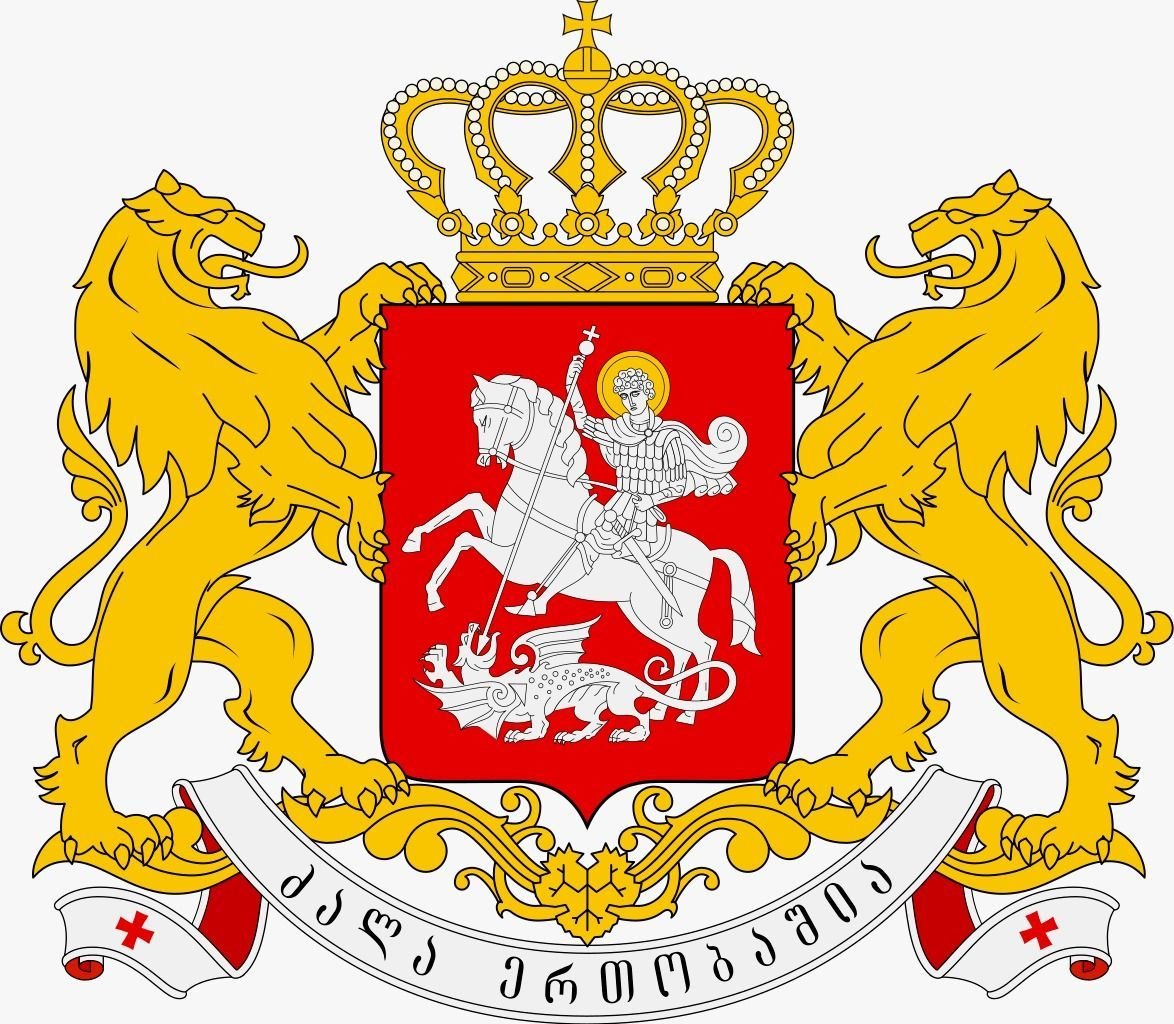 National coat of arms of Georgia.
Georgia's coat of arms, adopted in 2004, depicts the country's patron saint, Saint George, on horseback slaying the dragon against a red field. The composition is completed by two golden lions supporting the shield, the crown of the ancient Kingdom of Georgia at the top, and the national motto "Dzala ertobashia" ("Strength is in Unity") at the base.
The Origin of the Name "Georgia"
According to the studies of historian Grigol Peradze, several medieval European texts link the name "Georgia" to the people's devotion to Saint George. Jacques de Vitry, Latin Patriarch of Jerusalem at the end of the 12th century, wrote in his Historia Hierosolymitana about a people called "Georgians" who venerated the warrior saint as their protector.
The Legend of Saint George and the Battle of Didgori
The anonymous chronicle of King David IV the Builder recounts that during the decisive Battle of Didgori (1121), Saint George appeared as a celestial knight to lead the Georgian army to victory against the Seljuk invaders. From that moment, the saint has been considered the spiritual patron of Georgia.
The Georgian Lion
The lion, emblem of royal sovereignty, was adopted by King Erekle II in 1735 as the symbol of the Kingdom of Kartli-Kakheti. Its presence on the current coat of arms links modern Georgia to the dynastic tradition of the Bagrationi.
The Anthem of Georgia: Tavisupleba, a Song of Freedom
The national anthem is the sonic pulse of a nation. In Georgia, that pulse is called Tavisupleba ("Freedom"): an anthem that captures the spirit, memory, and hope of an entire people.
Origins of the National Anthem
Tavisupleba was officially adopted on 23 April 2004, following the Rose Revolution. The lyrics belong to poet David Magradze, while the music combines fragments from two operas by composer Zakaria Paliashvili: Abesalom da Eteri and Daisi.
Meaning and Message
The lyrics are a direct ode to freedom, to the beauty of the Caucasian landscape, and to the legacy of the ancestors. They speak of icons, of Georgian brothers, and of a clear sky as a metaphor for the future. Each verse evokes the yearning for independence that has guided the country throughout the centuries.
The Anthem in Everyday Life
Tavisupleba accompanies official ceremonies, sporting victories, cultural festivals, and every moment of national unity. It is a brief but intense melody, capable of moving equally those who hear it for the first time and those who have sung it their whole lives.
Three Symbols, One Identity
Flag, coat of arms, and anthem form a perfect triangle that defines Georgia to the world. Together they tell the story of a country small in size but immense in memory: the land of Saint George, of the five crosses, and of the song of freedom. If you travel to Georgia with Iberogeorgia, you will see them alive in every church, every square, and every popular celebration. And you will understand why they are far more than symbols: they are the soul of a people.