

Georgia and Armenia: Independent Travel Diary — Luis & Pilar's Account (Part 1)
We decided to visit these two countries for several reasons. The first is that for years we had been dreaming of doing a complete Silk Road journey, from Europe to China, and the Caucasus region would feature in one of the possible routes; for that reason we wanted to get to know these less-visited countries before embarking on a longer adventure. Another reason is that I have a particular passion for mountains, and the entire southern Caucasus, with its views over breathtaking ranges, was very tempting. Finally, we are both drawn to contact with more "authentic" peoples and societies, little altered by mass tourism, which allows them to preserve genuine cultures and ways of life.
We would have preferred to include some of Azerbaijan in the circuit, but we ruled it out for lack of time. Although the distances within the region are not great, three weeks never stretch very far; in this case it gave us two weeks to travel parts of Georgia and a third week to see something of northern Armenia.
The balance was very positive. Both countries are easy to visit and offer an interesting combination of nature and cultural heritage. While it is true that Georgians can seem somewhat reserved and the social climate reflects the country's economic difficulties and complex relations with its neighbors, they also preserve a very vibrant traditional culture rooted in family ties and Christian devotion (Georgia and Armenia were the first nations to officially adopt Christianity); they are at heart a hospitable people who love to have a good time, and above all feel deeply attached to their history, as evidenced by the wealth of ancient legends that survive in every corner of the country. Armenians, for their part, are a very pragmatic people — generally open and friendly to everyone, but also entrepreneurial and quick to spot an opportunity.
Georgia and Armenia independent travel: key facts
Visas for Georgia and Armenia
EU citizens can enter Georgia without a visa and stay in the country for up to 1 year. This applies to entries through Tbilisi airport and the land borders with Azerbaijan and Armenia. The borders between Georgia and the republics of the Russian Federation (Chechnya, Dagestan, etc.) remain closed to foreigners; this should be kept in mind when planning excursions in the Caucasus mountains.
To enter Armenia, EU citizens also need no visa and can stay up to 180 days per year. This visa-free arrangement greatly simplifies independent travel in Georgia and Armenia. Bear in mind that the border between Armenia and Turkey remains closed; travel between the two countries must go through Georgian territory. Following the dissolution of the self-proclaimed republic of Nagorno-Karabakh in 2024 and the peace agreement between Armenia and Azerbaijan signed in August 2025, the geopolitical situation in the area has changed considerably; the regions of Abkhazia and South Ossetia continue to be disputed territories with special access restrictions.
Currency and travel costs in the Caucasus
Georgia's currency is the lari (GEL) and Armenia's is the dram (AMD). As of 2026, the euro exchanges for approximately 3.10 GEL in Georgia and around 435 AMD in Armenia [VERIFY]. In the capitals and major cities of both countries there are plenty of private exchange bureaus and ATMs. Card payments are also increasingly common in both Georgia and Armenia, even in smaller shops.
In terms of costs, food and transport are very affordable in both countries. Accommodation has improved notably in recent years with the growth of platforms like Booking.com and family guesthouse options. In Yerevan and Tbilisi the range of accommodation is wide, with options for every budget. In the rural regions of both countries you can usually find guesthouses that offer an authentic and welcoming experience.
Climate and safety in Georgia and Armenia
Both are very mountainous countries and you should be prepared for wet and cold climates. In the Caucasus regions, snow can last until late spring and even in dry weather the nights are quite cold. On the Black Sea coast and in the lower-altitude regions of Armenia it can get very hot in summer; most other regions are rainy for much of the year.
Safety is very high in both countries. In the capitals it is wise to be alert to pickpockets and bag-snatchers in the busiest places (markets and bus stations) and at night it is better to take a taxi or use apps like Bolt — but there is no need to be overly concerned: they are probably two of the safest capitals in Europe. The remote and isolated Svaneti region was for centuries famous for its bandits and fierce people, but today it is an increasingly popular and safe trekking destination. There is no reason to be afraid of venturing into high mountain regions; people are very hospitable and many will let you camp on their land or offer you their homes for a modest fee. The only real risk is being obliged to drink large quantities of wine or chacha, as Georgians are extremely fond of communal drinking.
Transport and timetables
In general, transport is frequent but on most routes it is not conventional buses that operate but minivans. Throughout all the republics of the former USSR these minivans have kept their Russian name: "marshrutka."
They almost always depart from stations but can be flagged down anywhere along the road; they will stop if there are free seats. On some routes shared taxis are also used, and only on the most important routes are there scheduled buses, such as from Tbilisi to Batumi.
For independent travel around Georgia, we made no use of trains at all; in general they are much slower and less frequent than marshrutkas. That said, some routes are useful for certain travelers — for example, the overnight train from Tbilisi to Zugdidi makes it possible to reach Svaneti at an early hour. The international services from Tbilisi to Yerevan are also useful.
Where marshrutkas don't reach, or run only once a day, you can hire private taxis; you save time by including several visits in a single excursion, and they are cheap compared to Western Europe.
Georgia and Armenia are on GMT+4, meaning they are two hours ahead of mainland Spain in summer time and three hours ahead in winter time.
As for business hours, they are very similar to the rest of Europe. One advantage is that restaurants have their kitchen open all day long.

……………………………………
Original trip dates: April 15 – May 6, 2011
Itinerary:
GEORGIA independently
Day 1: Flight Madrid – Prague – Tbilisi
Days 2–4: Tbilisi
Day 5: Telavi
Day 6: Sighnaghi
Day 7: Gori
Days 8–9: Borjomi
Day 10: Kutaisi
Days 11–13: Mestia (Svaneti)
Day 14: Akhaltsikhe
ARMENIA
Days 15–17: Yerevan
Day 18: Dilijan
Days 19–20: Alaverdi
Day 21: Return to Georgia – Tbilisi
Day 22: Tbilisi – Return flight
Trip expenses (per person):
High-speed train round trip Zaragoza–Madrid: €60
Flights: €304
Expenses in Armenia (6 days): €322
Expenses in Georgia (15 days): €647
Total trip cost (per person): €1,393
Day-by-day itinerary in Georgia
Day 1: Transfer to Tbilisi
We take the high-speed train from Zaragoza to Madrid at 8:30. Our Madrid–Prague flight departs at 12:30, and at the check-in queue we notice that most of the passengers are Spanish tourists on organized trips to Armenia. The transit at Prague airport lasts 4 hours, which we use for a quick dash into the city center.
At 21:15 the flight to Tbilisi departs. We arrive at 4 in the morning and take a taxi (30 GEL) to the hotel we booked online.
Day 2: Discovering Tbilisi
We get up late, have breakfast, and set out at 11:00 to explore the city. The hotel is in the Sololaki neighborhood, a strip of old streets at the foot of Narikala hill. In 10 minutes on foot we reach Tavisuplebis Moedani ("Liberty Square"), the heart of the modern city.
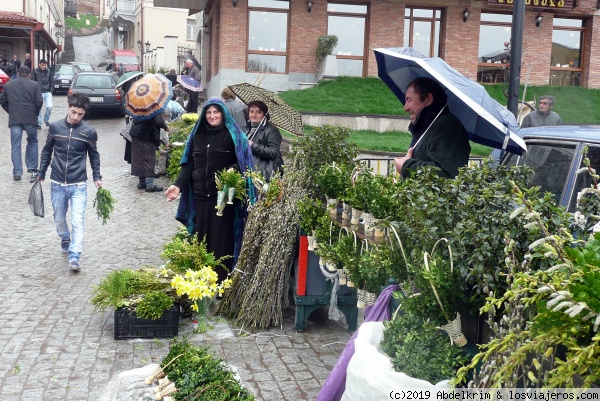
We stroll down Rustaveli Avenue, the city's main boulevard since the Tsarist era, lined with buildings from different periods. We also come across the Kashveti Church ("of the stone"), whose name derives from a remarkable ancient legend: a 6th-century monk was accused by a nun of having made her pregnant; as punishment for her slander, the woman ultimately gave birth to a stone. The current building dates from 1910 and the vestibule contains murals depicting the sacking and burning of the city by Arab warriors. Preparations are under way for Paska (the Orthodox Easter, whose calendar coincides with our Holy Week); today is the eve of Palm Sunday and at the church doors there are many people selling boxwood branches and other plants.

After lunch we meet Antonio, a young man from Madrid who has married a Georgian woman and lives in Tbilisi. He takes us to see the Tsaminda Sameba Cathedral (Holy Trinity), the largest and most modern church in Georgia. The cathedral is packed with people for Paska and we can barely move, so we leave it for another day. We visit one of the parks high up on the hills surrounding Tbilisi, then head to a restaurant with a folkloric atmosphere.
Watching the neighboring tables we begin to understand the importance Georgians place on the toast ceremony: whenever a group sits down to eat, one person must assume the role of tamada, or toastmaster. The tamada calls for glasses to be filled and, when they judge the moment right, proposes a toast with a speech that can last several minutes; only when it is finished can the diners agree and drink. In the most traditional ceremonies, drinking is done from cow horns that must be drained in one go since they cannot be set down while still full. Toasting is only done with wine or something stronger; doing so with beer is considered completely inappropriate. Although by the end of the meal most of those present are likely to be drunk, the tamada will never forget to close proceedings with a solemn toast to family members and friends who have passed away.
Day 3: Old Tbilisi
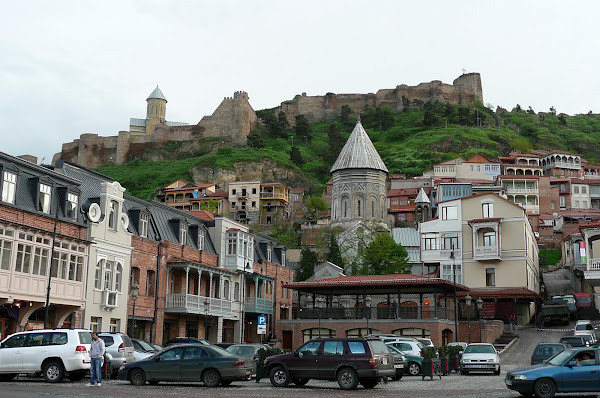
Antonio offers to drive us to Mtskheta, but the day dawns cold and very rainy, so we prefer to stay in the old part of Tbilisi. We cross the bridge to the Avlabari neighborhood, high on a promontory that commands the river from spectacular rocky cliffs. Here stands Metekhi Church, probably the oldest in the city; we don't manage to get in as it is completely packed with worshippers, but from the viewpoint we can see the whole old city: Narikala Fortress with its churches, the allegorical statue of Kartlis Deda (Mother of Georgia), and the cathedral.
We cross the river again and head straight to the ancient cathedral known as Sioni. Here the Cross of Saint Nino is venerated; it cannot be seen as it is kept inside, but it is believed to have been built by the saint from vine branches tied with her own hair, dating from the 4th century. There is a replica in the iconostasis that allows you to recognize the unusual shape of this cross, which is depicted in every church in the country. Georgian churches have no pews, which means many people can come in to listen to the religious chants and queue until a priest gives them his blessing.
We spend a pleasant while taking in the atmosphere in other ancient churches in the neighborhood, then go for lunch in the Marjanishvili area.
In the afternoon we decide to visit the baths. The name Tbilisi means "warm" and refers to the thermal waters that rise from underground. The bathhouses are concentrated in a central area called Abanotubani and are recognizable by the groups of domed structures resembling Turkish hammams. There are bathhouses with private rooms rented by the hour, but we go straight to the Orbeliani, the oldest establishment. This popular bathhouse has a curious facade decorated with tiles that imitates the mosques and madrasas of Uzbekistan, and among its illustrious past clients are the writers Alexander Pushkin and Alexandre Dumas (père).
We have dinner near City Hall and enjoy a drink at a venue offering live jazz, Café Kala, on Erekle II Street.


Day 4: Tbilisi and excursion to Davit Gareja
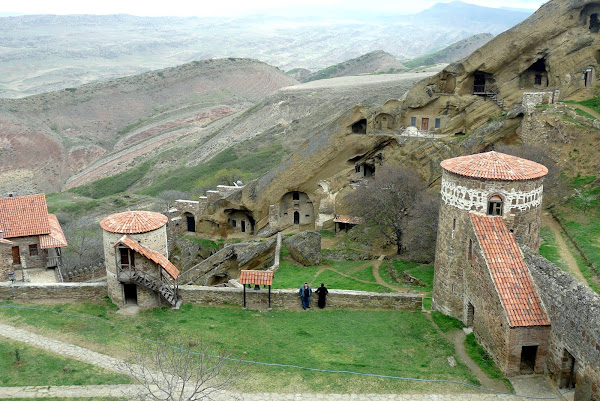
It is drizzling again, but today we venture out for a long excursion to the Davit Gareja caves. We take the Metro to the Didube bus station, but after asking everywhere we cannot find any shared transport and opt to hire a taxi (80 GEL).
Davit Gareja is a complex of monasteries founded in the 6th century by Syrian monks who carved many caves into the mountain's hillside. The main element is the Lavra monastery, which preserves original caves and the tombs of some of its founders. Around it other structures, walls, and defensive towers were built over time. This complex was destroyed several times by Muslim invaders and during the Soviet era lay uninhabited, but after independence it was reoccupied by a monastic community. The monks have reserved quarters and from outside you can hear them chanting and praying. It is a beautiful site in a harsh, almost desert landscape, with barely any trees.
We climb a steep slope to the ruined ancient monastery of Udabno. The ascent is a little tough but well worth it for the views: from the top you can see vast grasslands that are Azerbaijani territory. Amid the rocky chaos you can still make out many remnants of murals depicting Biblical scenes.
On the way back we become aware of the immensity of these almost deserted plains; we see only a few isolated flocks. It is a border zone and it is wise to find out the current situation before visiting.
Back in Tbilisi we spend the afternoon walking around Narikala Fortress up to the Mother of Georgia sculpture and discovering other historic buildings in the old quarter.
Accommodation and food in Tbilisi
In Tbilisi we stayed every night at Hotel David. We booked by email and it cost €60 per night including breakfast. The rooms are spacious and very clean; ours faces the street but at night the traffic stops completely and there is no noise at all; moreover the à la carte breakfast is quite good and they serve the best Turkish-style coffee I have ever had.
Restaurants are plentiful and come in various styles. Exploring different areas we found places where the food was good. But our favorite turned out to be one of the popular restaurants in the basement of a side street near City Hall; these places serve wine by the jug (in large pitchers), a variety of salads and cold cuts, khinkali (large dumplings filled with meat and onion), shaslik (Caucasian-style meat skewers), and so on — all quite good and cheap. For a quick snack there is nothing better than khachapuri, cheese breads baked in the oven that you find everywhere; the best are bought fresh from the bakeries that are still common in the old city.


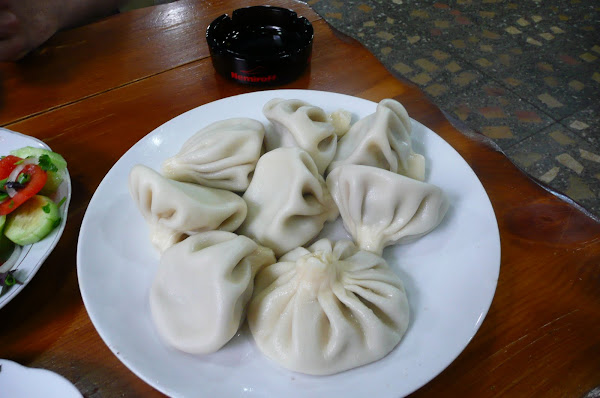
Typical starters: beef tongue, eggplant, salad… and the famous khinkali.
Day 5: Tbilisi – Mtskheta – Telavi
It is a sunny day and Antonio comes to pick us up at 10:00 to drive us to Mtskheta, about 20 km away.
Mtskheta is the spiritual heart of Georgia since the time of the conversion of the country's kings, back in the 4th century, when it was already the capital and they decided to build the first cathedral, known as Svetitskhoveli ("The Living Pillar"). The origin of the site's holiness is explained by a legend in which a 1st-century Jew named Elioz returned from a pilgrimage to Jerusalem bringing with him the sacred robe that Christ wore before the crucifixion. Elioz's sister Sidonia was so moved upon seeing the relic that she embraced it tightly and died. It proved impossible to remove the robe from the hands of the deceased, so they buried her just as she was; and when King Mirian decided to build the cathedral on the site of the burial, Saint Nino performed another miracle after a night of prayer: the wooden pillar rose up and moved until it settled in exactly the right spot.
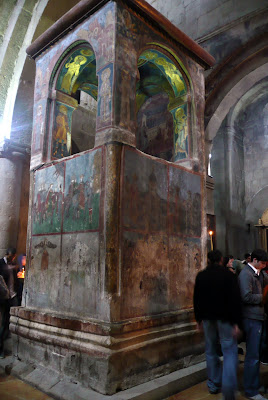
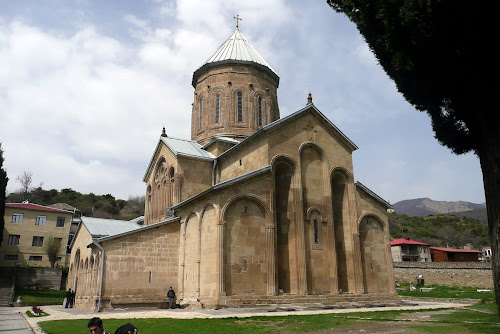
The current church is built in stone and dates from the 11th century; it is undoubtedly one of the most beautiful and grand in Georgia and is very busy at Easter time. It is well worth taking a close look at the interior decoration, which preserves very old frescoes and stone reliefs. While we are strolling around the outer courtyard there is a small commotion and we see a procession of black cars arrive. An elderly, stooped man dressed in black steps out and makes his way, escorted by clergy and bodyguards, between two long rows of faithful seeking his blessing: it is Ilia II, Patriarch of the Georgian Orthodox Church.

Thanks to having a car we also visit the other great monument of the city: the Jvari ("Cross") monastery, perched on a hill that can only be reached by a long footpath or a very winding road.
For many Georgians, Jvari is even more sacred than the cathedral in the village below, because on this hill, visible from the entire broad valley of the Mtkvari River, Saint Nino herself planted a large wooden cross. What stands there today is a stone church adorned with a few icons and tended by a handful of monks; the views are breathtaking, not only over the valley but reaching as far as the snow-capped peaks of Kazbegi, another of Georgia's great tourist attractions.
Saint Nino is a figure in whom history and legend merge; she is said to be a relative of Saint George, and although he is the official patron of the Georgian Church, in practice devotion to the saint is far more widespread and Nino is the most common name among women in Georgia.

We are eager to move on and discover other regions of the country, so we return to Tbilisi and stop for lunch in the Abanotubani area before heading to the Ortachala marshrutka station. There we say a temporary farewell to Antonio and board a minivan bound for Telavi, one of the cities of the Kakheti region, famous for its vineyards and wineries. The journey takes two and a half hours.
Accommodation and food in Kakheti
In Telavi we stayed at a guesthouse. The dormitory rooms were already taken (there are many Israeli tourists since Passover is a holiday there too) and what we were given was actually the living room, where beds had been set up. The room is decorated with antique furniture and filled with books, weapons, and other curious objects.
Day 6: Telavi – Sighnaghi
We get up early. Telavi was an important city in the past and still has a citadel housing a museum, but we don't stop because it opens late and we are keen to visit the monasteries of Alaverdi and Ikalto; we make do with the views of the Caucasus peaks visible from the park.
We take a marshrutka that drops us at the entrance to Alaverdi, which dates from the 11th century and was for a millennium the tallest church in Georgia (until the construction of Sameba in Tbilisi). The restoration of the building is well advanced and even today its elegant central dome, raised on a slender drum that gives it a height of 50 meters, is impressive. The interior of the church once contained magnificent frescoes, but at some point in history they were painted over in white and their recovery is now very difficult; the best preserved is a kind of altarpiece of Saint George on the outer wall of the porch. The monks oversee restoration work carried out by lay volunteers.
We try to get permission to visit the winery but have no luck, so we head outside to wait for another marshrutka that will drop us at the turnoff for the monastery-academy of Ikalto.
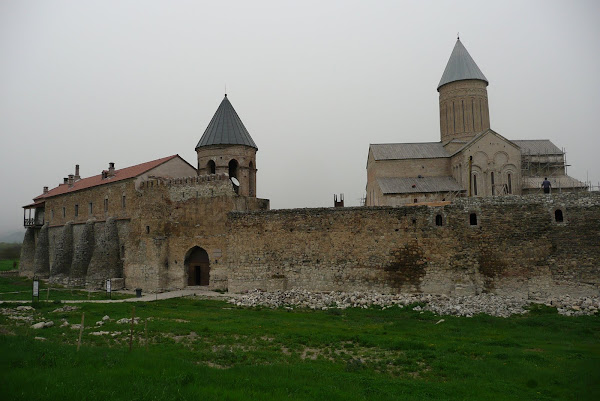
In addition to being a monastery, Ikalto was one of the academies founded by local kings (Kakheti had its own kingdom) to spread the philosophical doctrines associated with Christianity. The great national poet Shota Rustaveli, who lived in the 12th century, is said to have studied here. The complex is being restored and comprises the usual elements: a couple of churches, a winery, storehouses, and the building that housed the study rooms.
We hire a taxi (60 GEL) to take us to Gremi and Kvareli and then finish the day's stage in Sighnaghi, the other capital of Kakheti.
The city of Gremi was destroyed by the Persians in the 17th century and most of its rich heritage was lost, but the citadel, perched on a rocky hill, survived. The complex includes a church with 16th-century frescoes and a fortified palace, both very well restored.
In Kvareli the main attraction is the museum installed in the birthplace of the writer Ilya Chavchavadze. This figure lived in the 19th and early 20th centuries and is very important to local culture, though he has rarely been translated into other languages. We visit the exhibition housed in a striking contemporary building, then see what remains of the old house: a defensive tower in the middle of the garden and a winery still used to produce wine during the annual September harvest festival.
These traditional wineries are known as marani and consist of a large vat where the grapes are trodden, with channels directing the must into large vessels buried in the ground known as qvevri. The fermentation of this juice — undestemmed, with skins included — is what still distinguishes the most traditional Georgian wines, a method declared Intangible Cultural Heritage by UNESCO.
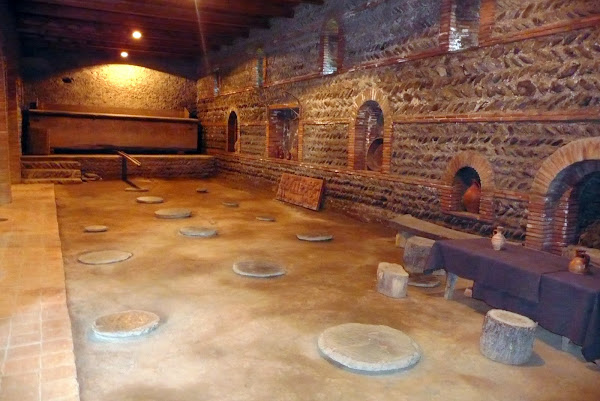
On leaving Kvareli we also visit the Kindzmarauli winery, one of the country's largest wine-producing facilities, occupying extensive tunnels carved into a hillside.
Accommodation and meals in Sighnaghi
Sighnaghi is a tourist hub and there are many hotels and guesthouses. We stay at the Zandarashvili family home, just a few meters from one of the town wall's gates. It is an old and somewhat run-down house, but very cozy and full of picturesque details. As soon as we unload our luggage we are called to the table, already occupied by other tourist couples. Dinner is delicious: the variety of salads and vegetable dishes is almost unlimited. The jugs of white and red wine are bottomless too, and the mischievous grandfather soon comes over to tempt us with a flask of chacha, the homemade grape marc spirit. This liquor is capable of flooring a herd of elephants, so tourists are easy prey — and sure enough we fall flat and don't stir until breakfast.
END OF PART 1 OF THE TRAVEL DIARY
You can continue reading the full diary on the Los Viajeros forum, where the text and photos were reproduced with the permission of Luis and Pilar.
If you have your own travel experience in Georgia and would like to share it with our readers, you can send it via this link.