
Shengavit Settlement
Շենգավիթ
Archaeological site from the 3rd millennium BC in Yerevan with remains of the Kura-Araxes culture and an on-site museum.
Location in the Caucasus
Description
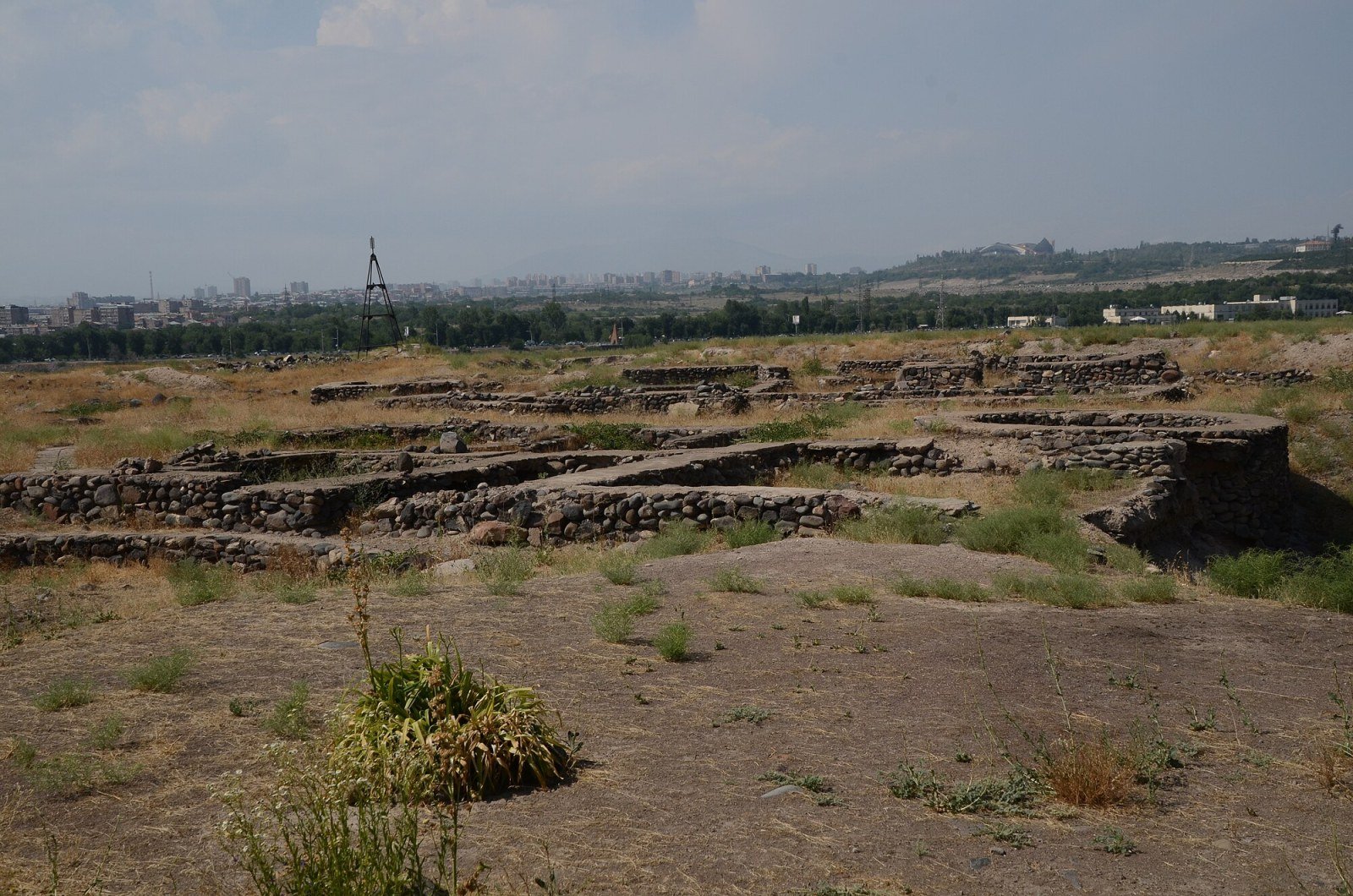
The Shengavit Settlement is located in a residential neighborhood in the southwest of Yerevan, and getting there already means crossing blocks of Soviet-era apartment buildings and quiet streets with little pedestrian activity. The site itself is an open expanse where stone and adobe walls from several millennia barely protrude above the level of the modern street. The scale is modest and honest: it's not Pompeii or Göbekli Tepe, but it has the virtue of showing archaeological work without filters or staging.
The adjacent museum holds objects recovered directly from the excavations at the Shengavit site: polished black clay ceramics with geometric motifs characteristic of the Kura-Araxes culture, flint tools, charred grain remains, and anthropomorphic terracotta figurines. The display cases are simple, the labels are in Armenian and English, and there is no café or shop on the premises. Natural light enters through narrow windows and gives the space a sober tone that suits its contents.
A complete visit takes between 45 minutes and an hour. For those interested in the prehistory of the Caucasus, the site proves more instructive than the History Museum of Armenia, where the same objects appear without spatial context. At Shengavit you can see exactly the ground where they were found, which gives each piece a different dimension.
History
The Shengavit Settlement was occupied between approximately 3200 and 2500 BC, during the Kura-Araxes culture, one of the first civilizations to spread across the entire southern Caucasus. Its inhabitants built circular and rectangular adobe dwellings on a hill overlooking the Hrazdan river. Excavations begun in the 1930s revealed a center of ceramic and metallurgical production with trade connections reaching Anatolia and Mesopotamia. Since then, Armenian and American teams have continued the work, making Shengavit one of the best-documented Bronze Age sites in the South Caucasus.
What to see & do
- Main excavation area The exposed walls allow you to read the succession of occupation layers and the floor plan of several Early Bronze Age dwellings. The stone foundations and adobe superstructures are clearly visible.
- Shengavit on-site museum Collection of polished black ceramics characteristic of the Kura-Araxes culture, together with flint tools, domestic animal bones, and everyday objects recovered from the site itself.
- Terracotta figurines and seals Small human and animal-shaped pieces that provide concrete clues about the ritual and symbolic practices of the community that inhabited Shengavit.
- Observation platform From the edge of the site, on clear days, you can make out the snow-capped profile of Mount Ararat, the same volcano that dominated the horizon for those who lived here five thousand years ago.
- Explanatory panels Next to the excavations there are signs in Armenian and English explaining the phases of occupation of the site and the building system of the Kura-Araxes culture dwellings.
Photo gallery
How to get there
The Shengavit Settlement is in the neighborhood of the same name, in the southwest of Yerevan. From the center you can reach it by metro to Shengavit station (line 1) and then about ten minutes on foot, or by taxi for around 500–700 drams. The site opens Tuesday to Sunday; closed Mondays. Entry is paid but inexpensive. From Zvartnots airport there is no direct public transport: the most practical option is to take a taxi to the center and connect with the metro.
Best time to visit
Being a largely open-air site, it is best to avoid days of heavy rain. Spring (April–May) and autumn (September–October) offer the most comfortable conditions, with temperatures of 15 to 22 degrees. In summer the sun beats down hard on the unsheltered expanse. In winter there may be mud or snow in the excavations, although the Shengavit indoor museum remains open.
More information
Photo: Wikimedia Commons · Public Domain