
Hayravank Monastery
Հայրավանք
9th-century Armenian monastery on black basalt on the southwest shore of Lake Sevan, with no ticket booths or tourist buses.
Location in the Caucasus
Description
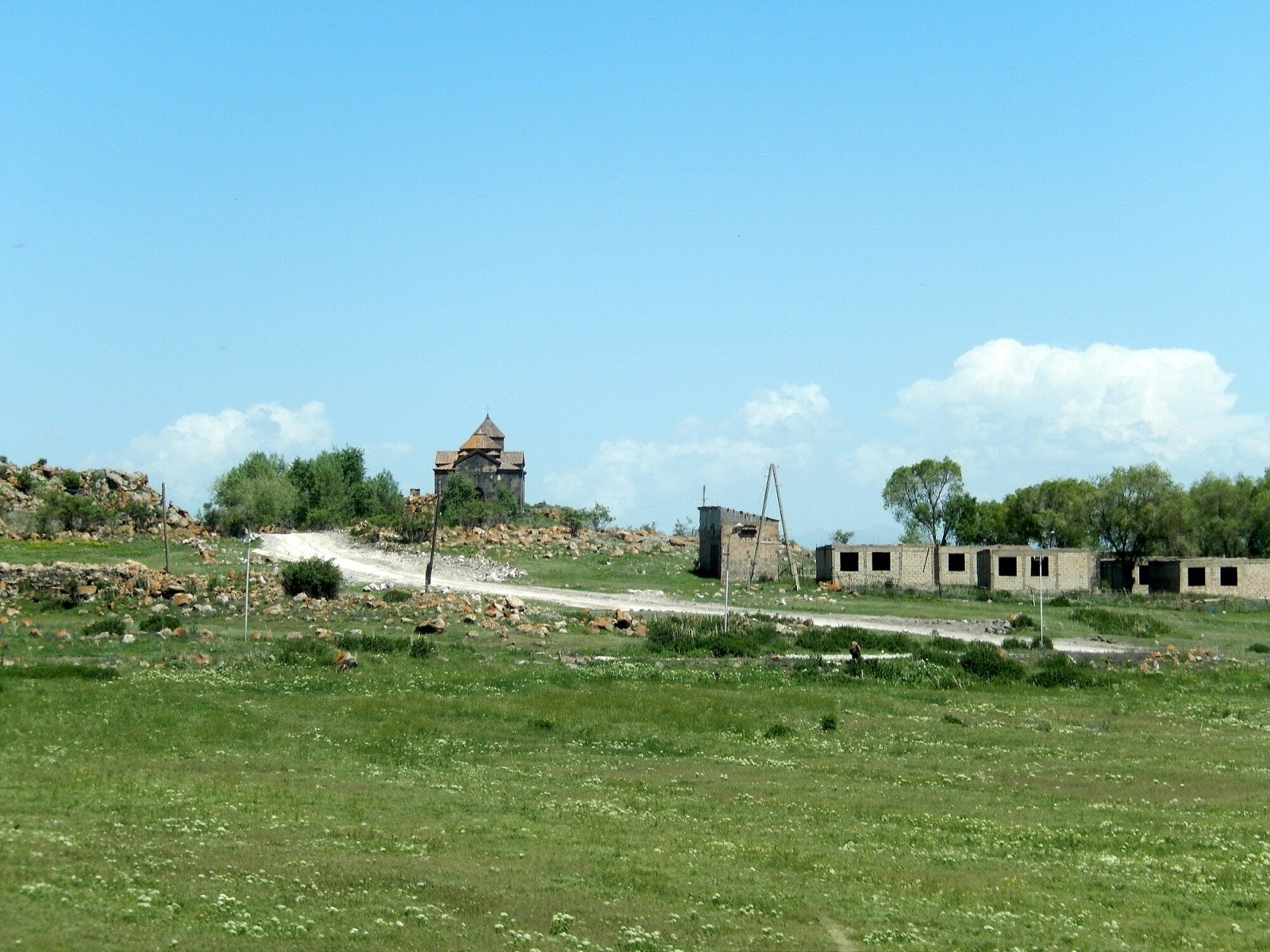
The turnoff from the M10 has no tourist sign, just a side track climbing between dry grass and a few bushes. On arrival, the first thing that breaks the horizon is the dark silhouette of the Church of Saint Stephen above Lake Sevan: barely worked blocks of black basalt, as if the building were a natural extension of the volcanic promontory. At 1,900 metres above sea level, the wind blows almost constantly, and on clear days the lake water turns a blue that contrasts with the black of the stone.
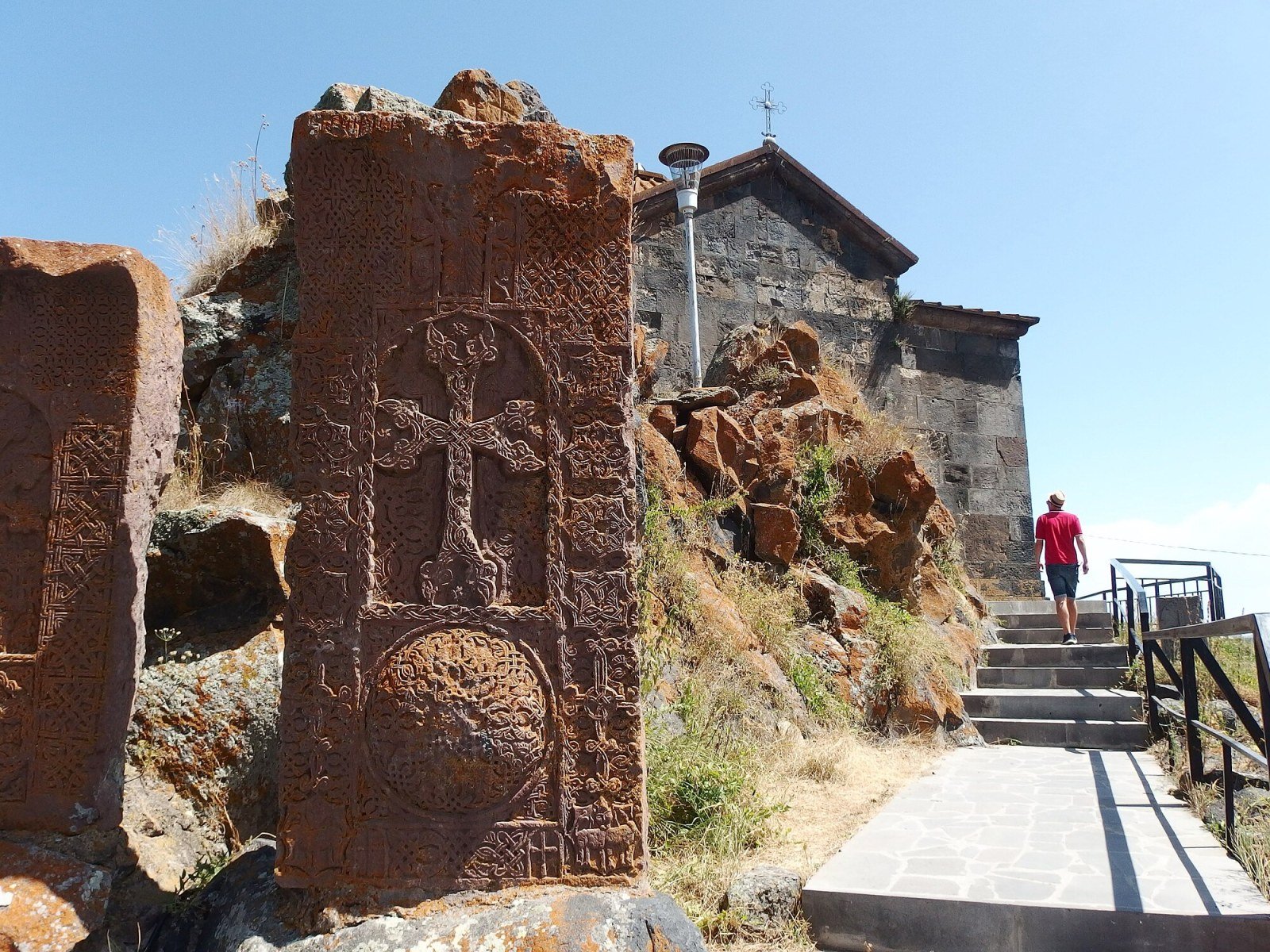
Climbing the steps towards the gavit you pass between khachkars — stelae with carved crosses — covered in moss and orange lichens. Some have well-preserved reliefs; others have slowly dissolved into the rock until they are almost abstract shapes. Inside the narthex, light enters through narrow windows and when the sun shines directly it forms beams that cross the interior of reddish and grey tuff. The silence is real: only birds, wind and, sometimes, a car coming up from the village of Hayravank.
There is no entrance fee, no shop, no permanent staff. Compared to Sevanavank, which receives buses from Yerevan, this place allows you to spend half an hour on the rocks looking at the lake without meeting anyone. The terrain is uneven and the stones become slippery with the morning mist, so closed footwear is advisable.
History
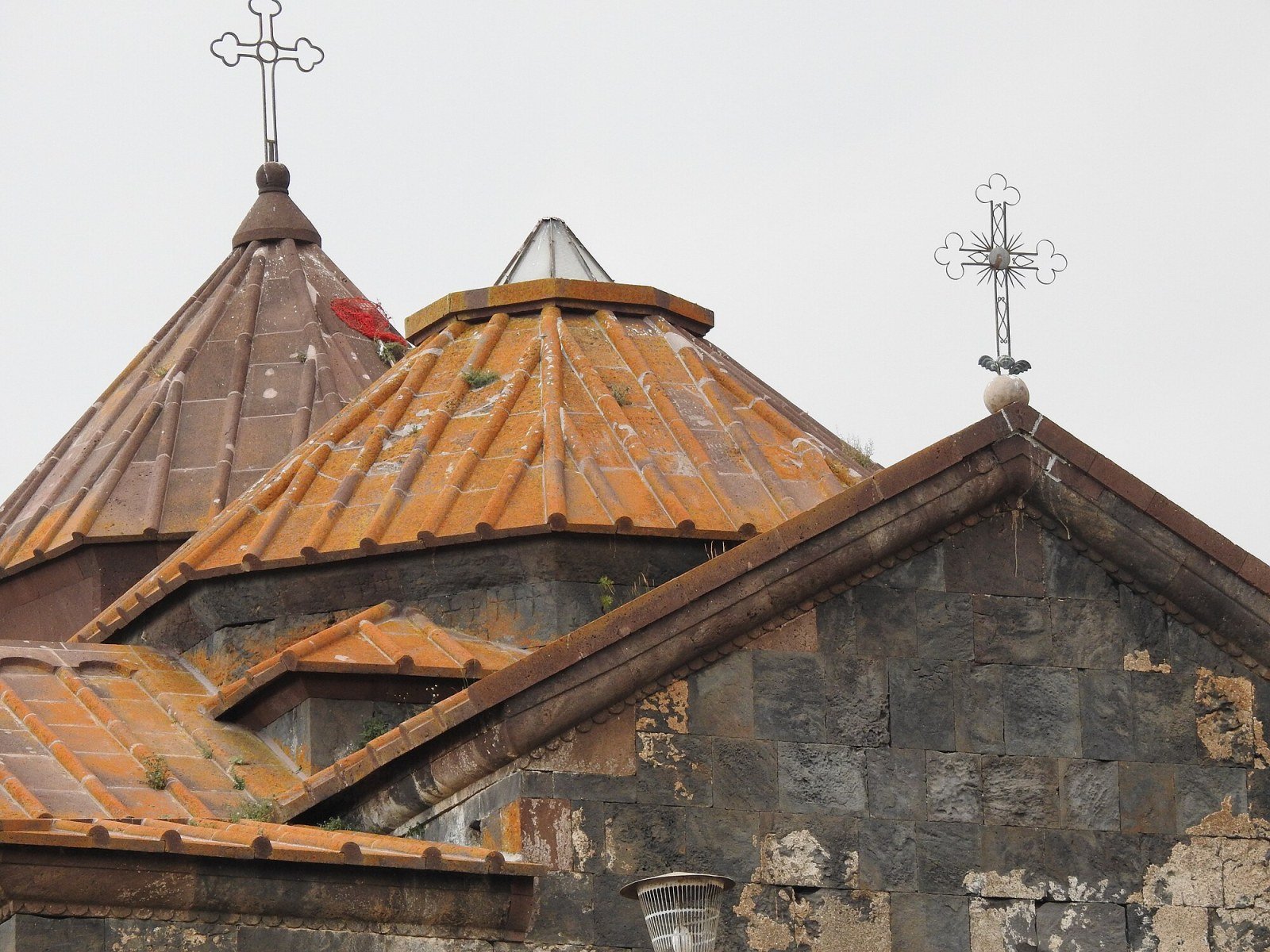
Hayravank Monastery was built in the 9th century, during the recovery of Armenian power after Arab domination. The Church of Saint Stephen has a cruciform plan with four semicircular apses that read from outside as continuous curves — an unusual solution in Armenian architecture of the period. In the 10th century a side chapel was added. In 1211, two monks, Hovhannes and Nerses, completed the gavit with its octagonal dome of bicoloured masonry — red and grey tuff — one of the first examples of polychrome stonework that later became widespread in the country. A few metres northwest of the complex, walls of an earlier fortress survive, with sections dating back to the Bronze Age.
What to see & do
- Church of Saint Stephen (9th century) The oldest structure. Its four rounded apses are visible from outside, and the dome restored in the 1980s recovers some of the original proportions. The interior is bare stone, with no painted decoration.
- Gavit (1211) The narthex attached to the west, built by monks Hovhannes and Nerses. Two thick columns support an octagonal dome with tuff in a red-and-grey chequerboard pattern. An oculus at the apex projects a circle of light onto the floor.
- Khachkars and cemetery Scattered around the complex. The oldest khachkars have reliefs worn down by water; more recent ones show highly detailed crosses. The contrast between the orange lichen and the dark basalt is one of the visual highlights of the site.
- Views of Lake Sevan From the rear of the monastery, Lake Sevan stretches east and southeast. At sunset the water shifts from deep blue to metallic grey tones.
- Ruins of the cyclopean fortress About five minutes' walk to the northwest, Bronze Age and Iron Age wall remains confirm that this shore was inhabited long before the first monks arrived.
Photo gallery
How to get there
Hayravank Monastery is about 100 km from Yerevan: motorway M4 to Sevan, then the M10 south along the lake for about 22 more km. There is no direct public transport; the usual options are a private car, a taxi from Sevan or an organised tour. The visit combines well with Sevanavank to the north and the khachkar cemetery at Noratus, a few kilometres to the southeast. Free entry, no fixed opening hours.
Best time to visit
May and June offer the greenest surroundings and temperatures of 15–22 °C. July and August are warmer and windier; the nearby beach area picks up, but Hayravank stays quiet. September and October bring ochre tones and fewer visitors. In winter, access depends on road conditions and temperatures are genuinely cold at 1,900 metres, though the snow-covered landscape has its own appeal.
More information
Photo: Palickap · CC BY-SA 4.0