
Goshavank Monastery
Գոշավանք
12th-century monastic complex in the Tavush forest, with intricately carved stone khachkars and free entry. Near-guaranteed silence on weekdays.
Location in the Caucasus
Description
Goshavank Monastery stands in the village of Gosh, in the Tavush region of northeastern Armenia, about 20 km from Dilijan. The complex sits at the edge of a dense beech and oak forest; on weekdays there is likely no other visitor in the compound. The air smells of damp wood and ancient stone, that scent left by Armenian monasteries deeply embedded in the forest, especially after rain.
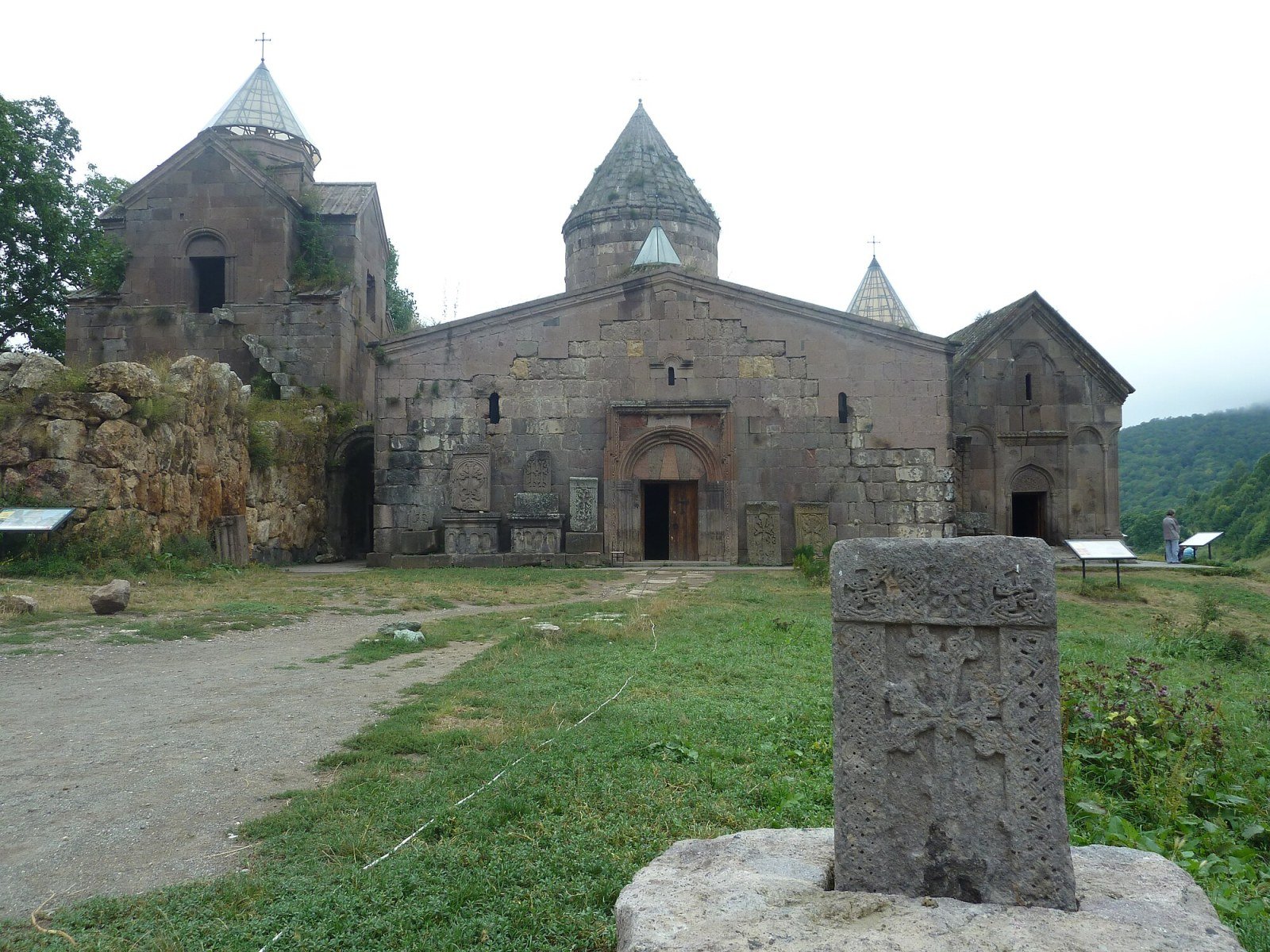
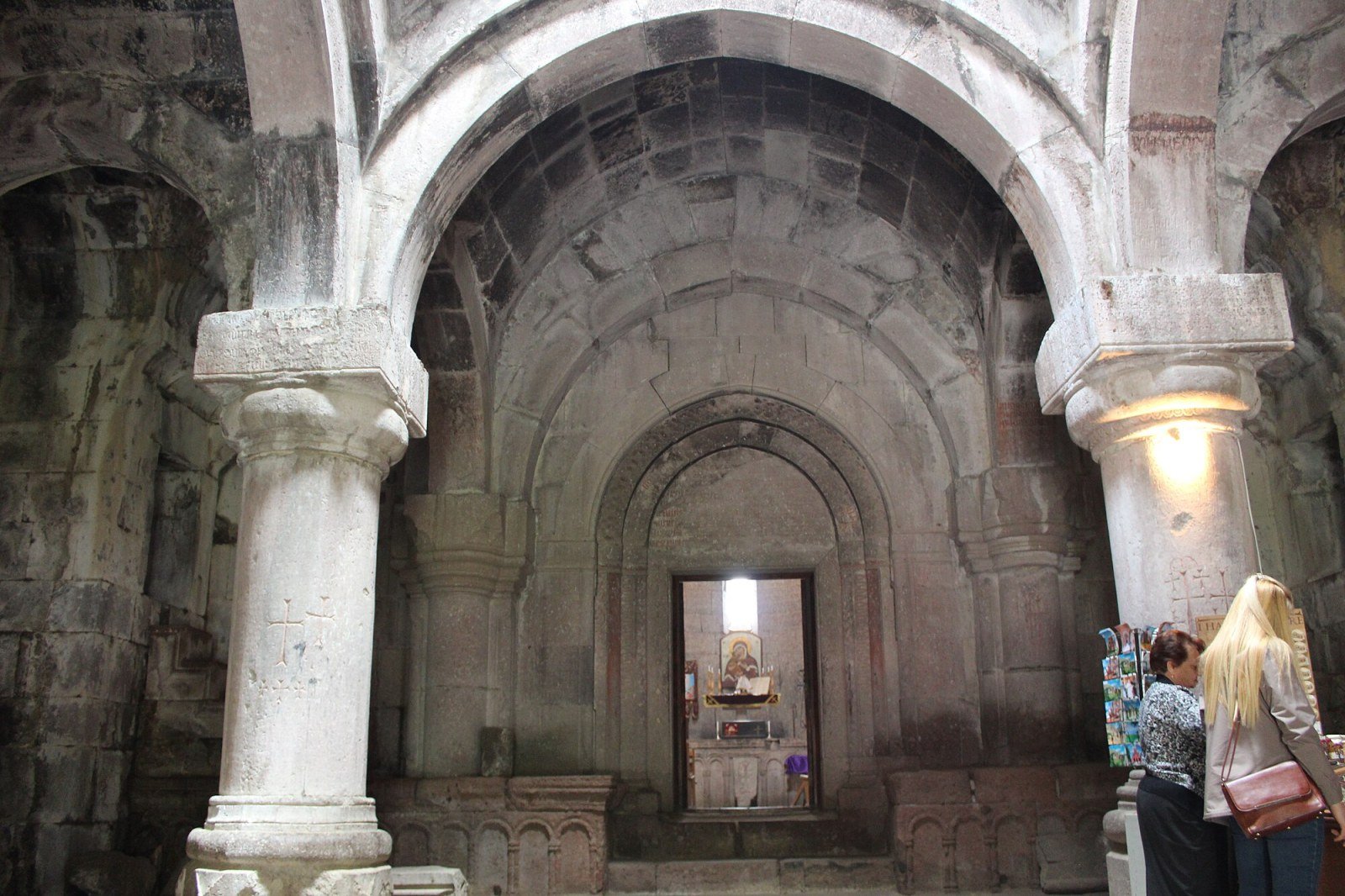
The layout is compact: three churches of different sizes grouped around a gavit — a column-covered porch — from the 13th century. The Goshavank Gavit combines geometric motifs with animal figures in its arches. The khachkars on the exterior deserve careful observation: there are examples at various stages of elaboration, from simple forms to the late-school ones with extraordinarily precise stone lacework. The most celebrated khachkar, carved by master Poghos in 1291, stands in front of the smaller church; its tracery recalls textile carving. The interior walls of the churches contain fragmentary frescoes; bare, unadorned stone predominates.
The village of Gosh is small, with barely a thousand inhabitants. A few houses offer accommodation and home-cooked meals. The road up from Dilijan is mostly paved and passable year-round, though after heavy rain the unpaved stretches can become muddy. Entry is free, as is the case at most Armenian historical monuments.
History
Mkhitar Gosh, monk, jurist, theologian and writer, founded the monastery in 1188 with the support of Prince Ivane Zakaryan. The Datastanagirk, the first medieval Armenian legal code, was his work and became a legal reference for centuries. Goshavank prospered as a top-tier academic centre: during the 13th century it was one of the intellectual hubs of the Armenian Caucasus. Its halls taught law, philosophy, writing, manuscript illumination, Greek and Latin. After Mkhitar Gosh's death in 1213, both the monastery and the village adopted his name. Mongol invasions and subsequent instabilities reduced the community. Modern restorations (1957–1966 and later) have consolidated the main buildings.
What to see & do
- Church of the Holy Mother of God (Surb Astvatsatsin) The largest in the complex, built between 1191 and 1196, with a round-drum vault and the gavit attached to the west. The interior has solemn proportions; fresco fragments remain in the apse. It is a canonical example of medieval Armenian architecture.
- 13th-century Gavit A covered porch with columns whose arches combine pure geometric motifs with carved animal figures. The structure conveys its dual function as narthex (liturgical entrance) and assembly hall.
- Lace-work Khachkars The stone crosses are the main reason to visit. The khachkar of Poghos (1291) in front of the smaller church is an extraordinary work of tracery; others from the same period adorn the outer walls. The contrast between plain and ornate khachkars shows the technical evolution over a century.
- Church of St Gregory (Surb Grigor) Next to the main church, built in 1231 in dark basalt, which contrasts with the sandstone of the rest of the complex. Compact architecture with windows strategically oriented towards the exterior khachkars.
- Church of St Gregory the Illuminator (Surb Grigor Lusavorich) The smallest church, from the 13th century, with ornamental decoration on its outer walls and considered a gem by locals. The original khachkars flanked its entrance; one was transferred to the History Museum of Armenia in Yerevan.
- Two-storey library-belfry Built in 1241 (library) and reinforced in 1291 (belfry), it contains niches for storing manuscripts. Academic-type architecture, similar to that of Haghpat.
- Forested surroundings of the Tavush region The forest around the monastery changes dramatically with the seasons. In autumn, oaks and beeches turn orange and gold, creating a dramatic contrast with the grey stone. The Dilijan Nature Reserve protects this area; 3 km away, Gosh Lake is a secondary destination reachable on foot, a serene forest lagoon.
Photo gallery
How to get there
Goshavank is 20 km north of Dilijan along a road that winds up through the forest. From Dilijan take a taxi to Gosh (around 15–20 minutes; typical fare 3,000–5,000 drams). Dilijan has regular marshrutka (shared minibus) connections to Yerevan (about 2 hours; ~1,000 drams / €2–3). From Yerevan, a private taxi costs around 12,500–18,500 drams (approx. €26–38). Those visiting Lake Sevan, Haghartsin monastery or Haghpat can combine Goshavank on the same or a nearby day.
Best time to visit
Spring (April–May) and autumn (September–October) are ideal: the Tavush forests display intense colours and temperatures hover around 15–20°C. Summer is cooler than the rest of Armenia (20–25°C), making it comfortable. Winter brings snow; the road can be cut off for days after a storm. The monastery remains accessible, but getting there without a vehicle with suitable tyres is difficult.
More information
Photo: Pandukht · CC BY-SA 3.0