
Matenadaran
Մատենադարան
The great repository of Armenian manuscripts in Yerevan: over 23,000 medieval codices with illuminations that have remained intact for centuries.
Location in the Caucasus
Description
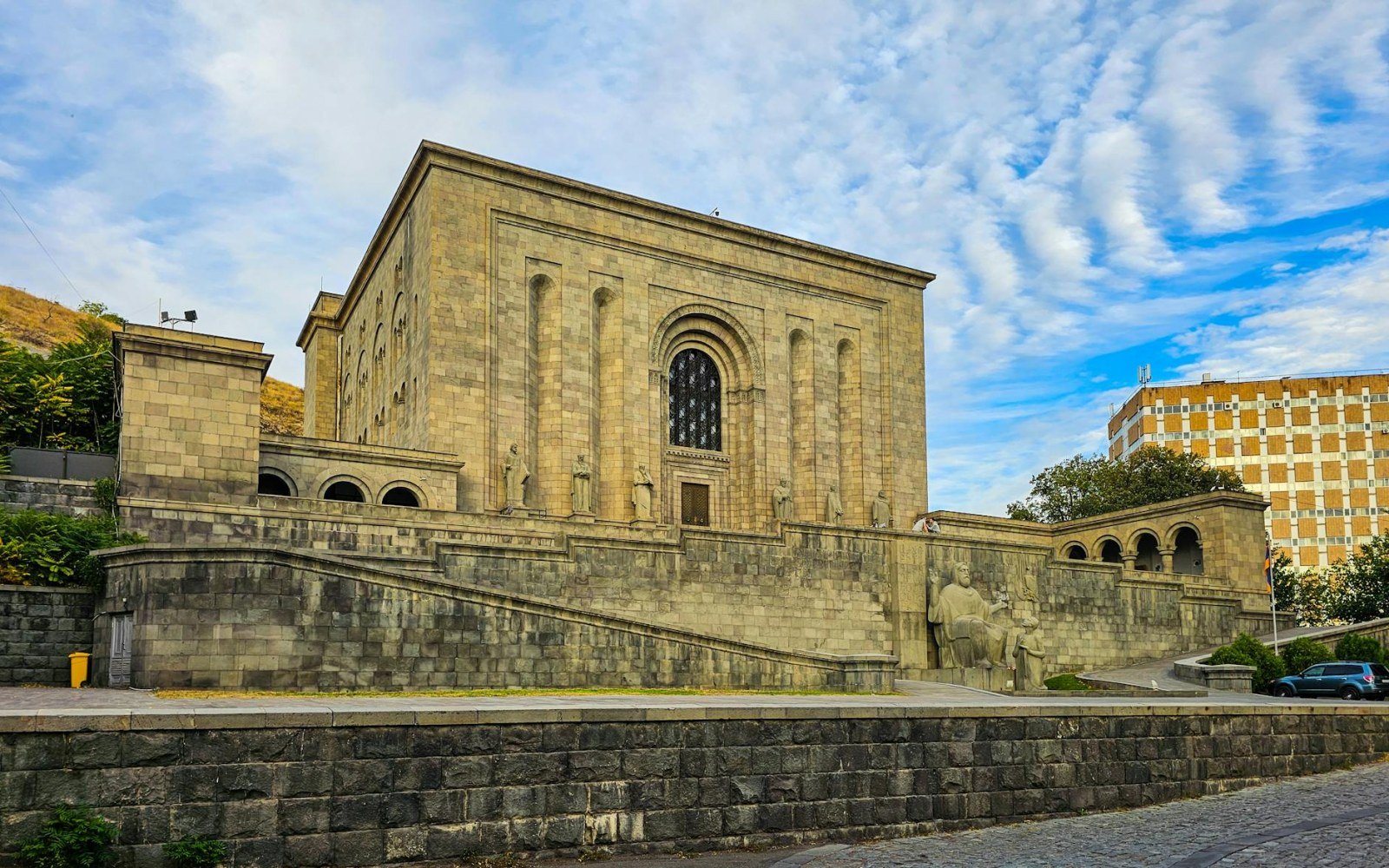
The Matenadaran stands at the northern end of Mesrop Mashtots Avenue, on a slight rise overlooking central Yerevan. The building, clad in pink volcanic tuff, has something of a secular temple about it: a wide staircase, figures of Armenian scholars in the facade niches, and a sense of weight before you step inside. Within, the air smells of old paper and the particular silence of well-kept archives.
The display cases in the permanent gallery hold gospel books with miniatures whose colours remain vivid after seven hundred years, astronomical calendars and medieval maps of the Caucasus. You don't need to read Classical Armenian to stand transfixed before them; the craftsmanship speaks for itself. An audio guide or a local guide adds context for pieces whose significance is not immediately obvious. The visit takes between one and two hours. The shop by the exit sells paper reproductions and books on medieval Armenian history of reasonable quality.
History
The word matenadaran means 'place of manuscripts' in Classical Armenian. During the Middle Ages, monasteries throughout the region kept their own collections, but Mongol and Ottoman invasions destroyed much of that heritage. The current repository was founded in 1959 as a Soviet research institute to centralise the scattered manuscripts that had survived. The collection includes texts in around twenty languages — Arabic, Persian, Greek, Syriac — in addition to Armenian, reflecting the role Armenian scriptoria played as centres of translation and transmission of knowledge in the medieval Caucasus.
What to see & do
- Permanent exhibition hall Around 60 rotating pieces among the most representative of the collection: illuminated gospel books, scientific treatises and historical documents. The selection changes partially each season.
- Mush Gospel A 13th-century codex of unusual dimensions — it weighs over 27 kilograms — with highly detailed illustrations. Its story of rescue and survival during the 1915 genocide is part of the museum's narrative.
- Works linked to Mesrop Mashtots The inventor of the Armenian alphabet in the 5th century has a central presence here, with copies of his works and documents on the creation of the writing system.
- Medieval cartography section Armenian and Arabic maps from the 12th to 15th centuries showing how the geography of the Caucasus and the Near East was conceived before modern cartography.
- Facade and exterior staircase The statues represent Mashtots and several medieval scholars. On clear days, from the top of the staircase you can see Ararat in the distance: worth going up even for a moment.
How to get there
The Matenadaran is at the end of Mesrop Mashtots Avenue, about a 20-minute walk from Republic Square. From Zvartnots airport you can reach the city centre by bus 116 or taxi (around 1,500–2,000 drams). The museum opens Tuesday to Saturday, 10:00–17:00; closed Mondays. Admission is approximately 1,500 drams. The audio guide in English is not always available; it is worth checking in advance.
Best time to visit
As an indoor museum, the time of year has little effect on the visit itself. In spring and autumn Yerevan's climate is pleasant for combining it with walks around the city. In summer, when street temperatures exceed 35 degrees, the cool interior is a welcome relief. In winter it can drop to -10 degrees outside, but the museum operates as normal.
More information
Photo: Uliana Denisova · Pexels License