
Makaravank Monastery
Մակարավանք
13th-century monastic complex amid the forests of Tavush, with a gavit covered in animal reliefs and an almost constant silence.
Location in the Caucasus
Description
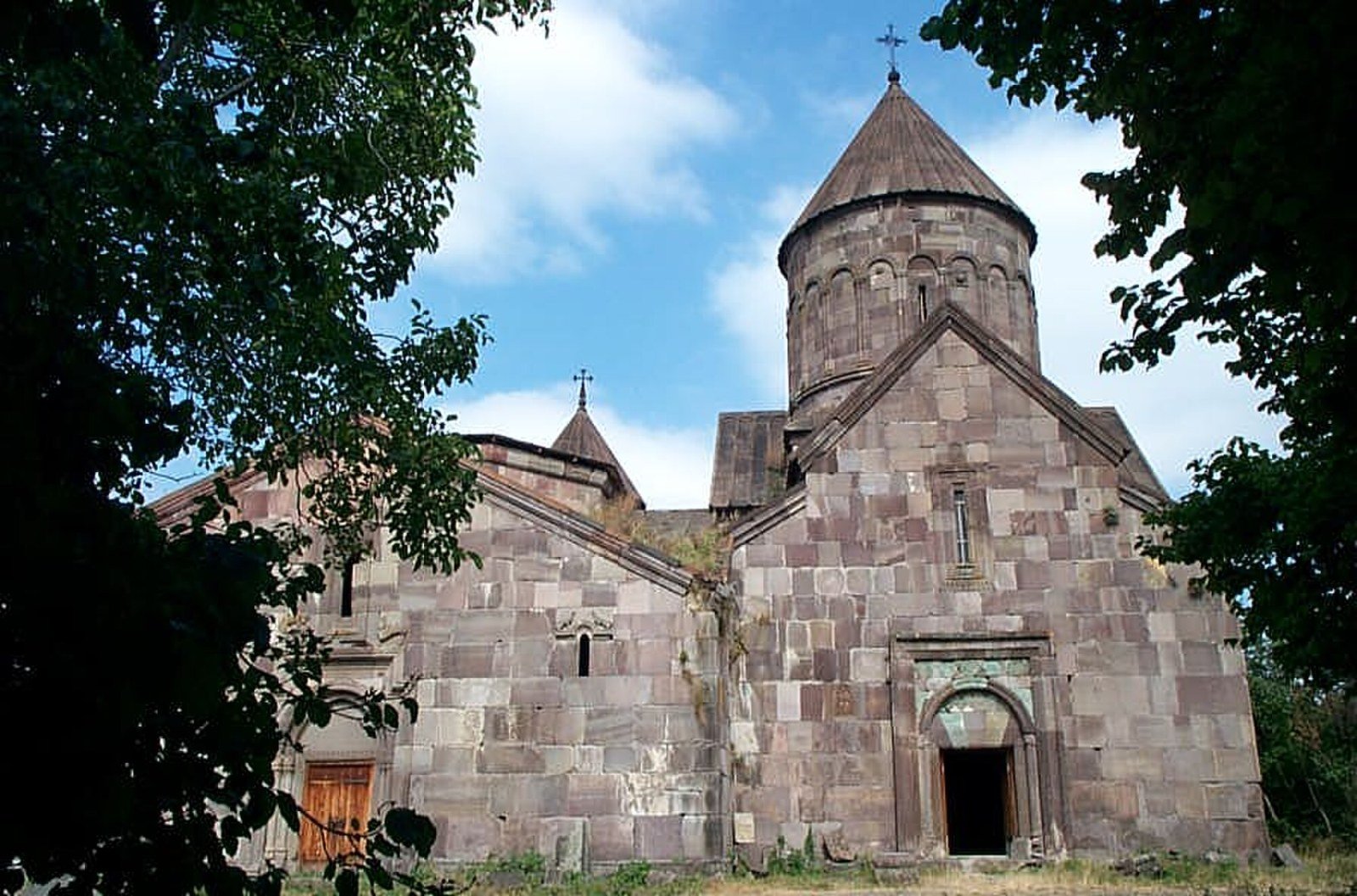
Makaravank Monastery sits on a forested hillside in the Tavush region of northeastern Armenia. Signposting from the main road is not always clear, so it is worth downloading the coordinates before leaving Ijevan. On arrival, the complex — three churches and a gavit (narthex) — appears among beeches and oaks, with moss growing on the stones of the ruined sections and birds audible constantly from inside.
What stops visitors most at Makaravank is the decoration of the gavit: the reliefs covering arches and walls show serpents, birds and lions intertwined with plant motifs. Some are well preserved; others have lost detail over the centuries. In mid-morning, the light entering through the dome windows casts oblique shadows on those friezes and makes it worth pausing before moving on.
There are no shops or restaurants near Makaravank Monastery. On most days the site is empty, or has a local group at weekends. It is worth bringing water, grippy footwear for the uneven ground and enough time to also walk the perimeter ruins, which give a sense of the original size of the complex.
History
Makaravank Monastery was founded in the 12th century and expanded mainly during the 13th century, during the golden age of the northeastern Armenian kingdoms. The reliefs of the gavit are the work of a local stone-carving school that flourished in Tavush during that period, with a distinctive decorative vocabulary combining Georgian and Persian influences with the Armenian architectural tradition. The complex was active until the 17th–18th centuries and fell into partial abandonment afterwards; minor restorations were carried out in the Soviet era and, more limitedly, in recent decades.
What to see & do
- Gavit with animal reliefs The narthex is the most elaborate part of the complex: friezes with serpents, birds and lions run along the arches in a style that blends Christian iconography with Oriental motifs, characteristic of the 13th-century Tavush school.
- Main church The central nave has the classical proportions of medieval Armenian religious architecture; several khachkars (carved stone crosses) are integrated into the exterior and interior walls.
- Perimeter ruins Parts of Makaravank Monastery are in partial ruins covered in moss and vegetation. Walking through them gives a sense of the original size of the complex and reveals scattered architectural details among the grass.
- Beech and oak forest The forest surroundings are part of the visit: the canopy is dense, the ground always damp, and in autumn the leaf colours contrast with the dark stone of the building.
Photo gallery
How to get there
Makaravank Monastery is about 160 km northeast of Yerevan, near the town of Ijevan. From Yerevan there are marshrutkas to Ijevan (about 2.5 hours); from there you need a taxi to reach the monastery (20–30 minutes along a forest road). By private car from Yerevan it is about 2 hours along the M4 highway. It can be combined in the same day with Haghartsin Monastery and Goshavank, both in the same region.
Best time to visit
Spring (May–June) and autumn (September–October) are the best times to visit Makaravank Monastery: the Tavush forest is at its most spectacular and temperatures are pleasant. Summer is warm but cooler than in central Armenia. In winter there may be snow and the access road can be in poor condition. The reliefs of the gavit are best appreciated in the lateral morning light.
More information
Photo: Raffi Kojian · CC BY-SA 3.0