
Lake Kari
Քարի լիճ
Glacial lake at 3,200 m on the slopes of <strong>Mount Aragats</strong>, accessible by car in summer and starting point for the highest peak in Armenia.
Location in the Caucasus
Description
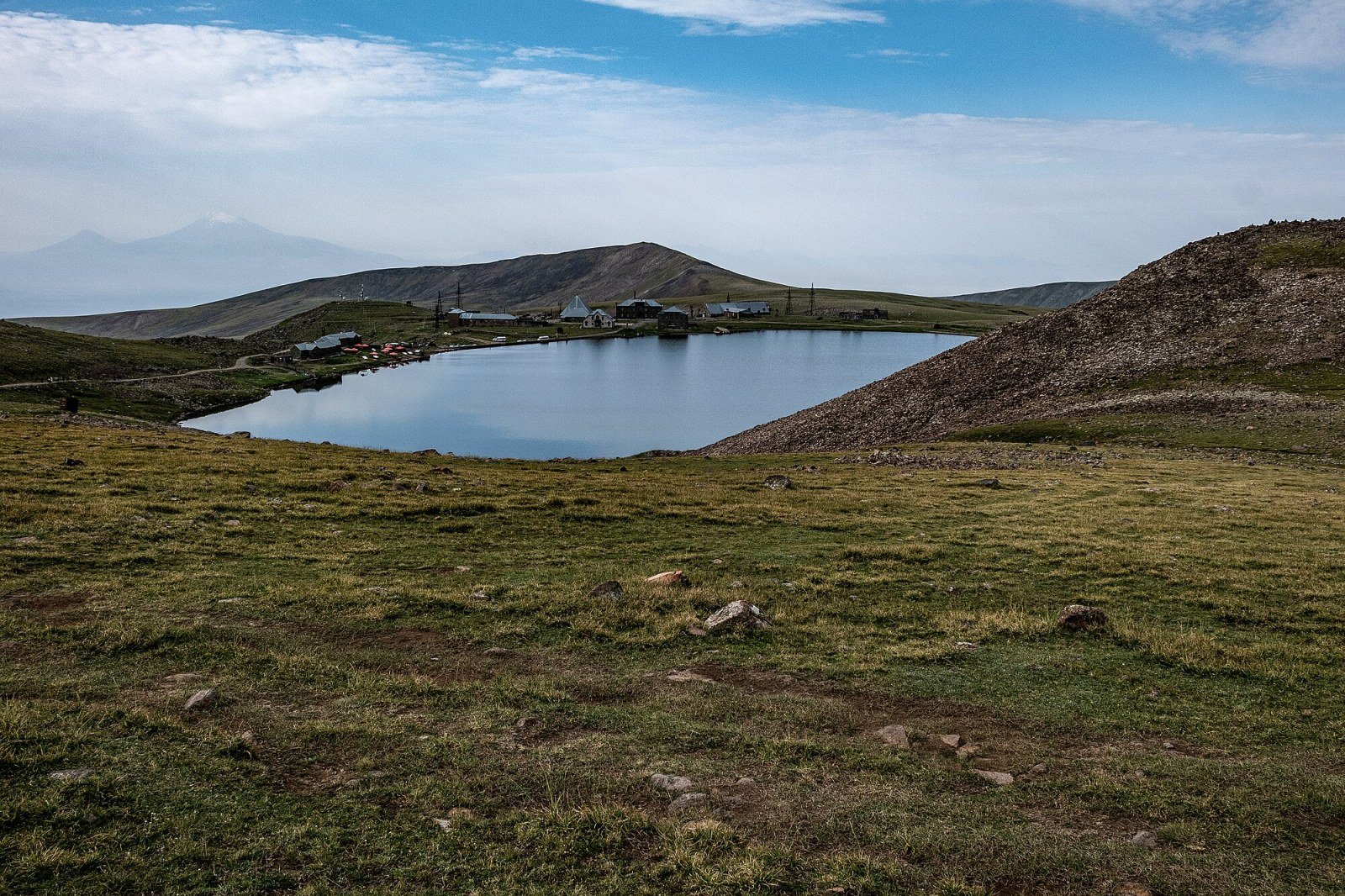
Lake Kari appears suddenly when the road climbing from Aparan makes its last bend: a slate-coloured mirror of water set between slopes of black lava, not a tree in sight, with the quadruple profile of Mount Aragats cutting the sky. The temperature drops ten degrees compared to the valley floor and the wind arrives without warning. The silence, when the wind drops, is almost unsettling.
The lake sits at just over 3,200 metres above sea level, next to the Cosmic Ray Research Station, a Soviet scientific facility that is still operational. Getting here requires no hiking: the road reaches the very shoreline, making it one of the most accessible high-mountain points in Armenia. Even so, the altitude is noticeable: those who come directly from Yerevan may feel some light-headedness during the first hour.
The water changes tone throughout the day, from the greyish green of the morning to the metallic blue of midday, with golden reflections if there is afternoon sun. The shores are stony and in June the slopes below the lake are covered in alpine flowers that contrast with the volcanic rock. There is no significant tourist infrastructure near the lake: a few parked cars, the occasional group with tents in summer and the buildings of the scientific station. The simplicity of the surroundings is part of what makes it worth staying longer than planned.
History
Mount Aragats is an extinct stratovolcano that has dominated the horizon of central-northern Armenia since prehistoric times. Bronze Age settlements and petroglyphs have been found on its slopes, suggesting a ritual significance for the ancient populations of the region. In medieval times the area was part of the territories controlled by the Pahlavuni family. During the Soviet period, the altitude and clear skies of Aragats attracted scientists: in the 1940s the Cosmic Ray Research Station was built beside Lake Kari, dedicated to the study of cosmic rays and solar phenomena. Some of its instruments remain active today.
What to see & do
- Lake Kari The lake itself, with its shifting tones between slate green and metallic blue depending on the time of day. It is worth staying at least an hour to watch how the light changes over the water and the volcanic slopes.
- South summit of Aragats (3,879 m) — The most accessible of the four peaks of Aragats: around 3–4 hours of hiking from the lake over stony terrain, no climbing technique required. The path is clear but the wind can be intense.
- North summit of Aragats (4,090 m) — The highest point in Armenia. Around 5–6 hours from Lake Kari; requires good physical fitness, solid warm clothing and attention to afternoon thunderstorms, which are common in summer.
- Cosmic Ray Research Station The Soviet scientific research facilities beside the lake. They can be seen from outside and provide historical context; the staff occasionally allow visitors to approach the instruments.
- Alpine meadows of Aragats In June and early July the slopes below the lake are carpeted with wildflowers. The contrast with the black volcanic rock is one of the most distinctive features of the Aragats landscape.
Photo gallery
How to get there
Lake Kari is about 100 km north of Yerevan, approximately 2 hours by car. There is no direct public transport: the usual option is to rent a car or hire a taxi from Yerevan or from Aparan, the nearest town with services. The road is paved but the last few kilometres have sections in poor condition; a vehicle with good ground clearance is recommended.
Best time to visit
The access road is open approximately from June to October; for the rest of the year snow makes it impassable. July and August are the busiest months, with temperatures of 10–18 °C at the lake. June is the best time to see the alpine flowers. Nights are cold even in midsummer and afternoon thunderstorms are frequent: it is advisable to bring warm clothing and set out early if planning to climb Aragats.
More information
Photo: Doğancan Eker · Pexels License