
Odzun Church
Օձունի եկեղեցի
5th-century Armenian basilica on the Lori plateau, with black basalt stelae in the atrium and views over the Debed River valley.
Location in the Caucasus
Description
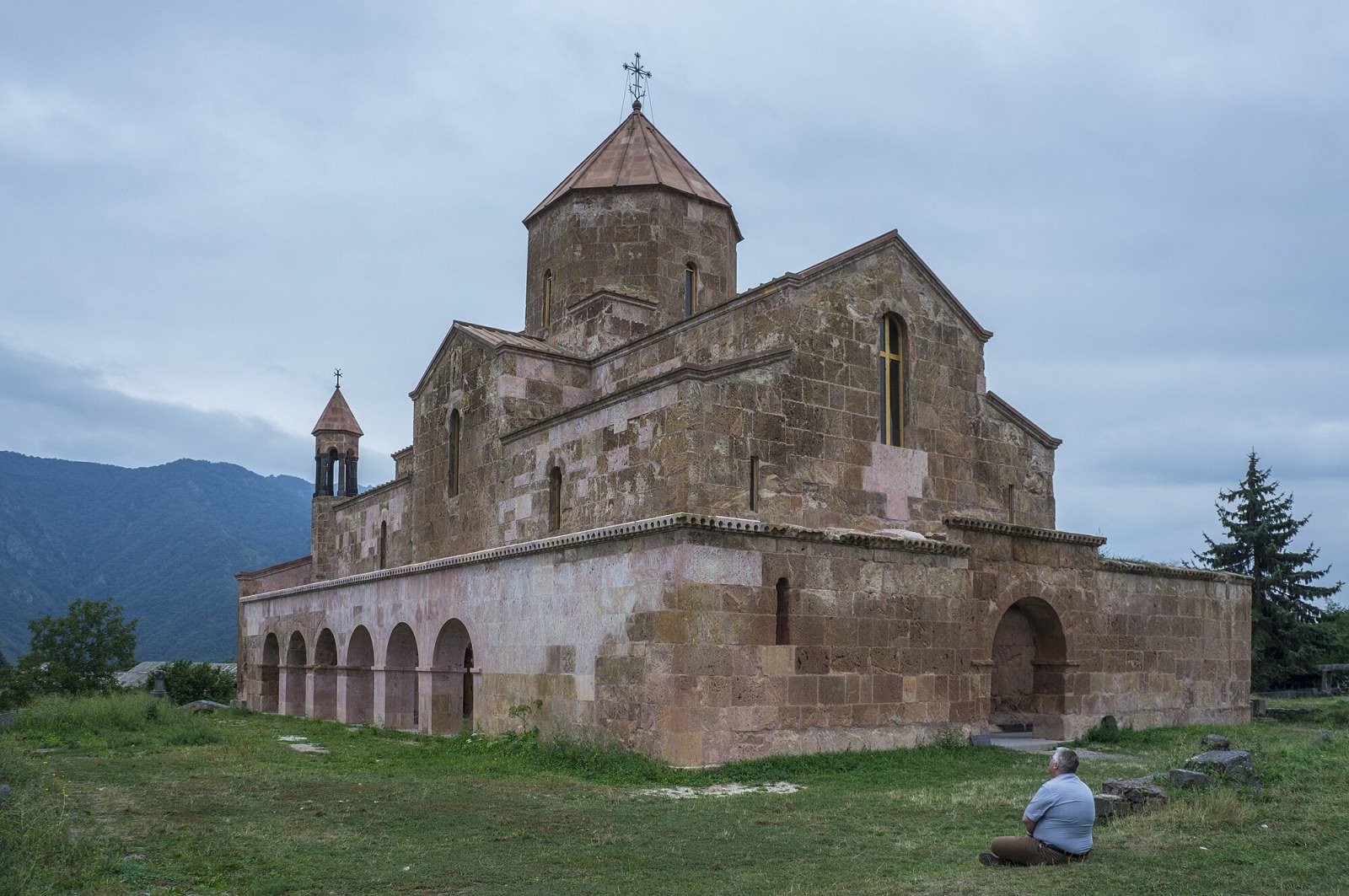
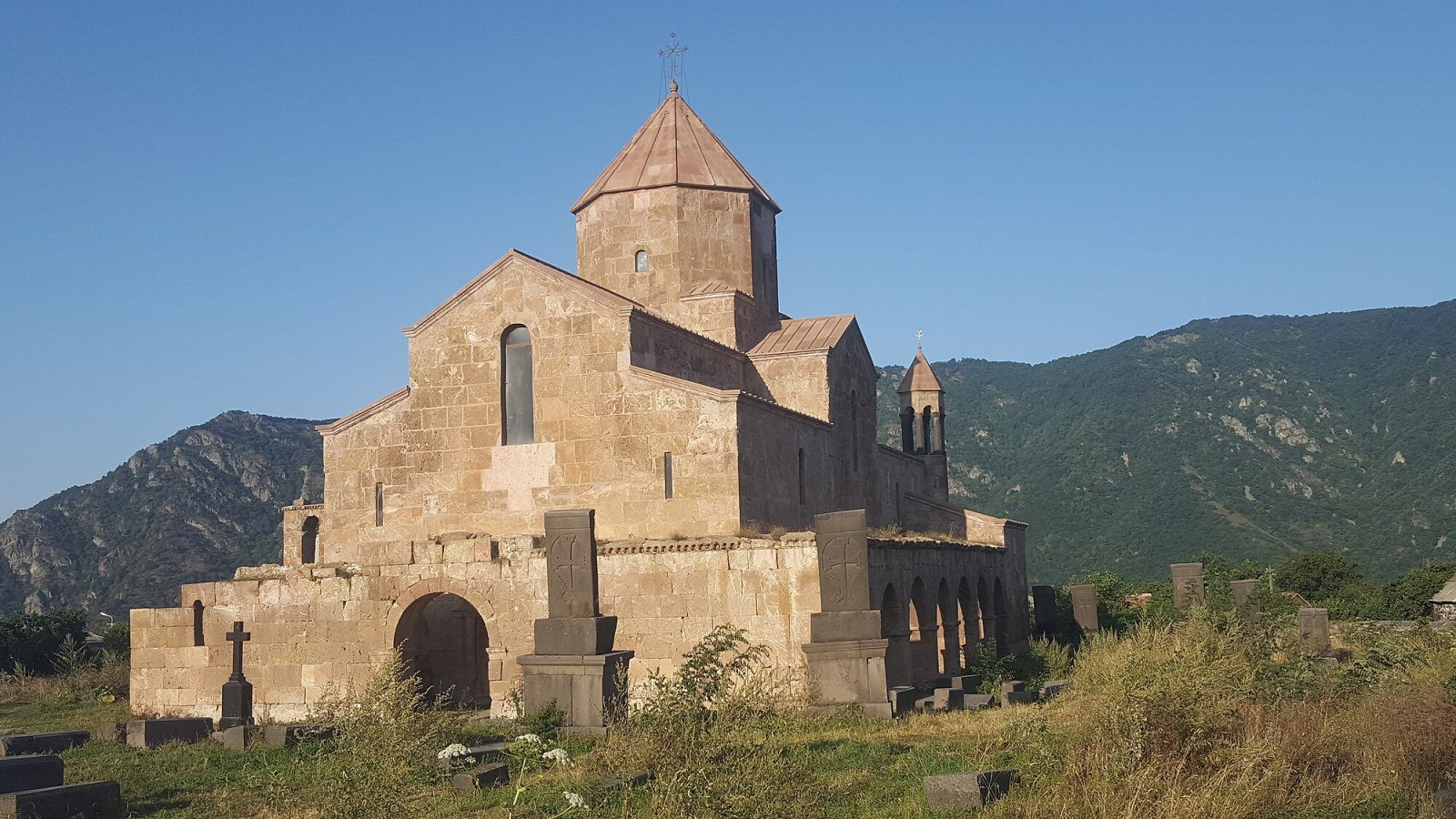
The village of Odzun sits on the edge of a plateau that drops steeply towards the Debed valley. Odzun Church appears at the end of the main street, behind a low dark stone wall. Before looking at the building, your eye goes straight to the two large black basalt funerary stelae rising in the atrium: more than two metres of carved stone, motionless and somewhat enigmatic, whose exact dating and authorship remain a subject of scholarly debate.
The basilica is built of rose-tinted volcanic tufa that time has darkened at the edges. The single-nave interior receives light through narrow windows that cast strips of brightness onto the medieval flagstone floor, some of which have been tilted by centuries of use. On the east wall there are remains of badly deteriorated frescoes — figures barely discernible — that local guides identify as representations of saints.
Odzun does not feature on any main tourist route. The enclosure is almost always empty, except for the occasional local worshipper. From the north end of the wall the view opens onto the deep cut of the Debed: forested slopes that turn yellow and orange in autumn, and on clear days the green of the valley stretches to the horizon.
History
Odzun Church was built in the 5th century, at the height of the consolidation of Armenian Christianity, and is an example of the single-nave basilica type characteristic of that era. It was enlarged and modified during the 6th and 7th centuries. The two funerary stelae in the atrium pre-date the current building and are associated, according to some historical sources, with Syrian missionaries — the so-called Syrian Illuminators — who evangelised the Lori region before the church was built. The complex remained under the jurisdiction of the Armenian Catholicosate for centuries and continued as an active place of worship without documented long interruptions.
What to see & do
- Funerary stelae in the atrium Two black basalt monuments over two metres tall with reliefs combining Christian iconography and pre-Christian motifs. Their precise dating is still debated by archaeologists.
- South facade of the basilica The main entrance retains a 6th-century relief tympanum and geometric mouldings in good condition, allowing you to appreciate the quality of the period's craftsmanship.
- Single-nave interior An austere space with filtered light entering through narrow windows. The fresco remains on the east wall are hard to read, but local guides identify saintly figures among the layers of deteriorated paint.
- Views over the Debed valley From the north boundary of the enclosure you can see the deep cut of the Debed River, with forested slopes that change colour in autumn and an unusual perspective over the Lori canyon.
- Village of Odzun The quiet, tourist-free immediate surroundings are worth a short walk: stone houses, family vegetable gardens and views of the plateau that give context to the site.
Photo gallery
How to get there
Odzun is about 10 km from Alaverdi, the industrial city in northern Lori. From Alaverdi taxis cover the route for around 1,000–1,500 Armenian drams. From Yerevan the distance is approximately 180 km via the northern motorway; the journey takes about two and a half hours by car. Odzun is frequently visited in combination with Haghpat Monastery — 15 km away — and Sanahin Monastery, both UNESCO World Heritage Sites.
Best time to visit
Spring, from April to June, is the best time to visit Odzun Church: the Debed valley is green, temperatures in the village hover around 14–20 °C and the days are long. Summer is pleasant in Lori — cooler than in Yerevan — with highs of around 28 °C. Autumn brings warm colours on the forested canyon slopes. In January and February the access road can ice over and the village may be cut off for a day.
More information
Photo: Armenak Margarian · CC BY-SA 3.0