
Jermuk Waterfall
Ջերմուկի ջրվեժ
72-metre waterfall of the Arpa River in the heart of the thermal spa town of Jermuk, Armenia. Free access year-round.
Location in the Caucasus
Description
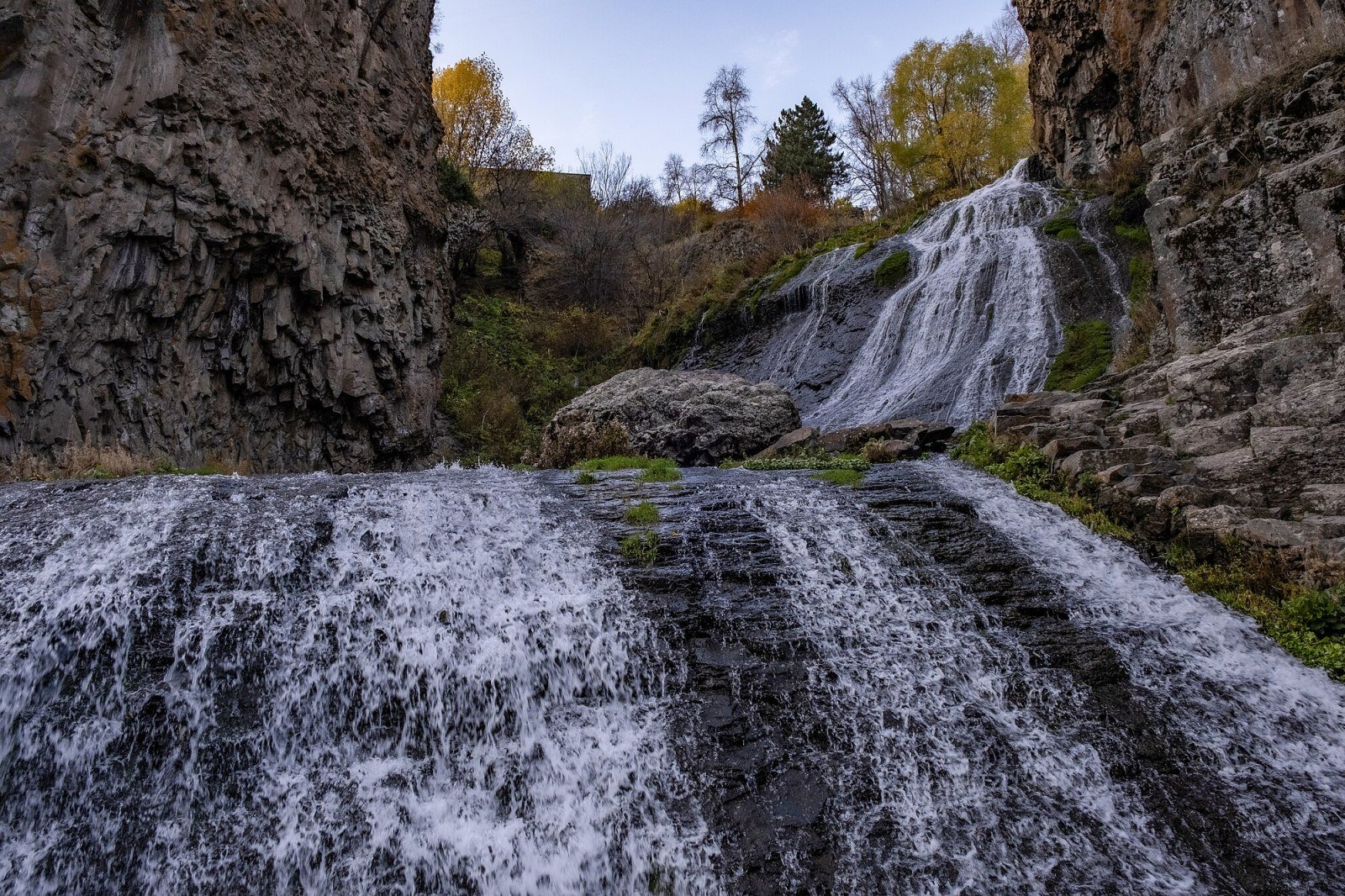
The Jermuk Waterfall is not hidden in some remote gorge: it falls right in the centre of the town, and you hear it before you see it. The roar of the Arpa River striking the basalt rock carries from the main avenue and effortlessly guides you to the metal walkway built expressly to get close to the roughly 72-metre drop. In spring and early summer, when snowmelt from the mountains of Vayots Dzor adds volume to the thermal water that feeds the town, the flow is truly impressive.
Entry is free and the walkway is well maintained. The cold mist reaches anyone leaning on the nearest railing; on hot August days that spray of moisture is welcome, though your clothes will be damp after a few minutes. Early in the morning, before excursion groups arrive from Yerevan, the place has a quiet quality that disappears after noon.
At the base of the falls the Arpa River fans out over pools and rounded stones. Some visitors make their way down the unmarked side paths to water level, though the terrain is steep and there is no safety signage: sturdy-soled footwear is advisable. Most people combine the waterfall with the spa park and the mineral water gallery — less than ten minutes' walk — and it makes perfect sense: the entire visit rarely takes more than two hours.
History
The Arpa River forms this waterfall naturally where the basalt terrain creates a sudden step on the valley floor. The town of Jermuk — whose name derives from the Armenian word jerm, meaning «hot» — developed mainly during the Soviet period thanks to the mineral-rich thermal springs of the Vayots Dzor region. The waterfall existed long before the town grew up around it, but it was Soviet urban development that created the pedestrian access, walkway and viewpoint we see today. Since Armenian independence in 1991 the area has been refurbished on several occasions, though it retains the basic layout of the original Soviet design.
What to see & do
- Main walkway The metal structure extending over the void that allows you to get close to the drop; from here you can see both the free-falling curtain of water and the base where the Arpa River breaks into spray.
- Arpa River pools Accessible via unmarked side paths at the foot of the Jermuk Waterfall; the water is cold even in August because of its partly thermal origin and the late snowmelt from the mountains.
- Upper viewpoint A path climbs above the falls and allows you to see the river before it drops and the panorama of the Jermuk valley; it is the preferred spot for photography in morning light.
- Spa park A few minutes' walk away, the Soviet-era park with the cure pavilions and the tree-lined promenade that forms the backbone of the town of Jermuk.
- Mineral water gallery (pitevaya galereja) The spring gallery where you can drink mineral water from different sources with varying mineral content, about ten minutes' walk from the waterfall.
Photo gallery
How to get there
Jermuk is about 170 km southeast of Yerevan via the M2 road with a subsequent turn north. There are direct marshrutkas from Yerevan bus station several times a day; the journey takes 2.5 to 3 hours. The Jermuk Waterfall is in the town centre, less than ten minutes' walk from the bus stop. It is easy to combine with Noravank Monastery on the same Vayots Dzor itinerary.
Best time to visit
Flow is at its peak between May and July, when snowmelt feeds the Arpa River most forcefully and the Jermuk Waterfall shows its full volume. In August the level drops but it is still impressive. September and October are quieter and the landscape of the Vayots Dzor valley turns ochre. In winter the falls partially freeze, forming ice columns; access can be slippery and temperatures frequently drop below zero.
More information
Photo: Diego Delso · CC BY-SA 4.0