
Haghartsin Monastery
Հաղարծնի վանք
10th-century monastery in the Tavush forest with three medieval churches, a vaulted refectory and free admission. Easy access from Dilijan.
Location in the Caucasus
Description
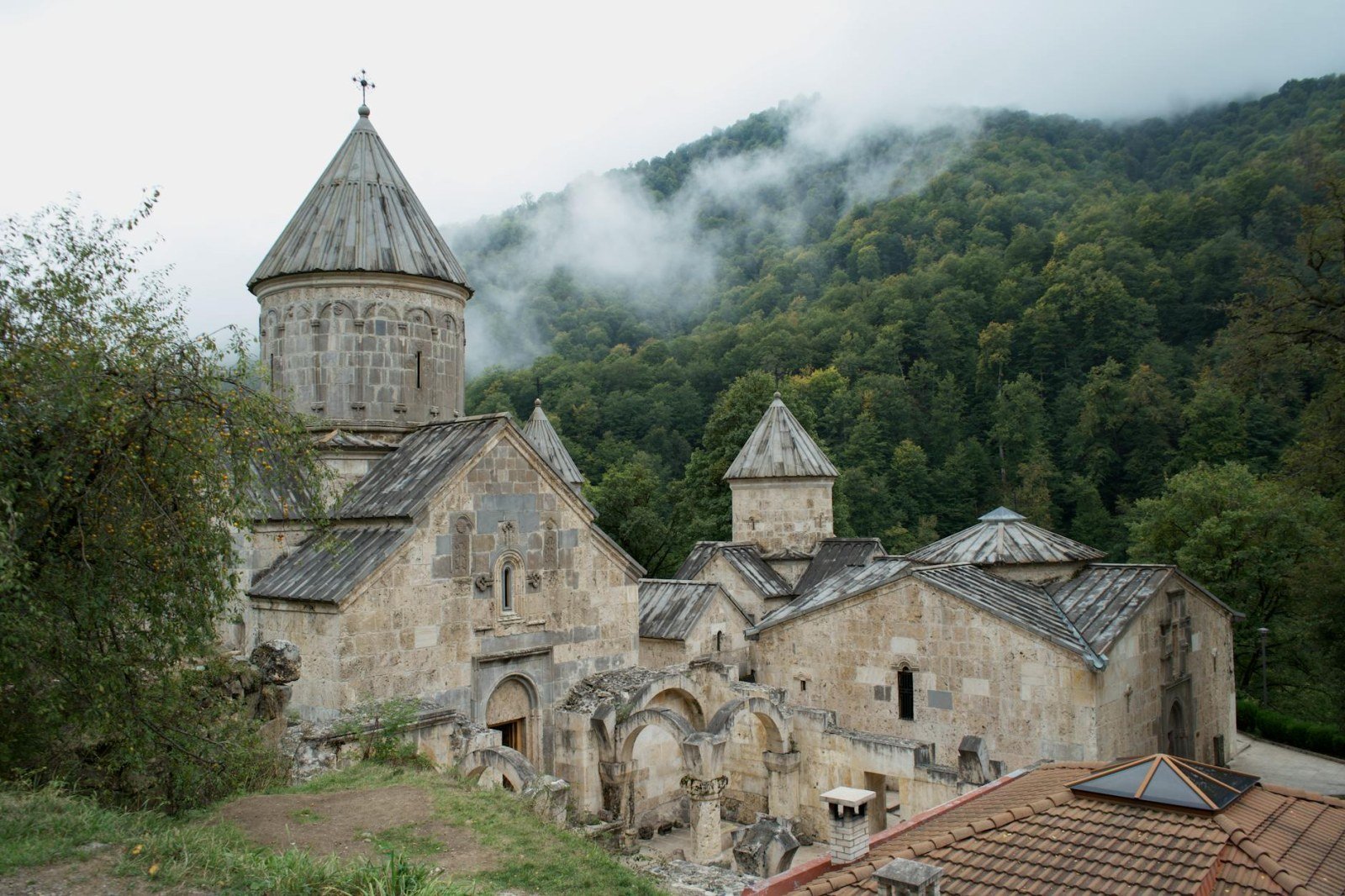
The Haghartsin Monastery (Հաղարծնի վանք) stands in a wooded gorge about 18 kilometres from Dilijan, in the province of Tavush, in north-eastern Armenia. It appears suddenly among beeches and oaks as you round the last bend: a cluster of grey stone that blends into the trees. The Dilijan National Park, which surrounds the monastery, protects one of the densest forest masses in the country. In summer shade and cool air prevail; the stream running beside the walls is audible from the courtyard, and the air smells of damp earth and moss even in August.
The complex houses three churches from different periods: Surb Grigor (10th century), Surb Stepanos (11th century) and Surb Astvatsatsin (13th century), a 13th-century gavit (portico) and a medieval refectory considered one of the best preserved in Armenia. The refectory has a ribbed cross-vault resting on two pairs of slender columns and narrow windows that filter the light. The space is more intimate than the churches; the acoustics make any voice resonate in the stone. The 2011–2013 restoration, funded by Sheikh Sultan bin Mohammed Al Qasimi of Sharjah, improved roofs and interiors, though it introduced some elements that contrast with the ancient stone. On weekdays the atmosphere is peaceful and you may find only two or three monks; on Sundays Armenian families arrive with thermos flasks of coffee and gata (sweet cake). Admission is free and the grounds are open from dawn to dusk.
History
The Haghartsin Monastery was founded in the 10th century and flourished during the 12th and 13th centuries under the patronage of the Bagratuni dynasty and then the Zakarian princes, who also promoted Goshavank and other foundations in Tavush. The name means play of eagles or flight of the eagle in Old Armenian, referring to the birds that circled the gorge during the founding consecration, according to local tradition. The community was a manuscript-copying centre under the direction of vardapet (master) Joanés of Haghartsin. The complex suffered Seljuk raids and seismic damage. The main restoration was funded by Sharjah in 2013.
What to see & do
- Church of Saint Gregory (Surb Grigor) The oldest in the complex, from the 10th century, with darker stone than the later buildings and a dome rebuilt in the Middle Ages. Simple interior, no frescoes, with a contemplative atmosphere and windows that frame the surrounding forest.
- Church of the Virgin (Surb Astvatsatsin) From the 13th century, the largest and best preserved in the complex. On the eastern facade there is a much-discussed relief: two donors dressed as princes holding a model of the church above their heads, a reference to its historical patrons.
- Church of Saint Stephen (Surb Stepanos) From the 11th century, small in plan with a low dome, attached to the side of the main complex. It retains the compact proportions typical of Armenian secondary chapels.
- Medieval refectory The 13th-century monastic dining hall, attributed to architect Minás, with a ribbed cross-vault over two pairs of columns. Considered the finest surviving example of medieval Armenian secular architecture; shafts of light pass through the narrow windows like drawn lines.
- Gavit (portico) Attached to Surb Astvatsatsin, with carved decoration on the arches and khachkars (stone crosses) set into the walls. Dual function as a liturgical entrance and monastic assembly hall.
- Dilijan National Park forest The surroundings form part of the park, with beech, oak and hornbeam woods. There are marked trails from the car park, including a stretch of the Transcaucasian Trail, allowing the visit to be extended with walks through the trees.
Photo gallery
How to get there
Haghartsin is 18 km from Dilijan along a paved mountain road with sharp bends. From Dilijan a return taxi costs 3,000–4,000 dram (approximately €6–8). Dilijan has regular marshrutka (minibus) connections to Yerevan (2 hours; ~1,500 dram) from Kilikia station, and also to Vanadzor and the north. There is no direct public transport to the monastery, but the visit is often combined on the same day with Goshavank (20 km) and Parz Lake.
Best time to visit
Tavush has cool summers (highs of 20–25 °C) and constant humidity; the forest stays dense from May to September. After summer rains, chanterelles and other mushrooms appear in the surroundings of Dilijan National Park. Autumn (mid-October to early November) is the most striking period: the beech woods turn yellow and red. In winter snowfall can be heavy and the road closes on some days, though it clears quickly. Spring comes late to the forest (May) but brings primroses and wildflowers among the trees.
More information
Photo: Ash Haghighi · Pexels License