
Chronicle of Georgia
საქართველოს მატიანე
Sixteen concrete pillars 35 m tall beside the Tbilisi reservoir, covered in reliefs narrating Georgia's history from its origins to the 20th century.
Location in the Caucasus
Description
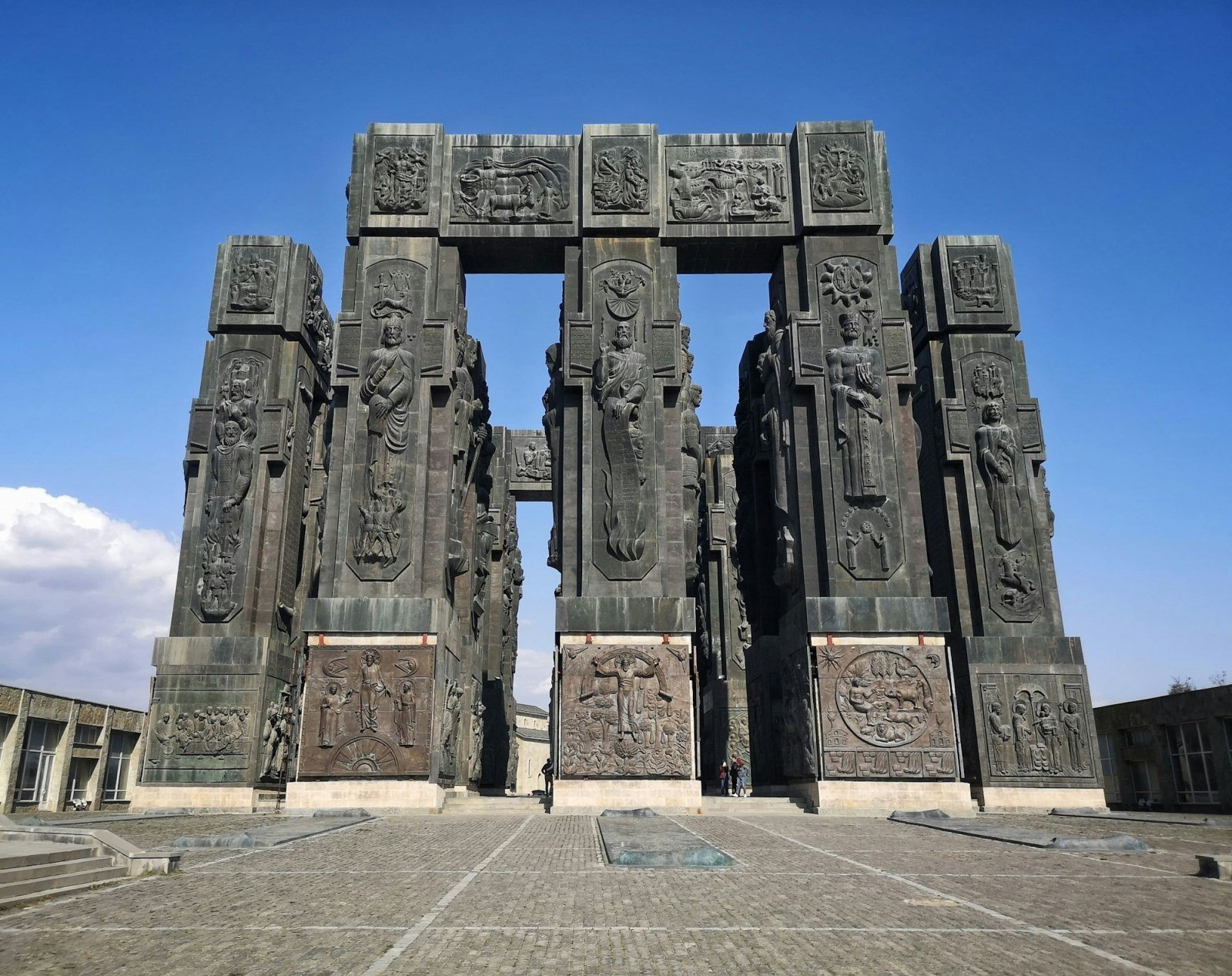
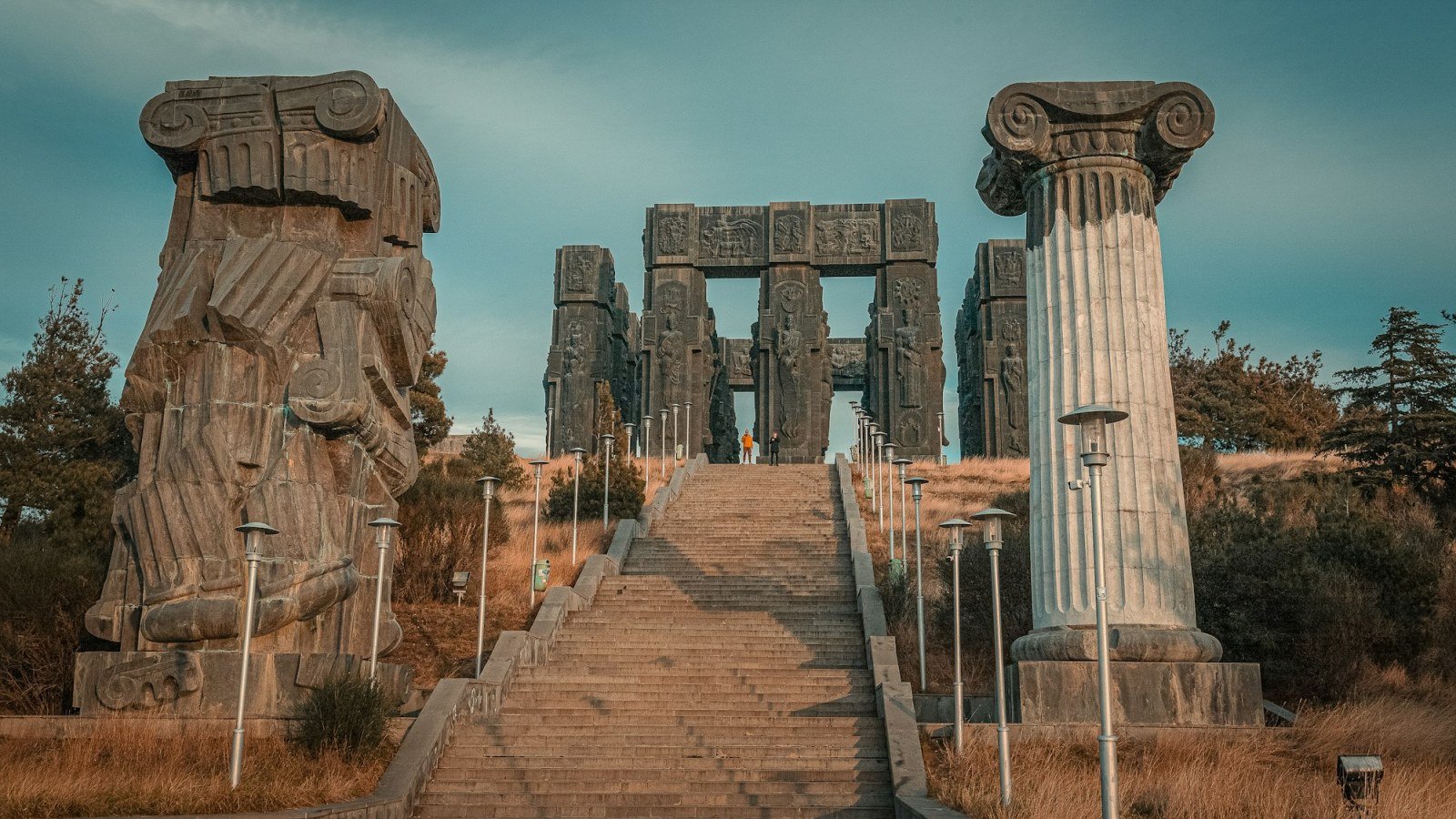
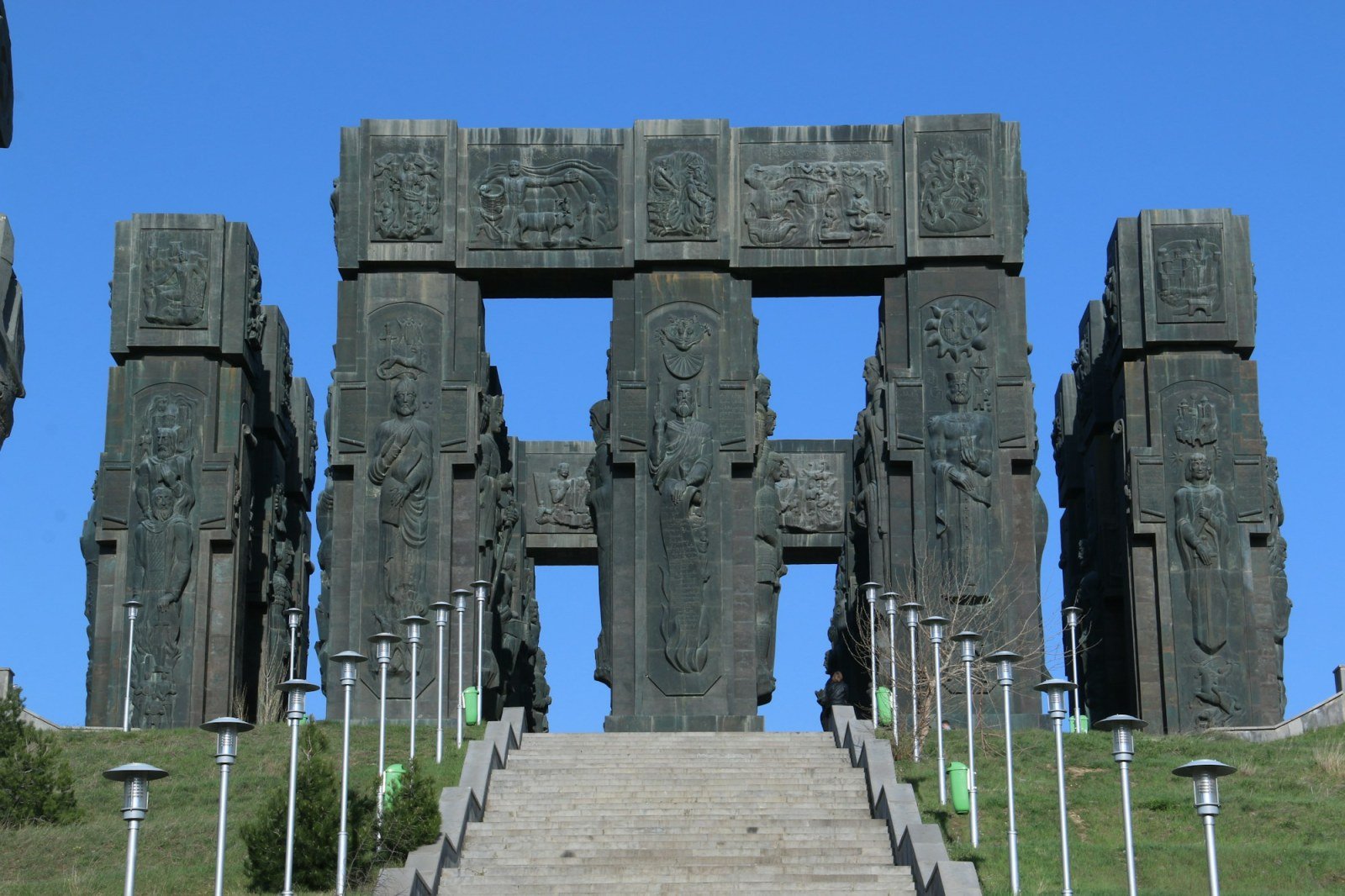
The Chronicle of Georgia rises on a bare hill on the outskirts of Tbilisi, beside the shore of the Tbilisi reservoir. The scale cannot be grasped from the road: you have to get out of the car and walk to the base of the pillars for the size to truly hit you. Sixteen concrete columns about 35 metres tall — taller than a ten-storey building — stand in two rows, each covered in reliefs featuring kings, saints, warriors and biblical scenes. There is no ticket booth, no explanatory sign, no guide. The wind rising from the reservoir and the sound of cars on the Mtskheta road are the only soundtrack.
The reliefs are dense and well carved. With relative ease you can pick out figures of Saint Nino, Georgia's evangelist, the medieval king David the Builder, Queen Tamar and Saint George on horseback. The upper section of some columns ends in Orthodox crosses. The concrete has aged with dignity: there are grey and greenish lichens in the cracks, damp stains and, on summer afternoons, a raking light that travels along the reliefs and gives volume to each figure.
The access road has potholes and the immediate surroundings are unkempt, with no bins or benches. That said, for those interested in late Soviet monumental art — or who simply want to step off the usual Tbilisi circuit — it is worth a stop of about thirty minutes. Entry is free and access is unrestricted at any hour.
History
The Chronicle of Georgia was conceived and entirely financed by Georgian artist Zurab Tsereteli, also known for monuments in Moscow, New York and other cities. Tsereteli donated the work to the Georgian state. Construction began in the 1980s during the late Soviet period, but the dissolution of the USSR in 1991 interrupted the project before its completion; the pillars were only partially finished relative to the original design. The monument has no documented official inauguration and remains technically unfinished. Tsereteli's grandiloquent style generates divided opinions both in Georgia and in the countries where he has work, but the Chronicle has gained recognition over the years as a singular visual landmark on the outskirts of Tbilisi.
What to see & do
- North pillars — evangelisation reliefs Closest to the road access. The reliefs in this area focus on the arrival of Christianity in Georgia: figures of Saint Nino, baptism scenes and vine crosses, the country's symbol.
- South pillars — medieval kings Here are the representations of the most celebrated monarchs in Georgian history, including Queen Tamar and King David the Builder. The reliefs are more narrative and recognisable if you know the country's medieval history.
- 20th-century reliefs On the upper sections of some pillars there are references to more recent historical events. These are the most difficult to interpret without context, and also the ones that generate the most debate among scholars of the work.
- View over the Tbilisi reservoir From the base of the pillars the Tbilisi reservoir is visible in the background and the city's silhouette on the horizon. At dusk, raking light travels across the reliefs in a way that does not happen at midday.
- Detail of aged concrete Time has given the ensemble a texture it did not have originally: lichens, rain stains and spontaneous vegetation between the blocks. It is worth getting within a metre to see the carving.
Photo gallery
How to get there
The monument is about 10 km northwest of central Tbilisi, beside the Tbilisi reservoir. There is no direct public transport. The most practical option is a taxi or Bolt from the centre: about 15–20 minutes and between 15 and 20 lari (4–5 €). It can be combined with a visit to Jvari Monastery or the historic centre of Mtskheta, which lies in the same general direction heading north out of the city.
Best time to visit
Access is free year-round. In summer the hill has no shade and the midday heat is considerable; it is better to go before 9 am or from 6 pm onwards, when the raking light also favours photographing the reliefs. Spring and autumn offer pleasant temperatures and softer light. In winter the Tbilisi reservoir may be wrapped in mist, which gives the ensemble a particular atmosphere though it reduces the views.
More information
Photo: Alex Slav · Unsplash License