
Carahunge
Զորաց Քարեր
Over 200 basalt megaliths with perforations on the Syunik plateau: Armenia's most enigmatic prehistoric site.
Location in the Caucasus
Description
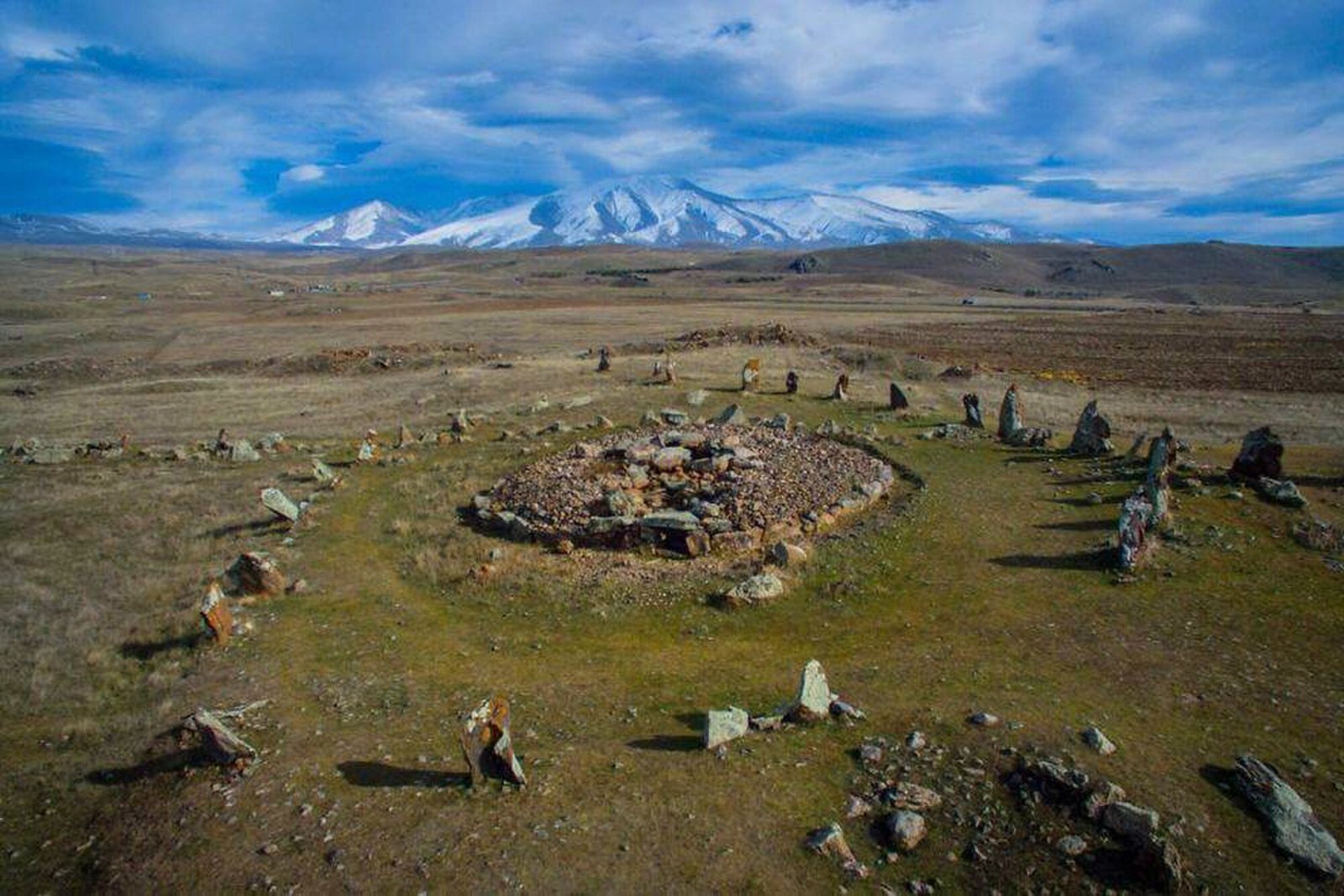
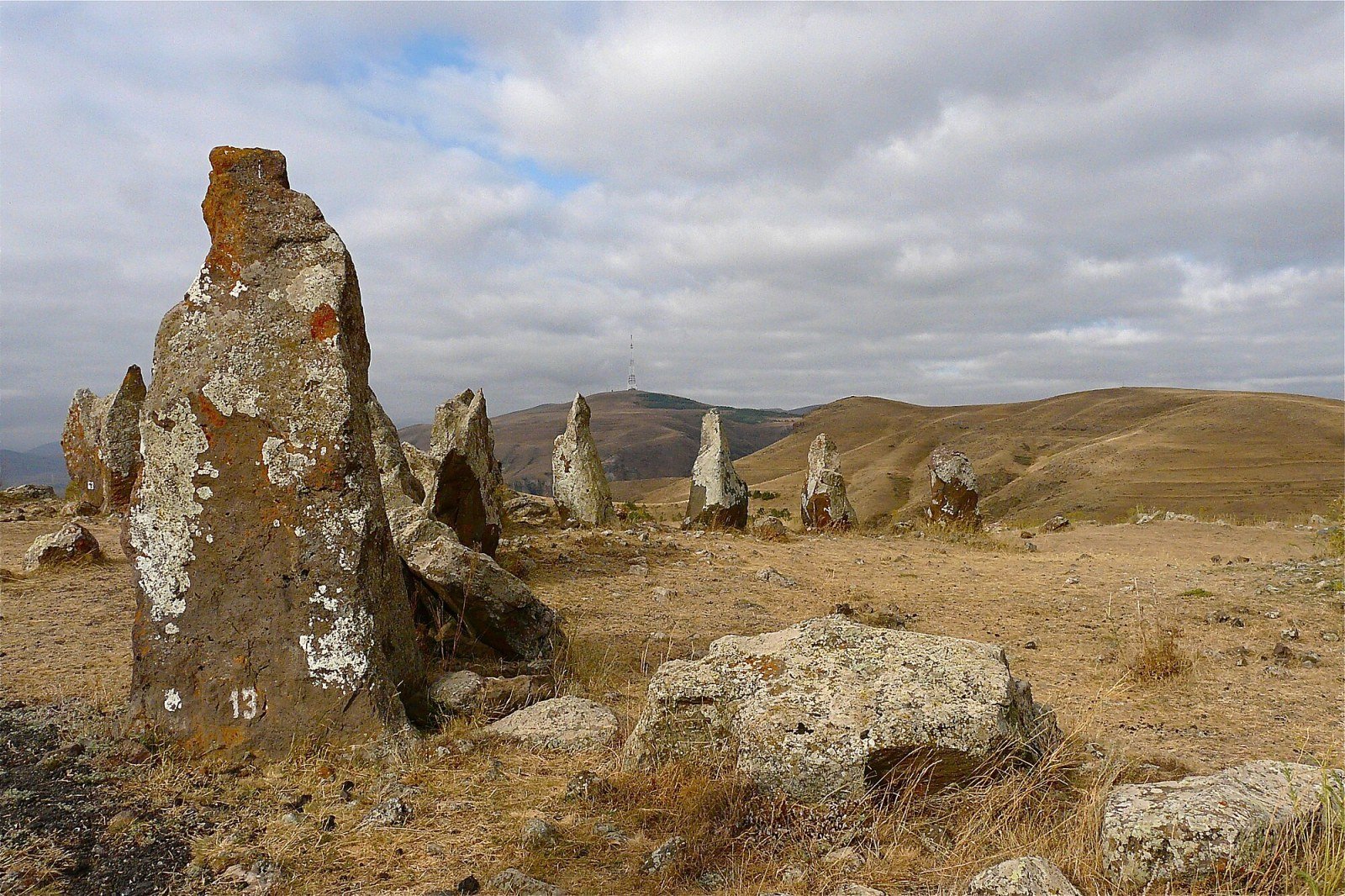
Carahunge — also known as Zorats Karer or the «Armenian Stonehenge» — is a field of some 223 grey basalt stones scattered across a plateau at 1,770 metres above sea level in the Armenian province of Syunik. The comparison with Stonehenge is a shorthand that oversimplifies: there is no single monumental circle here, but groups of standing stones, some weighing several hundred kilos, spread across an open expanse where the wind almost always blows and the light changes quickly.
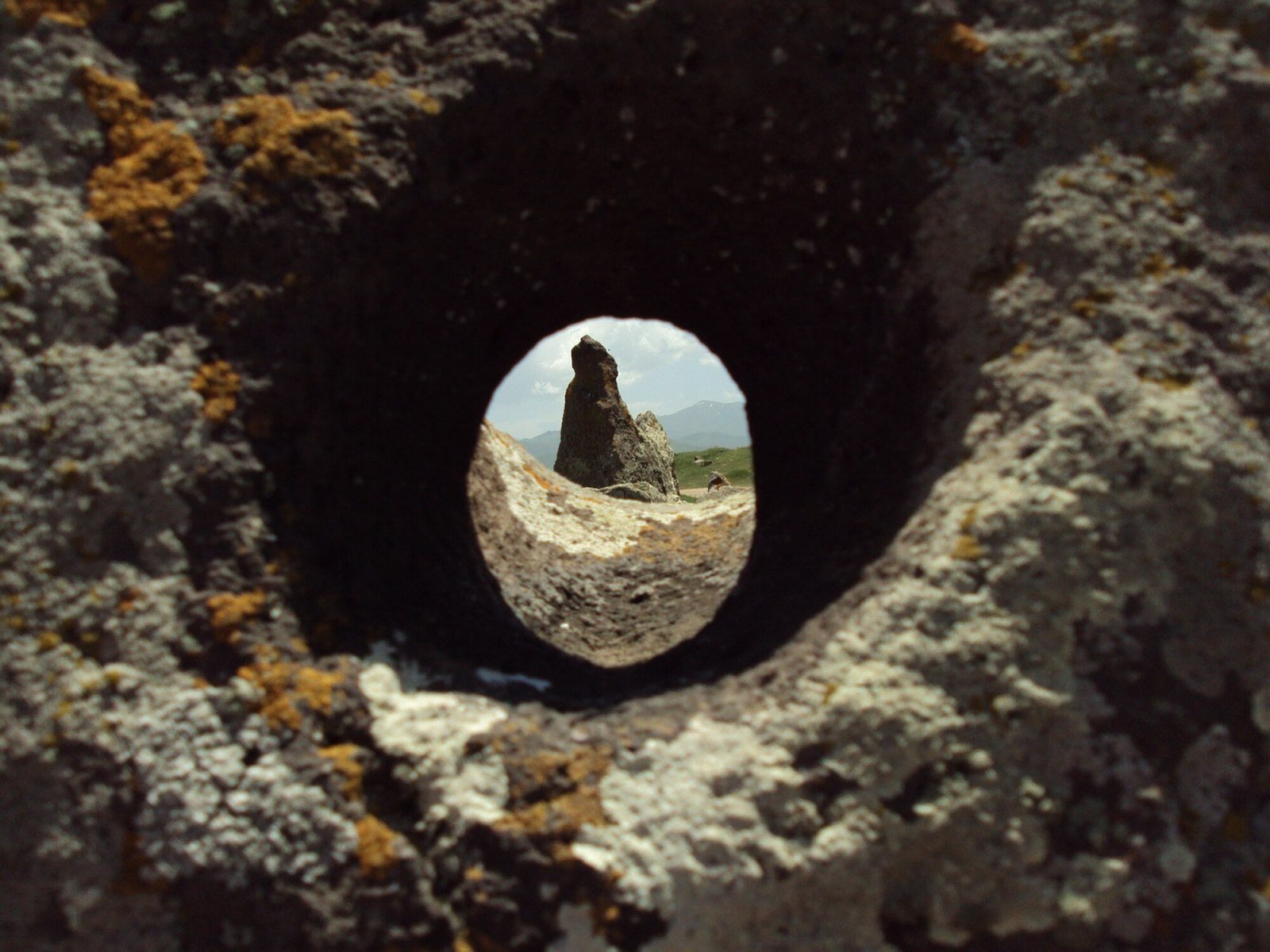
What makes Carahunge hard to forget are the perforations: circular holes, about five centimetres in diameter, carved near the upper end of many stones. You can walk up, put your eye to one and see the sky on the other side. Some of these openings appear to be aligned with specific points on the horizon, though the debate about whether they reflect a deliberate astronomical design remains open among researchers. Mount Kaputjugh closes the southern background of the landscape; in front, the Syunik plain stretches away unobstructed.
The site has no significant visitor centre. Access is free or involves a nominal entry fee depending on the season — around 500 Armenian drams (less than €1). The stones can be touched and walked around, allowing the perforations to be examined up close. In summer it is worth bringing water and arriving before ten in the morning: there is no shade and the sun on the plateau beats straight down. Honesty about the place is worth more than any label: funerary function, observatory, place of worship, or all at once. That ambiguity is part of the visit.
History
Dating of Carahunge varies depending on the method and the researcher: estimates range from the third millennium BC to more recent periods of the Bronze Age. In the nineties, Armenian astronomer Paris Herouni popularised the hypothesis that the site was a prehistoric astronomical observatory more than 7,500 years old — a figure the international archaeological community treats with caution. The toponym Zorats Karer — «soldiers' stones» in Armenian — suggested in local tradition a military or ceremonial function, though its exact origin is also unclear. Excavations have revealed funerary structures associated with the stone field, pointing to a use of the space that was probably multiple and changed over the centuries.
What to see & do
- Central megalith circle The densest grouping of standing stones, where the perforations are most visible and the scale of the site is best appreciated. It is the usual starting point for any tour of Carahunge.
- Stones with perforations The circular openings carved near the upper end of many basalt blocks are the site's most distinctive feature. With good light, some allow you to see the sky directly through the rock.
- Tombs and funerary structures On the margins of the main field there are mounds and cists that appear to be tombs from different periods; they indicate that the space had ceremonial uses beyond the standing stones.
- Panorama towards Mount Kaputjugh The site occupies an open plateau at about 1,770 m altitude. The views towards Mount Kaputjugh to the south and towards the Vorotan Valley are part of the experience and justify pausing a few minutes away from the monument itself.
- Perimeter trail An unmarked dirt path circles the complex and allows the stones to be seen from different angles; it takes about 40 minutes at a leisurely pace and is the best way to detect the orientations of the perforations.
Photo gallery
How to get there
Carahunge is about 9 km north of Sisian, the nearest town in Syunik. From Yerevan there are daily marshrutkas to Sisian (about 200 km, approximately 3 hours). From there the site is reached by taxi — about 1,500–2,000 drams (€3–4) one way — or by private car. The usual route combines it with Khndzoresk and Kapan on a two or three-day trip through southern Armenia.
Best time to visit
May–June and September–October are the best months to visit Carahunge: temperatures of 12–20 °C, moderate wind and lateral light that brings out the relief of the stones. In July and August the sun on the plateau is intense and there is no shade; if visiting in summer, aim to arrive before ten. In winter snow may cover some of the stones and make road access from Sisian difficult.
More information
Photo: Sarkisianarto · CC BY-SA 4.0