

National symbols are a country's calling card. Georgia's flag, the coat of arms with St George and the anthem Tavisupleba condense centuries of history, Orthodox faith and national pride. In this article we explore their origin, their meaning and why every traveller arriving in the Caucasus should know them.
The Flag of Georgia: the Five Crosses
The national flag of Georgia, popularly known as the Five Cross Flag, is one of the oldest and most recognisable emblems of the Caucasus. Its current design, officially adopted on 14 January 2004, features a large red St George's Cross on a white background and four small Bolnisi crosses (or Jerusalem crosses) in each quadrant.
Origin and History of the Flag
The tradition of Georgia's flag goes back centuries. Georgian historiography records several medieval manuscripts describing its colours and their connection to the Bagrationi monarchy. As early as the 14th century, the Majorcan cartographer Angelino Dulcert depicted this flag on one of his celebrated maps.

During the reign of Queen Tamar and her consort David Soslan (12th–13th centuries), the flag of the unified Georgian kingdom was known as Gorgasliani-Davitiani drosha (the flag of Gorgasali and David). In the 20th century, after a Soviet interlude, the historic colours returned to public life thanks to the Georgian national movement.
Meaning of the Colours and Crosses
- White background: purity, wisdom, peace and love.
- Red St George's Cross: courage, justice and Christian faith, represented by the country's patron saint.
- Four Bolnisi crosses: evoke the four corners of the world and the five evangelists together with Christ.
Cultural Significance of the Flag
Georgia's flag is much more than a piece of cloth: it is an emblem of resistance against invasions and a reminder of centuries of Orthodox faith. Today it flies from official buildings, schools, homes, sporting competitions and national celebrations. 14 January is celebrated as Flag Day across the country.
Georgia's Coat of Arms: St George and the Lion
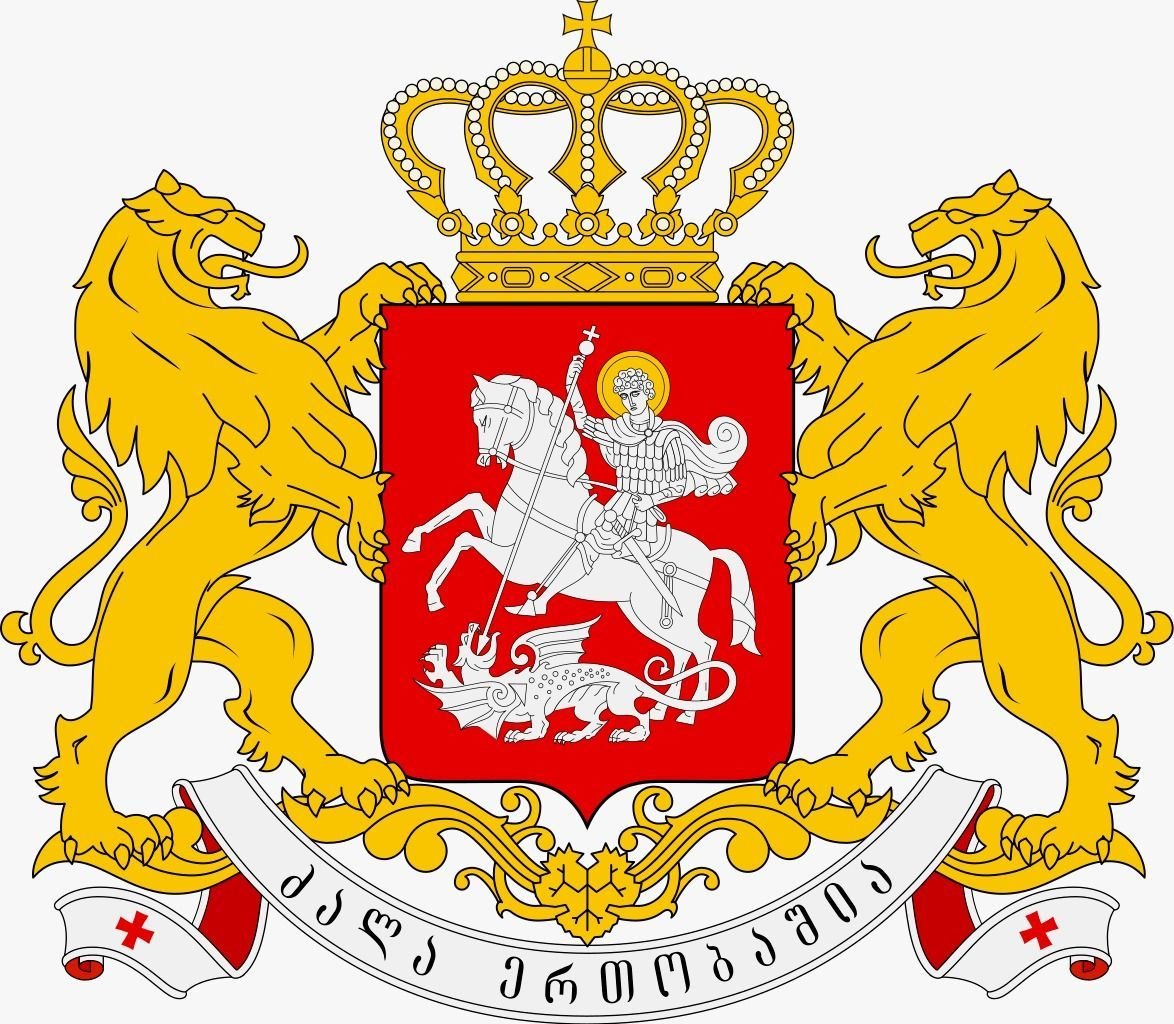
Georgia's coat of arms, adopted in 2004, shows St George on horseback slaying the dragon on a red field, flanked by two golden lions and crowned with the royal crown of the Bagrationi dynasty. At the base is the national inscription «Dzala ertobashia» ("Strength is in unity").
The Origin of the Name "Georgia"
The historian Grigol Feradze documented the connection between the country's international name and devotion to St George. Jacques de Vitry, Latin Patriarch of Jerusalem in the late 12th century, already described the "Georgians" as a people particularly devoted to St George, whom they considered their patron and protector.
The Legend of St George in Georgia
According to a medieval chronicle about King David IV the Builder, at the decisive Battle of Didgori (1121), St George appeared as a heavenly soldier and led the small Georgian army to a miraculous victory over the Seljuks. Since then, he has been regarded as the intercessor of the Georgian people.
The Georgian Lion: Symbol of Sovereignty
The crowned lion appeared as an emblem of the unified kingdom as early as the 18th century, during the reign of Erekle II, as a symbol of the Kingdom of Kartli-Kakheti. Today it endures on the official coat of arms as a symbol of state sovereignty.
Georgia's Anthem: "Tavisupleba", a Song to Freedom
The national anthem "Tavisupleba" (Freedom) embodies the spirit of the Georgian people. Officially adopted on 20 May 2004, it forms, together with the flag and the coat of arms, the three great symbols of the nation.
Origin of the Anthem
The lyrics were written by the poet David Magradze, and the music combines melodies by the celebrated Georgian composer Zakaria Paliashvili, drawn from his operas Abesalom and Eteri and Daisi. The anthem replaced the former Dideba, used during the first Democratic Republic of Georgia (1918–1921).
Meaning and Message
"Tavisupleba" is a call to freedom, unity and hope. It pays tribute to the heroes who fought for Georgia's sovereignty and to the sacrifices of its people over the centuries. Its verses speak of sacred mountains, vineyards and a hard-won freedom.
Celebrations and Events
The anthem is heard at official ceremonies, international competitions, school events and patriotic celebrations. Hearing it at a Lelos rugby match or on Independence Day (26 May) is a deeply moving experience.
The Importance of Knowing the National Symbols
Understanding Georgia's flag, coat of arms and anthem brings you closer to the essence of a country deeply proud of its identity. They are living elements that reflect centuries of history, Orthodox Christian faith and the struggle for sovereignty.
Discover Georgia with Iberogeorgia
Want to experience Georgia's history and symbols first-hand? At Iberogeorgia we design tailor-made routes that take you to the key places of Georgian identity: Mtskheta, Gelati, the Gergeti Church and the vineyards of Kakheti. Write to us and start planning your next trip to the Caucasus.